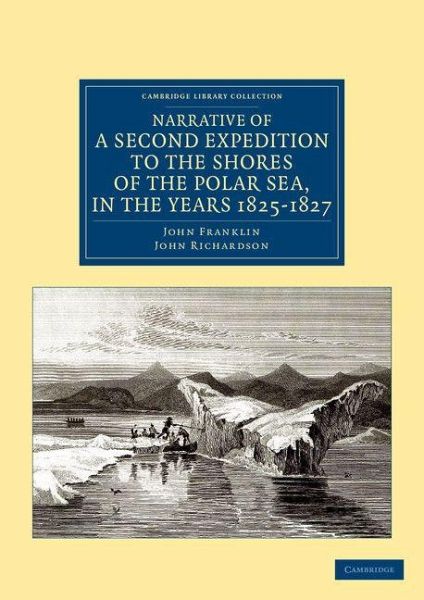
Sir John Franklin (1786-1847) joined the Navy at the age of fourteen and saw action at Copenhagen and Trafalgar. Between those battles, he circumnavigated Australia with his uncle, Matthew Flinders; he became famous after his first major expedition to northern Canada in 1819-22, although it resulted in the deaths of over half of his men. Accounts of both of these voyages are also reissued in this series. Franklin returned to the Arctic in 1825, and this, his second book, describes that more successful endeavour. Published in 1828, it records the expedition's planning, route, scientific…mehr
Sir John Franklin (1786-1847) joined the Navy at the age of fourteen and saw action at Copenhagen and Trafalgar. Between those battles, he circumnavigated Australia with his uncle, Matthew Flinders; he became famous after his first major expedition to northern Canada in 1819-22, although it resulted in the deaths of over half of his men. Accounts of both of these voyages are also reissued in this series. Franklin returned to the Arctic in 1825, and this, his second book, describes that more successful endeavour. Published in 1828, it records the expedition's planning, route, scientific observations, and the mapping of over 1200 miles of Canada's northern coastline. The party included two artists, and their work is reproduced in over thirty engravings. Franklin was later posted to the Mediterranean and Tasmania, but in 1845 embarked on his disastrous third expedition to the North-West Passage, during which he and his entire crew were lost.
Sir John Franklin was a British Royal Navy officer, explorer, and colonial administrator. After serving in significant military conflicts such as the Napoleonic Wars and the War of 1812, he led two major expeditions into the Canadian Arctic: the Coppermine expedition in 1819 and the Mackenzie River expedition in 1825. Later, he served as Lieutenant-Governor of Van Diemen's Land from 1837 to 1843. His final expedition in 1845 aimed to navigate the Northwest Passage. However, Franklin's ships became trapped in ice off King William Island, leading to his death in 1847, along with his entire crew due to starvation, hypothermia, and scurvy. Franklin was born on April 16, 1786, in Spilsby, Lincolnshire, as the ninth child of a family with merchant and agricultural roots. His early life was marked by a desire to improve his social standing, as several of his siblings pursued diverse careers. Despite his father s initial objections, Franklin pursued a seafaring career and joined the Royal Navy at the age of 14. His maritime journey eventually led to his significant contributions to Arctic exploration.
Inhaltsangabe
Introductory chapter Official instructions 1. Join the boats in the Methye River 2. Transactions at Fort Franklin, 1825-6 3. Voyage to the sea 4. Babbage River 5. Commence return to the Mackenzie Dr Richardson's Narrative of the Proceedings of the Eastern Detachment of the Expedition: 1. Leave Point Separation, and descend the eastern channel of the Mackenzie 2. Detention by wind 3. Double Cape Bathurst 4. Ascend the Coppermine River Captain Franklin's Narrative Resumed: 6. Brief notices of the second winter at Bear Lake Appendix.
Introductory chapter Official instructions 1. Join the boats in the Methye River 2. Transactions at Fort Franklin, 1825-6 3. Voyage to the sea 4. Babbage River 5. Commence return to the Mackenzie Dr Richardson's Narrative of the Proceedings of the Eastern Detachment of the Expedition: 1. Leave Point Separation, and descend the eastern channel of the Mackenzie 2. Detention by wind 3. Double Cape Bathurst 4. Ascend the Coppermine River Captain Franklin's Narrative Resumed: 6. Brief notices of the second winter at Bear Lake Appendix.
Es gelten unsere Allgemeinen Geschäftsbedingungen: www.buecher.de/agb
Impressum
www.buecher.de ist ein Internetauftritt der buecher.de internetstores GmbH
Geschäftsführung: Monica Sawhney | Roland Kölbl | Günter Hilger
Sitz der Gesellschaft: Batheyer Straße 115 - 117, 58099 Hagen
Postanschrift: Bürgermeister-Wegele-Str. 12, 86167 Augsburg
Amtsgericht Hagen HRB 13257
Steuernummer: 321/5800/1497
USt-IdNr: DE450055826