151,99 €
inkl. MwSt.
Versandkostenfrei*Erscheint vorauss. Februar 2026
Melden Sie sich
hier
hier
für den Produktalarm an, um über die Verfügbarkeit des Produkts informiert zu werden.

76 °P sammeln
Andere Kunden interessierten sich auch für
 Conjectura Physica Circa Propagationem Soni Ac Luminis: Una Cum Aliis Dissertationibus Analyticis, De Numeris Amicabilibus, De Natura Aequationum, Ac29,99 €
 Problem-Solving Strategies90,99 €
 Quadrivium: The Four Classical Liberal Arts of Number, Geometry, Music, & Cosmology19,99 €
 The IMO Compendium61,99 €
 Space, Time and Number in the Brain69,99 €
 The Pythagorean Theorem14,99 €
 Mathematics in Ancient Iraq87,99 €



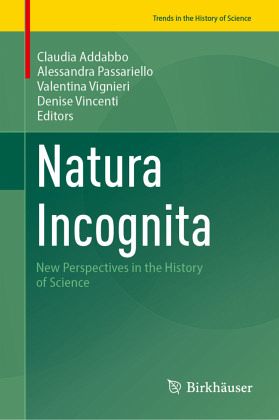
Natura incognita explores the theme of the unknown nature, offering an interdisciplinary perspective that bridges the history of science with other fields of enquiry, such as the history of philosophy, museology, environmental and animal studies.
Far from exhaustive yet remarkably rich, the volume brings a collection of previously unpublished contributions by early-career scholars that together provide an overview of current research trends in the Italian history of science community. The essays employ diverse methodologies, all rooted in a careful analysis of textual, archival, material, and visual sources from which local and global stories of science emerge. These contributions were originally presented at the Early Career Conference of the Italian Society for the History of Science (Stazione Zoologica Anton Dohrn Naples, September 6 8, 2023), and cover a wide range of scientific fields, from botany to zoology, medicine to mental sciences, physics to earth sciences,with a particular focus on the tools and techniques used in the study of nature. The timeframe is broad, taking the reader on a journey from antiquity through the early modern era and well into the 20th century. Overall, the book highlights how the production of new scientific knowledge and practices results from a sustained, long-standing interest in the natural world.
Scholars and students interested in the evolving landscape of the history of science will find this reading an illuminating resource.
Far from exhaustive yet remarkably rich, the volume brings a collection of previously unpublished contributions by early-career scholars that together provide an overview of current research trends in the Italian history of science community. The essays employ diverse methodologies, all rooted in a careful analysis of textual, archival, material, and visual sources from which local and global stories of science emerge. These contributions were originally presented at the Early Career Conference of the Italian Society for the History of Science (Stazione Zoologica Anton Dohrn Naples, September 6 8, 2023), and cover a wide range of scientific fields, from botany to zoology, medicine to mental sciences, physics to earth sciences,with a particular focus on the tools and techniques used in the study of nature. The timeframe is broad, taking the reader on a journey from antiquity through the early modern era and well into the 20th century. Overall, the book highlights how the production of new scientific knowledge and practices results from a sustained, long-standing interest in the natural world.
Scholars and students interested in the evolving landscape of the history of science will find this reading an illuminating resource.