

Andere Kunden interessierten sich auch für
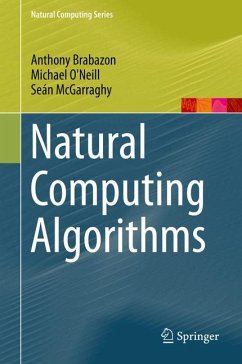
 Natural Computing Algorithms38,99 €
 Computational Electrodynamics41,99 €
 Introduction to Evolutionary Computing34,99 €
 Introduction to Evolutionary Computing48,14 €
 Contemporary Evolution Strategies31,99 €
 Foraging-Inspired Optimisation Algorithms53,99 €
 Artificial Intelligence and Evolutionary Computations in Engineering Systems153,99 €
The field of natural computing has been the focus of a substantial research effort in recent decades. One particular strand of this research concerns the development of computational algorithms using metaphorical inspiration from systems and phenomena that occur in the natural world. These naturally inspired computing algorithms have proven to be successful problem-solvers across domains as diverse as management science, bioinformatics, finance, marketing, engineering, architecture and design.
This book is a comprehensive introduction to natural computing algorithms, suitable for academic and industrial researchers and for undergraduate and graduate courses on natural computing in computer science, engineering and management science.
This book is a comprehensive introduction to natural computing algorithms, suitable for academic and industrial researchers and for undergraduate and graduate courses on natural computing in computer science, engineering and management science.
"The book is very well organized. ... the book is not only suitable for beginners in natural computing, it can also serve as a valuable reference for experts. ... the book can be thought of not only as a collection of algorithms illustrating many methods and tools used in natural computing, but also as a textbook covering many aspects of the area which can be used in an introductory course on natural computing." (Miguel A. Gutiérrez-Naranjo, Mathematical Reviews, June, 2016)
"One interesting advantage of the volume is that it was prepared by and for scholars that are not necessarily in computer science. The book is definitely a good reference and a well-written and well-explained introduction to natural computing ... ." (Hector Zenil, Computing Reviews, April, 2016)
"I very much enjoyed reading this book and found it to be very comprehensive, well-structured, and well-written. It provides good coverage of natural computing approaches as well as a thorough description of each algorithm with its variants. ... suitable as a textbook for a graduate student course as well as a self-study guide for research students, since there are a good number of examples provided throughout. Furthermore, the algorithm descriptions, figures and tables facilitate the learning of the different concepts." (Simone A. Ludwig, Genetic Programming and Evolvable Machines, March, 2016)
"One interesting advantage of the volume is that it was prepared by and for scholars that are not necessarily in computer science. The book is definitely a good reference and a well-written and well-explained introduction to natural computing ... ." (Hector Zenil, Computing Reviews, April, 2016)
"I very much enjoyed reading this book and found it to be very comprehensive, well-structured, and well-written. It provides good coverage of natural computing approaches as well as a thorough description of each algorithm with its variants. ... suitable as a textbook for a graduate student course as well as a self-study guide for research students, since there are a good number of examples provided throughout. Furthermore, the algorithm descriptions, figures and tables facilitate the learning of the different concepts." (Simone A. Ludwig, Genetic Programming and Evolvable Machines, March, 2016)