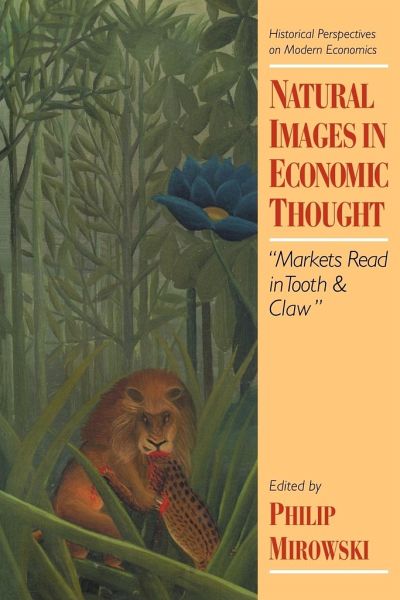
Philip J. MirowskiMarkets Read in Tooth and Claw
Natural Images in Economic Thought
Markets Read in Tooth and Claw
Herausgeber: Goodwin, Craufurd; Mirowski, Philip
Philip J. MirowskiMarkets Read in Tooth and Claw
Natural Images in Economic Thought
Markets Read in Tooth and Claw
Herausgeber: Goodwin, Craufurd; Mirowski, Philip
- Broschiertes Buch
- Merkliste
- Auf die Merkliste
- Bewerten Bewerten
- Teilen
- Produkt teilen
- Produkterinnerung
- Produkterinnerung
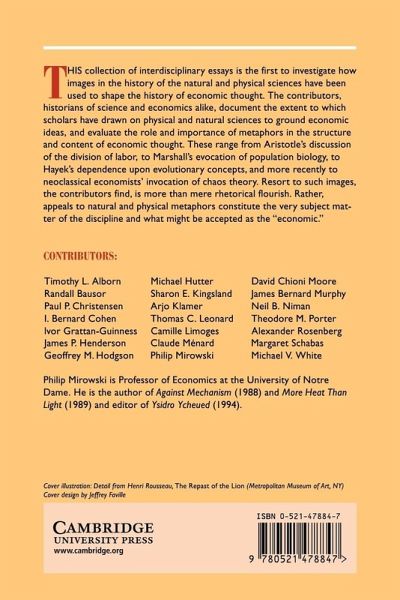
First conference devoted to impact of natural sciences on content and form of economics in history.
Andere Kunden interessierten sich auch für
G. L. S. ShackleThe Nature of Economic Thought49,99 €
Alessandro RoncagliaA Brief History of Economic Thought35,99 €
Pekka SutelaEconomic Thought and Economic Reform in the Soviet Union43,99 €
R. D. Collison BlackEconomic Thought and the Irish Question 1817-187043,99 €
Samuel Jacob BrandenburgContributions To Thought On Agricultural And Land Economics By The English Economists And Contemporary Writers To The Time Of Adam Smith26,99 €
Ernest MandelThe Formation of the Economic Thought of Karl Marx20,99 €
Edward B BarbierNatural Resources and Economic Development50,99 €-
-
-
First conference devoted to impact of natural sciences on content and form of economics in history.
Produktdetails
- Produktdetails
- Verlag: Cambridge University Press
- Seitenzahl: 636
- Erscheinungstermin: 20. März 2008
- Englisch
- Abmessung: 229mm x 152mm x 37mm
- Gewicht: 1018g
- ISBN-13: 9780521478847
- ISBN-10: 0521478847
- Artikelnr.: 22085429
- Herstellerkennzeichnung
- Libri GmbH
- Europaallee 1
- 36244 Bad Hersfeld
- gpsr@libri.de
- Verlag: Cambridge University Press
- Seitenzahl: 636
- Erscheinungstermin: 20. März 2008
- Englisch
- Abmessung: 229mm x 152mm x 37mm
- Gewicht: 1018g
- ISBN-13: 9780521478847
- ISBN-10: 0521478847
- Artikelnr.: 22085429
- Herstellerkennzeichnung
- Libri GmbH
- Europaallee 1
- 36244 Bad Hersfeld
- gpsr@libri.de
List of contributors; Acknowledgements; Part I. The Natural and the Social:
1. Doing what comes naturally: four metanarratives on what metaphors are
for Philip Mirowski; 2. So what's an economic metaphor? Arjo Klamer and
Thomas C. Leonard; Part II. Physical Metaphors and Mathematical
Formalization: 3. Newton and the social sciences, with special reference to
economics, or, the case of the missing paradigm I. Bernard Cohen; 4. From
virtual velocities to economic action: the very slow arrivals of linear
programming and locational equilibrium Ivor Grattan-Guinness; 5.
Qualitative dynamics in economics and fluid mechanics: a comparison of
recent applications Randall Bausor; 6. Rigor and practicality: rival ideals
of quantification in nineteenth-century economics Theodore M. Porter; Part
III. Uneasy boundaries between man and machine: 7. Economic man, economic
machine: images of circulation in the Victorian money market Timothy L.
Alborn; 8. The moment of Richard Jennings: the production of Jevons's
marginalist economic agent Michael V. White; 9. Economics and evolution:
Alfred James Lotka and the economy of nature Sharon E. Kingsland; Part IV.
Organic Metaphors and their stimuli: 10. Fire, motion, and productivity:
the proto-energetics of nature and economy in François Quesnay Paul P.
Christensen; 11. Organism as a metaphor in German economic thought Michael
Hutter; 12. The greyhound and the mastiff: Darwinian themes in Mill and
Marshall Margaret Schabas; 13. Organization and the division of labor:
biological metaphors at work in Alfred Marshall's Principles of Economics,
Camille Limoges and Claude Ménard; 14. The role of biological analogies in
the theory of the firm Neil B. Niman; 15. Does evolutionary theory give
comfort of inspiration to economics? Alexander Rosenberg; 16. Hayek,
evolution, and spontaneous order Geoffrey M. Hodgson; Part V. Negotiating
over Nature: 17. The realms of the Natural Philip Mirowski; 18. The place
of economics in the hierarchy of the sciences: Section F from Whewell to
Edgeworth James P. Henderson; 19. The kinds of order in society James
Bernard Murphy; 20. Feminist accounting theory as a critique of what's
'natural' in economics David Chioni Moore; Index.
1. Doing what comes naturally: four metanarratives on what metaphors are
for Philip Mirowski; 2. So what's an economic metaphor? Arjo Klamer and
Thomas C. Leonard; Part II. Physical Metaphors and Mathematical
Formalization: 3. Newton and the social sciences, with special reference to
economics, or, the case of the missing paradigm I. Bernard Cohen; 4. From
virtual velocities to economic action: the very slow arrivals of linear
programming and locational equilibrium Ivor Grattan-Guinness; 5.
Qualitative dynamics in economics and fluid mechanics: a comparison of
recent applications Randall Bausor; 6. Rigor and practicality: rival ideals
of quantification in nineteenth-century economics Theodore M. Porter; Part
III. Uneasy boundaries between man and machine: 7. Economic man, economic
machine: images of circulation in the Victorian money market Timothy L.
Alborn; 8. The moment of Richard Jennings: the production of Jevons's
marginalist economic agent Michael V. White; 9. Economics and evolution:
Alfred James Lotka and the economy of nature Sharon E. Kingsland; Part IV.
Organic Metaphors and their stimuli: 10. Fire, motion, and productivity:
the proto-energetics of nature and economy in François Quesnay Paul P.
Christensen; 11. Organism as a metaphor in German economic thought Michael
Hutter; 12. The greyhound and the mastiff: Darwinian themes in Mill and
Marshall Margaret Schabas; 13. Organization and the division of labor:
biological metaphors at work in Alfred Marshall's Principles of Economics,
Camille Limoges and Claude Ménard; 14. The role of biological analogies in
the theory of the firm Neil B. Niman; 15. Does evolutionary theory give
comfort of inspiration to economics? Alexander Rosenberg; 16. Hayek,
evolution, and spontaneous order Geoffrey M. Hodgson; Part V. Negotiating
over Nature: 17. The realms of the Natural Philip Mirowski; 18. The place
of economics in the hierarchy of the sciences: Section F from Whewell to
Edgeworth James P. Henderson; 19. The kinds of order in society James
Bernard Murphy; 20. Feminist accounting theory as a critique of what's
'natural' in economics David Chioni Moore; Index.
List of contributors; Acknowledgements; Part I. The Natural and the Social:
1. Doing what comes naturally: four metanarratives on what metaphors are
for Philip Mirowski; 2. So what's an economic metaphor? Arjo Klamer and
Thomas C. Leonard; Part II. Physical Metaphors and Mathematical
Formalization: 3. Newton and the social sciences, with special reference to
economics, or, the case of the missing paradigm I. Bernard Cohen; 4. From
virtual velocities to economic action: the very slow arrivals of linear
programming and locational equilibrium Ivor Grattan-Guinness; 5.
Qualitative dynamics in economics and fluid mechanics: a comparison of
recent applications Randall Bausor; 6. Rigor and practicality: rival ideals
of quantification in nineteenth-century economics Theodore M. Porter; Part
III. Uneasy boundaries between man and machine: 7. Economic man, economic
machine: images of circulation in the Victorian money market Timothy L.
Alborn; 8. The moment of Richard Jennings: the production of Jevons's
marginalist economic agent Michael V. White; 9. Economics and evolution:
Alfred James Lotka and the economy of nature Sharon E. Kingsland; Part IV.
Organic Metaphors and their stimuli: 10. Fire, motion, and productivity:
the proto-energetics of nature and economy in François Quesnay Paul P.
Christensen; 11. Organism as a metaphor in German economic thought Michael
Hutter; 12. The greyhound and the mastiff: Darwinian themes in Mill and
Marshall Margaret Schabas; 13. Organization and the division of labor:
biological metaphors at work in Alfred Marshall's Principles of Economics,
Camille Limoges and Claude Ménard; 14. The role of biological analogies in
the theory of the firm Neil B. Niman; 15. Does evolutionary theory give
comfort of inspiration to economics? Alexander Rosenberg; 16. Hayek,
evolution, and spontaneous order Geoffrey M. Hodgson; Part V. Negotiating
over Nature: 17. The realms of the Natural Philip Mirowski; 18. The place
of economics in the hierarchy of the sciences: Section F from Whewell to
Edgeworth James P. Henderson; 19. The kinds of order in society James
Bernard Murphy; 20. Feminist accounting theory as a critique of what's
'natural' in economics David Chioni Moore; Index.
1. Doing what comes naturally: four metanarratives on what metaphors are
for Philip Mirowski; 2. So what's an economic metaphor? Arjo Klamer and
Thomas C. Leonard; Part II. Physical Metaphors and Mathematical
Formalization: 3. Newton and the social sciences, with special reference to
economics, or, the case of the missing paradigm I. Bernard Cohen; 4. From
virtual velocities to economic action: the very slow arrivals of linear
programming and locational equilibrium Ivor Grattan-Guinness; 5.
Qualitative dynamics in economics and fluid mechanics: a comparison of
recent applications Randall Bausor; 6. Rigor and practicality: rival ideals
of quantification in nineteenth-century economics Theodore M. Porter; Part
III. Uneasy boundaries between man and machine: 7. Economic man, economic
machine: images of circulation in the Victorian money market Timothy L.
Alborn; 8. The moment of Richard Jennings: the production of Jevons's
marginalist economic agent Michael V. White; 9. Economics and evolution:
Alfred James Lotka and the economy of nature Sharon E. Kingsland; Part IV.
Organic Metaphors and their stimuli: 10. Fire, motion, and productivity:
the proto-energetics of nature and economy in François Quesnay Paul P.
Christensen; 11. Organism as a metaphor in German economic thought Michael
Hutter; 12. The greyhound and the mastiff: Darwinian themes in Mill and
Marshall Margaret Schabas; 13. Organization and the division of labor:
biological metaphors at work in Alfred Marshall's Principles of Economics,
Camille Limoges and Claude Ménard; 14. The role of biological analogies in
the theory of the firm Neil B. Niman; 15. Does evolutionary theory give
comfort of inspiration to economics? Alexander Rosenberg; 16. Hayek,
evolution, and spontaneous order Geoffrey M. Hodgson; Part V. Negotiating
over Nature: 17. The realms of the Natural Philip Mirowski; 18. The place
of economics in the hierarchy of the sciences: Section F from Whewell to
Edgeworth James P. Henderson; 19. The kinds of order in society James
Bernard Murphy; 20. Feminist accounting theory as a critique of what's
'natural' in economics David Chioni Moore; Index.