This book makes connections between mythopoeic fantasy--works that engage the numinous--and the critical apparatuses of ecocriticism and posthumanism. Drawing from the ideas of Rudolf Otto in The Idea of the Holy, mythopoeic fantasy is a means of subverting normative modes of perception to both encounter the numinous and to challenge the perceptions of the natural world. Beginning with S.T. Coleridge's theories of the imagination as embodied in The Rime of the Ancient Mariner, the book moves on to explore standard mythopoeic fantasists such as George MacDonald, C.S. Lewis, and J.R.R. Tolkien.…mehr
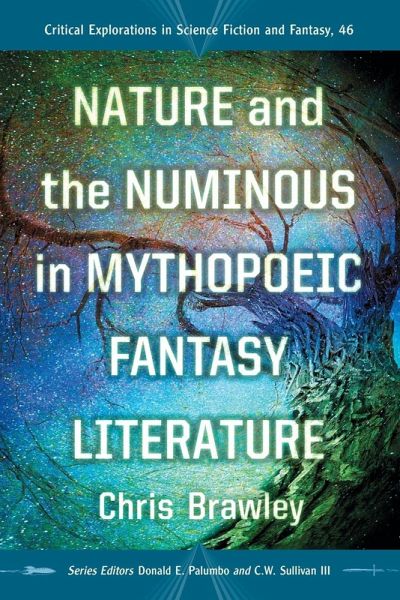
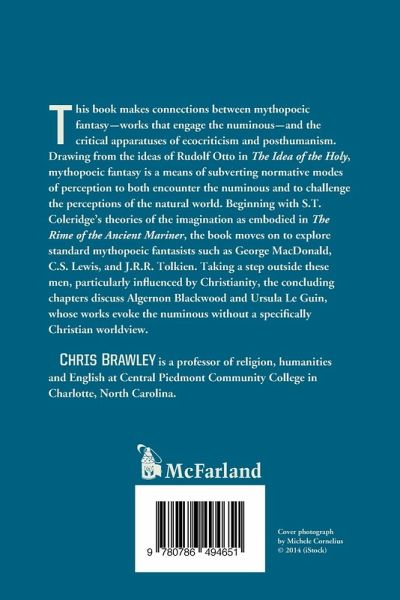
This book makes connections between mythopoeic fantasy--works that engage the numinous--and the critical apparatuses of ecocriticism and posthumanism. Drawing from the ideas of Rudolf Otto in The Idea of the Holy, mythopoeic fantasy is a means of subverting normative modes of perception to both encounter the numinous and to challenge the perceptions of the natural world. Beginning with S.T. Coleridge's theories of the imagination as embodied in The Rime of the Ancient Mariner, the book moves on to explore standard mythopoeic fantasists such as George MacDonald, C.S. Lewis, and J.R.R. Tolkien. Taking a step outside these men, particularly influenced by Christianity, the concluding chapters discuss Algernon Blackwood and Ursula Le Guin, whose works evoke the numinous without a specifically Christian worldview.
Chris Brawley is a professor of religion, humanities and English at Central Piedmont Community College in Charlotte, North Carolina.
Inhaltsangabe
Table of Contents Preface Introduction. Fantasy: Recovering What Was Lost One. "Quieting the Eye": The Perception of the Eternal through the Temporal in Coleridge's The Rime of the Ancient Mariner Two. The Ideal and the Shadow: George MacDonald's Phantastes Three. "Further Up and Further In": Apocalypse and the New Narnia in C.S. Lewis's The Last Battle Four. The Fading of the World: Tolkien's Ecology and Loss in The Lord of the Rings Five. Affirming the World that Swerves: The Alter-Tales in Algernon Blackwood's The Centaur and Ursula Le Guin's Buffalo Gals and Other Animal Presences Six. "A daisy is nearer heaven than an airship": The Utopian Vision in Algernon Blackwood's The Centaur Seven. "Yes. You can keep your eye": Ursula Le Guin's Buffalo Gals and Other Animal Presences Eight. The Sacramental Vision: Perceiving the World Anew Bibliography Index
Es gelten unsere Allgemeinen Geschäftsbedingungen: www.buecher.de/agb
Impressum
www.buecher.de ist ein Internetauftritt der buecher.de internetstores GmbH
Geschäftsführung: Monica Sawhney | Roland Kölbl | Günter Hilger
Sitz der Gesellschaft: Batheyer Straße 115 - 117, 58099 Hagen
Postanschrift: Bürgermeister-Wegele-Str. 12, 86167 Augsburg
Amtsgericht Hagen HRB 13257
Steuernummer: 321/5800/1497
USt-IdNr: DE450055826