
Andere Kunden interessierten sich auch für
 History of Anthropology as a Holistic Science115,99 €
 Food, Power, and Resistance in the Andes119,99 €
 Technique of Some South American Feather-Work; Volume 136,99 €
 The Way Around20,99 €
 Bows and Arrows in Central Brazil28,99 €
 Sorcery in Amazonia79,00 €
 Missionizing on the Edge142,99 €






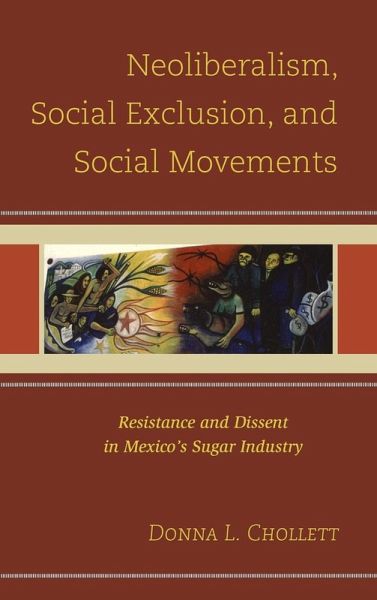
Neoliberalism, Social Exclusion, and Social Movements critically examines struggles for social justice in an era of neoliberal globalization. Chollett perceptively elucidates the intertwining of debt restructuring, the debacle of privatization, NAFTA-generated distortions in the sugar market, and social and economic exclusion of Mexican sugarcane growers and mill workers. The enclosure of community commons is but one of the devastating impacts of neoliberal policies that generated social movements across Latin America and beyond. Closure of one of Michoacán, Mexico's five sugar mills following privatization brought unemployment and economic havoc to the region. This region is unique in that it is the only locality where a social movement repossessed the closed sugar refinery and created a cooperative, worker-run workplace. The book offers a historically contextualized, globally situated, and ethnographically grounded analysis of the social movement as sugarcane growers and mill workers challenged the end to their way of life as they knew it. It takes the reader into the very real lives of movement participants, their aspirations, struggles, and accommodations. Chollett skillfully peels back the layers of this social movement as activists sought to remake their own history, but under circumstances that did not, in the end, ensure social justice. The author demonstrates empathy for collective struggles confronting the ravages of neoliberal globalization, yet explodes the myth that intuitively exalts social movements as morally noble forces for democratization and solidarity. She offers a critical perspective on the internal factions and lack of democratization of a social movement gone awry and presents a sorely-needed critique of social movement theory. While focusing on a particular social movement, this book carries wide applicability for all social movements concerned with social justice in an era of enduring neoliberalism. It is essential reading for students, academics, activists, and policy-makers concerned with global inequalities.