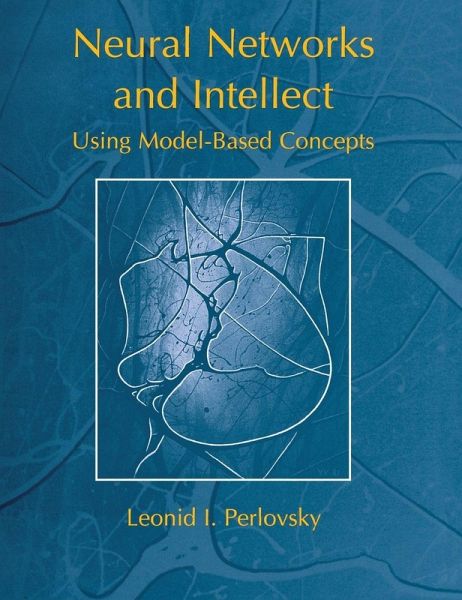
Among the topics disucssed are hierarchical and heterarchical organization of intelligent systems, statistical learning theory, genetic algorithms, complex adaptive systems, mathematical semiotics, the dynamical nature of symbols, Godel theorems and intelligence, emotions and thinking, mathematics of emotional intellect, and consciousness. The author's striking conclusion is that philosphers of the past have been closer to the computational concepts emerging today than pattern recognition and AI experts of just a few years ago. Neural Networks and Intellect: Using Model-Based Concepts…mehr
Among the topics disucssed are hierarchical and heterarchical organization of intelligent systems, statistical learning theory, genetic algorithms, complex adaptive systems, mathematical semiotics, the dynamical nature of symbols, Godel theorems and intelligence, emotions and thinking, mathematics of emotional intellect, and consciousness. The author's striking conclusion is that philosphers of the past have been closer to the computational concepts emerging today than pattern recognition and AI experts of just a few years ago.Neural Networks and Intellect: Using Model-Based Concepts describes a new mathematical concept of modeling field theory and its applications to a variety of problems. Examining the relationships among mathematics, computations in neural networks, signs and symbols in semiotics, and ideas of mind in psychology and philosophy, this unique text discusses deep philosophical questions in detail and relates them to mathematics and the engineering of intelligence. Ideal for courses in neural networks, modern pattern recognition, and mathematical concepts of intelligence, it will also be of interest to anyone working in a variety of fields including neural networks, AI, cognitive science, fuzzy systems, pattern recognition and machine/computer vision, data mining, robotics, target tracking, and financial forecasting.
* Part I. Overview. 2300 years of philosophy; 100 years of mathematical logic and 50 years of computational intelligence * 1: Introduction. Concepts of Intelligence * 1.1: Concepts of Intelligence in Mathematics, Psychology, and Philosophy * 1.2: Probability, Hypothesis Choice, Pattern Recognition, and Complexity * 1.3: Prediction, Tracking, and Dynamical Models * 1.4: Preview: Intelligence, Internal Model, Symbol, Emotions and Consciousness * Notes * Bibliographical Notes * Problems * 2: Mathematical Concepts of Mind * 2.1: Complexity, Aristotle, and Fuzzy Logic * 2.2: Nearest Neighbors and Degenerate Geometries * 2.3: Gradient Learning, Back Propagation and Feedforward Neural Networks * 2.4: Rule-Based Artificial Intelligence * 2.5: Concept of Internal Model * 2.6: Abductive Reasoning * 2.7: Statistical Learning Theory and Support Vector Machines * 2.8: AI Debates Past and Future * 2.9: Societ of Mind * 2.10: Sensor Fusion and JDL Model * 2.11: Hierarchical Organization * 2.12: Semiotics * 2.13: Evolutionary Computation, Genetic Algorithms, and CAS * 2.14: Neural Field Theories * 2.15: Intelligence, Learning, and Computability * Problems * Bibliographical Notes * Notes * 3: Mathematical vs. Metaphysical Concepts of Mind * 3.1: Prolegomenon. Plato, Antisthenes, and Artifical Intelligence * 3.2: Learning from Aristotle to Maimonides * 3.3: Heresy of Occam and Scientific Method * 3.4: Mathematics vs. Physics * 3.5: Kant: Pure Spirit and Psychology * 3.6: Freud vs. Jung. Psychology of Philosophy * 3.7: Wither We Go From Here? * Notes * Bibliographical Notes * Part II. Modeling Field Theory. New mathmatical theory of intelligence with examples of engineering applications * 4: Modeling Field Theory and Model-Based Neural Networks * 4.1: Internal Models, Uncertainties, and Similarities * 4.2: Modeling Field Theory Dynamics * 4.3: Bayesian MFT * 4.4: Shannon-Einsteinian MFT * 4.5: Modeling Field Theory Neural Architecture * 4.6: Convergence * 4.7: Learning of Structures and AIC * 4.8: Instinct of World Modeling: Knowledge Instinct * 4.9: Summary * 5: Maximum Likelihood Adaptive Neural System (MLANS) for Grouping and Recognition * 5.1: Grouping, Recognition and Models * 5.2: Gaussian Mixture Model. Unsupervised Learning * 5.3: Combined Unsupervised and Interactive Learning * 5.4: Structure Estimation * 5.5: Wishart and Rician Mixture Models for Radar Image Classification * 5.6: Convergence * 5.7: MLANS, Physics, Biology, and Other Neural Networks * Notes * Bibliographical Notes * Problems * 6: Einsteinian Neural Network (ENN) for Signal and Image Processing * 6.1: Images, Signals, and Spectra * 6.2: Spectral Models * 6.3: Neural Dynamics of ENN * 6.4: Applications to Acoustic Transient Signals and Speech Recognition * 6.5: Applications to Electromagnetic Wave Propagation in Ionosphere * 6.6: Summary * Appendix * Notes * Bibliograhical Notes * Problems * 7: Prediction, Association, Tracking, and Information Fusion * 7.1: Prediction, Association, and Non-linear Regression * 7.2: Association and Tracking Using Bayesian MFT * 7.3: Association and Tracking Using Shannon-Einsteinian MFT (SE-CAT) * 7.4: Sensor Fusion MFT * 7.5: Attention * Notes * Bibliographical Notes * Problems * 8: Quantum Modeling Field Theory (QMFT) * 8.1: Quantum Computing and Quantum Physics Notations * 8.2: Gibbs Quantum Modeling Field System * 8.3: Hamiltonian Quantum Modeling Field System * Bibliographical Notes * Problems * 9: Fundamental Limitations on Learning * 9.1: The Cramer-Rao Bound (CRB) on Speed of Learning * 9.2: Overlap Between Classes * 9.3: CRB for MLANS * 9.4: CRB for Concurrent Association and Tracking (CAT) * 9.5: Summary. Bounds for Intellect and Evolution? * Appendix. CRB Rule-of-Thumb for CAT * Notes * Bibliographical Notes * Problems * 10: Intelligent Systems Organization, Kant vs. MFT * 10.1: Kant, MFT and Intelligent Systems * 10.2: Emotional Machines (Toward Mathematics of Beauty) * 10.3: Learning: Genetic Algorithms, MFT and Semiosis * Notes * Bibliographical Notes * Problems * Part III. Futuristic Directions. Fun Stuff. Mind: Physics+Mind+Conjectures * 11: Goodel's Theorem and Fundamental Limitations of Computation and Learning * 11.1: Penrose and Computability of Mathematical Understanding * 11.2: Logic and Mind * 11.3: Godel, Turing, Penrose, and Putnam * 11.4: Godel Theorem vs. Physics of Mind * Notes * Biliographical Notes * 12: Toward Physics of Consciousness * 12.1: Phenomenology of Consciousness * 12.2: Physics of Spiritual Substance. Future Directions * 12.3: Epilogue * Notes * Bibliographical Notes * Symbols and Notations * Definitions and Index * Bibliography
* Part I. Overview. 2300 years of philosophy; 100 years of mathematical logic and 50 years of computational intelligence * 1: Introduction. Concepts of Intelligence * 1.1: Concepts of Intelligence in Mathematics, Psychology, and Philosophy * 1.2: Probability, Hypothesis Choice, Pattern Recognition, and Complexity * 1.3: Prediction, Tracking, and Dynamical Models * 1.4: Preview: Intelligence, Internal Model, Symbol, Emotions and Consciousness * Notes * Bibliographical Notes * Problems * 2: Mathematical Concepts of Mind * 2.1: Complexity, Aristotle, and Fuzzy Logic * 2.2: Nearest Neighbors and Degenerate Geometries * 2.3: Gradient Learning, Back Propagation and Feedforward Neural Networks * 2.4: Rule-Based Artificial Intelligence * 2.5: Concept of Internal Model * 2.6: Abductive Reasoning * 2.7: Statistical Learning Theory and Support Vector Machines * 2.8: AI Debates Past and Future * 2.9: Societ of Mind * 2.10: Sensor Fusion and JDL Model * 2.11: Hierarchical Organization * 2.12: Semiotics * 2.13: Evolutionary Computation, Genetic Algorithms, and CAS * 2.14: Neural Field Theories * 2.15: Intelligence, Learning, and Computability * Problems * Bibliographical Notes * Notes * 3: Mathematical vs. Metaphysical Concepts of Mind * 3.1: Prolegomenon. Plato, Antisthenes, and Artifical Intelligence * 3.2: Learning from Aristotle to Maimonides * 3.3: Heresy of Occam and Scientific Method * 3.4: Mathematics vs. Physics * 3.5: Kant: Pure Spirit and Psychology * 3.6: Freud vs. Jung. Psychology of Philosophy * 3.7: Wither We Go From Here? * Notes * Bibliographical Notes * Part II. Modeling Field Theory. New mathmatical theory of intelligence with examples of engineering applications * 4: Modeling Field Theory and Model-Based Neural Networks * 4.1: Internal Models, Uncertainties, and Similarities * 4.2: Modeling Field Theory Dynamics * 4.3: Bayesian MFT * 4.4: Shannon-Einsteinian MFT * 4.5: Modeling Field Theory Neural Architecture * 4.6: Convergence * 4.7: Learning of Structures and AIC * 4.8: Instinct of World Modeling: Knowledge Instinct * 4.9: Summary * 5: Maximum Likelihood Adaptive Neural System (MLANS) for Grouping and Recognition * 5.1: Grouping, Recognition and Models * 5.2: Gaussian Mixture Model. Unsupervised Learning * 5.3: Combined Unsupervised and Interactive Learning * 5.4: Structure Estimation * 5.5: Wishart and Rician Mixture Models for Radar Image Classification * 5.6: Convergence * 5.7: MLANS, Physics, Biology, and Other Neural Networks * Notes * Bibliographical Notes * Problems * 6: Einsteinian Neural Network (ENN) for Signal and Image Processing * 6.1: Images, Signals, and Spectra * 6.2: Spectral Models * 6.3: Neural Dynamics of ENN * 6.4: Applications to Acoustic Transient Signals and Speech Recognition * 6.5: Applications to Electromagnetic Wave Propagation in Ionosphere * 6.6: Summary * Appendix * Notes * Bibliograhical Notes * Problems * 7: Prediction, Association, Tracking, and Information Fusion * 7.1: Prediction, Association, and Non-linear Regression * 7.2: Association and Tracking Using Bayesian MFT * 7.3: Association and Tracking Using Shannon-Einsteinian MFT (SE-CAT) * 7.4: Sensor Fusion MFT * 7.5: Attention * Notes * Bibliographical Notes * Problems * 8: Quantum Modeling Field Theory (QMFT) * 8.1: Quantum Computing and Quantum Physics Notations * 8.2: Gibbs Quantum Modeling Field System * 8.3: Hamiltonian Quantum Modeling Field System * Bibliographical Notes * Problems * 9: Fundamental Limitations on Learning * 9.1: The Cramer-Rao Bound (CRB) on Speed of Learning * 9.2: Overlap Between Classes * 9.3: CRB for MLANS * 9.4: CRB for Concurrent Association and Tracking (CAT) * 9.5: Summary. Bounds for Intellect and Evolution? * Appendix. CRB Rule-of-Thumb for CAT * Notes * Bibliographical Notes * Problems * 10: Intelligent Systems Organization, Kant vs. MFT * 10.1: Kant, MFT and Intelligent Systems * 10.2: Emotional Machines (Toward Mathematics of Beauty) * 10.3: Learning: Genetic Algorithms, MFT and Semiosis * Notes * Bibliographical Notes * Problems * Part III. Futuristic Directions. Fun Stuff. Mind: Physics+Mind+Conjectures * 11: Goodel's Theorem and Fundamental Limitations of Computation and Learning * 11.1: Penrose and Computability of Mathematical Understanding * 11.2: Logic and Mind * 11.3: Godel, Turing, Penrose, and Putnam * 11.4: Godel Theorem vs. Physics of Mind * Notes * Biliographical Notes * 12: Toward Physics of Consciousness * 12.1: Phenomenology of Consciousness * 12.2: Physics of Spiritual Substance. Future Directions * 12.3: Epilogue * Notes * Bibliographical Notes * Symbols and Notations * Definitions and Index * Bibliography
Es gelten unsere Allgemeinen Geschäftsbedingungen: www.buecher.de/agb
Impressum
www.buecher.de ist ein Internetauftritt der buecher.de internetstores GmbH
Geschäftsführung: Monica Sawhney | Roland Kölbl | Günter Hilger
Sitz der Gesellschaft: Batheyer Straße 115 - 117, 58099 Hagen
Postanschrift: Bürgermeister-Wegele-Str. 12, 86167 Augsburg
Amtsgericht Hagen HRB 13257
Steuernummer: 321/5800/1497
USt-IdNr: DE450055826