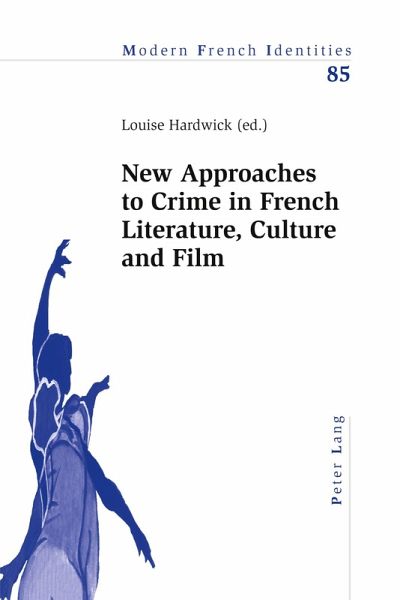
The notion of crime crosses generic, disciplinary and cultural frontiers. In an era of identity fraud, eco-crime and global terrorism, this collection moves towards a reconsideration of crime in the French and Francophone literary and cultural imagination. How have our conceptions of 'criminal' behaviour developed? How has the French genre of crime fiction, encompassing, but not limited to, the polar , the roman policier and film noir , evolved and reinvented itself? The volume adopts a number of theoretical approaches, which range from sociological and criminological discourse to literary…mehr
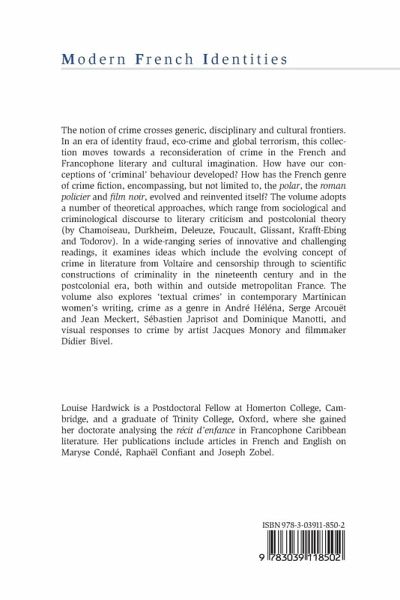
The notion of crime crosses generic, disciplinary and cultural frontiers. In an era of identity fraud, eco-crime and global terrorism, this collection moves towards a reconsideration of crime in the French and Francophone literary and cultural imagination. How have our conceptions of 'criminal' behaviour developed? How has the French genre of crime fiction, encompassing, but not limited to, the polar , the roman policier and film noir , evolved and reinvented itself? The volume adopts a number of theoretical approaches, which range from sociological and criminological discourse to literary criticism and postcolonial theory (by Chamoiseau, Durkheim, Deleuze, Foucault, Glissant, Krafft-Ebing and Todorov). In a wide-ranging series of innovative and challenging readings, it examines ideas which include the evolving concept of crime in literature from Voltaire and censorship through to scientific constructions of criminality in the nineteenth century and in the postcolonial era, both within and outside metropolitan France. The volume also explores 'textual crimes' in contemporary Martinican women's writing, crime as a genre in André Héléna, Serge Arcouët and Jean Meckert, Sébastien Japrisot and Dominique Manotti, and visual responses to crime by artist Jacques Monory and filmmaker Didier Bivel.
The Editor: Louise Hardwick is a Postdoctoral Fellow at Homerton College, Cambridge, and a graduate of Trinity College, Oxford, where she gained her doctorate analysing the récit d'enfance in Francophone Caribbean literature. Her publications include articles in French and English on Maryse Condé, Raphaël Confiant and Joseph Zobel.
Inhaltsangabe
Contents: Louise Hardwick: Introduction - Lisa Downing: Criminality, Sexuality, Abnormality: Nineteenth-Century Scientific Constructions - Emma Bielecki: Faking it: Representations of Art Forgery from the Second Empire to the Belle Epoque - Aurélie L'Hostis: Unchaining Memory in the French Caribbean - Lorna Milne: Who Done What? Marie Nimier's Text Crimes - James Hanrahan: Literary Crime and Innovation against Punishment: Voltaire and the Censorship Authorities before 1750 - Jennifer Jahn: Colonial Crimes: Female Perspectives of the Colonial Legacy - Claire Gorrara: Dramatic and Traumatic: French Crime Fiction and the Reconstruction of France - Simon Kemp: 'Le Roman Policier Par Excellence': Narrative Perspective in Sébastien Japrisot and the Norms of the Crime Novel - Véronique Desnain: 'L'histoire du crime': The Crime Novels of Dominique Manotti - Fernando Stefanich: Crime and the Figuration narrative Movement: The Case of Jacques Monory - Deborah S. Reisinger: Writing Memory: Point Kilométrique 190 and the Grimzi Affair - Chong J. Wojtkowski: Bad Boys/Petits Frères: The Representation of Delinquency in Fais-moi des vacances .
Contents: Louise Hardwick: Introduction - Lisa Downing: Criminality, Sexuality, Abnormality: Nineteenth-Century Scientific Constructions - Emma Bielecki: Faking it: Representations of Art Forgery from the Second Empire to the Belle Epoque - Aurélie L'Hostis: Unchaining Memory in the French Caribbean - Lorna Milne: Who Done What? Marie Nimier's Text Crimes - James Hanrahan: Literary Crime and Innovation against Punishment: Voltaire and the Censorship Authorities before 1750 - Jennifer Jahn: Colonial Crimes: Female Perspectives of the Colonial Legacy - Claire Gorrara: Dramatic and Traumatic: French Crime Fiction and the Reconstruction of France - Simon Kemp: 'Le Roman Policier Par Excellence': Narrative Perspective in Sébastien Japrisot and the Norms of the Crime Novel - Véronique Desnain: 'L'histoire du crime': The Crime Novels of Dominique Manotti - Fernando Stefanich: Crime and the Figuration narrative Movement: The Case of Jacques Monory - Deborah S. Reisinger: Writing Memory: Point Kilométrique 190 and the Grimzi Affair - Chong J. Wojtkowski: Bad Boys/Petits Frères: The Representation of Delinquency in Fais-moi des vacances .
Es gelten unsere Allgemeinen Geschäftsbedingungen: www.buecher.de/agb
Impressum
www.buecher.de ist ein Internetauftritt der buecher.de internetstores GmbH
Geschäftsführung: Monica Sawhney | Roland Kölbl | Günter Hilger
Sitz der Gesellschaft: Batheyer Straße 115 - 117, 58099 Hagen
Postanschrift: Bürgermeister-Wegele-Str. 12, 86167 Augsburg
Amtsgericht Hagen HRB 13257
Steuernummer: 321/5800/1497
USt-IdNr: DE450055826