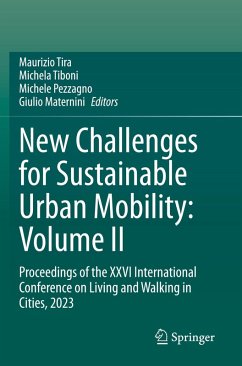
New Challenges for Sustainable Urban Mobility: Volume II
Proceedings of the XXVI International Conference on Living and Walking in Cities, 2023 Herausgegeben:Tira, Maurizio; Tiboni, Michela; Pezzagno, Michele; Maternini, Giulio
New Challenges for Sustainable Urban Mobility: Volume II
Proceedings of the XXVI International Conference on Living and Walking in Cities, 2023 Herausgegeben:Tira, Maurizio; Tiboni, Michela; Pezzagno, Michele; Maternini, Giulio
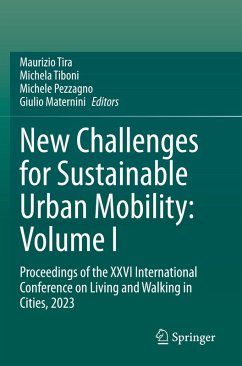
This volume is the second of a two-volume set of the Proceedings of the XXVI International Conference on Living and Walking in Cities, held September 6-8 2023 at the University of Brescia, Italy. The LWC International Conference was first organized in 1994 at the Department of Civil and Environmental Engineering of the University of Brescia (IT). This year the LWC Conference has arrived at its XXVI edition. The Conference traditionally deals with the topics of urban mobility and quality of life in urban areas, with a specific focus on vulnerable road users. The LWC Conference allows…mehr
This volume is the second of a two-volume set of the Proceedings of the XXVI International Conference on Living and Walking in Cities, held September 6-8 2023 at the University of Brescia, Italy. The LWC International Conference was first organized in 1994 at the Department of Civil and Environmental Engineering of the University of Brescia (IT). This year the LWC Conference has arrived at its XXVI edition. The Conference traditionally deals with the topics of urban mobility and quality of life in urban areas, with a specific focus on vulnerable road users. The LWC Conference allows researchers, experts, administrators, and practitioners to gather and discuss policy issues, best practices, and research findings from different perspectives. The main theme of the 2023 conference was "new challenges for sustainable urban mobility", and the papers herein address the issue from a multidisciplinary perspective and cover a wide variety of related topics. These books are divided intofour topical sections:
o Transport Systems and Pedestrian Mobility
o Urban Regeneration through Active Mobility
o Public Transport: New Technologies and Economic Sustainability
Maurizio Tira Maurizio Tira is Full Professor of Urban planning at the University of Brescia (I), member of the Academy of Sciences of Bologna and member of the board of the European University Association. He has been President of the Italian Urban Planners' Society and he acted as Rector of the University of Brescia from November 1 st 2016 until 31 st October 2022. In that role, he was delegate for international affairs within the Board of the Italian Rectors' Conference. He has been member of the Technical Structure of the Italian Ministry of Transport and Infrastructures from 2017 to 2018 and he is at present member of the Transport Research Committee of OECD-ITF and of the DG Move Expert Group on Urban mobility. He is President of "GARR, the ultra-broadband network dedicated to the Italian research and education community". He participated in several EU funded projects mainly in the field of urban and mobility planning, focusing on the urban safety management, publishing 275 scientific works. In December 2020, the President of the Italian Republic made him Commander of the Italian Republic. Michela Tiboni Michela Tiboni, born in 1970, is a Civil Engineer and Full Professor of Urban Planning. Since 1996, Tiboni has been at the forefront of scientific research, collaborating with national and international institutes on various projects. Her focus spans from urban planning to Geographic Information Systems (GIS), utilizing innovative techniques to analyze and address urban challenges, territorial planning in high-risk areas, emphasizing vulnerability and exposure within established cities. She also explores accessibility and safety in urban environments, pioneering methodologies to enhance safety and studying accident phenomena, especially among vulnerable users. Her commitment extends beyond academia; she actively engages in civic leadership roles, notably as Councilor for Urban Planning and Sustainable Development in Brescia. The approach in sustainable urban development aimed at revitalizing urban areas and improving citizens' quality of life. Michele Pezzagno Michele Pezzagno serves as an Associate Professor of Urban and Landscape Planning at the University of Brescia, Italy. She leads the University Research and Documentation Center for the 2030 Sustainable Development Agenda (CRA2030). Her research primarily revolves around developing technical planning strategies for fostering sustainable development within urbanized regions. Author of more than 130 publications, she also dedicates her teaching efforts to topics such as participatory planning and engaging citizens in sustainable urban development. Giulio Maternini Giulio Maternini is Full Professor in Transport Engineering at the University of Brescia. He is a member of the Scientific Committee of CeSCAM and has assumed the role of Director since 2019. Since 2004, he has served as the Rector's Delegate for Sustainable Mobility, showcasing his commitment to enhancing sustainable transport systems. Since 1998, he has been involved in AIIT (Italian Association for Traffic and Transport Engineering), where he became National Vice-President (2007-2010) and National President (2010-2014). He is a member of the Scientific Association SIIV (Italian Road Infrastructure Society) and SIDT (Italian Society of Transportation Academicians). Since 2018, he has been the Editor of the European Transport/Trasporti Europei. He has spearheaded numerous research initiatives focused on safety and mobility in urban areas, collaborating extensively with local governments, underlining his dedication to improving public transport and road safety standards.
Inhaltsangabe
Chapter 1: Accessibility Evaluation of Electric Micro-mobility and Public Transport: An Application to the Medium-sized City of Salerno (Italy).- Chapter 2: Which factors contribute to the mobility of persons with physical disabilities? Case study Serbia.- Chapter 3: Accessibility in the metropolitan spatial transition. The case study of Cagliari City (Sardinia, Italy).- Chapter 4: Geo-mining landscape, slow mobility and services in spatial regeneration.- Chapter 5: An Indicator of Walkability for urban districts, oriented towards the MaaS component, with case study of Naples.- Chapter 6: Assessing the Impacts of Urban Regeneration Projects on Smart and Active Mobility. An Application to the Cases of Cesena and Rimini.- Chapter 7: Urban Green Space accessibility as a strategic tool to design Green Infrastructure and pedestrian way.- Chapter 8: Walking accessibility for individuals with reduced mobility: A Sicilian case study.- Chapter 9: The protected areas as accessible walking-destinations: propensity and limits in the Partenio's Park in Campania.- Chapter 10: Sustainable policies and participation for integrated mobility prospects in cities. Case studies in Ligurian Region.- Chapter 11: Nudging walking and cycling in extreme car dependent communities.- Chapter 12: Soft Mobility Knowledge Model: Heavyweight Ontologies.- Chapter 13: Integration between urban and mobility planning in territorial government processes: a case study.- Chapter 14: Survey and monitoring of the mobility in the Parma University Campus for improving sustainable transportation options.- Chapter 15: Sustainable Urban Design Strategies for Pedestrian Oriented Neighborhood: Pozcu, Mersin.- Chapter 16: The process of city logistics supported by regional program: general model and applicative case study.- Chapter 17: Limited Traffic Zones around school for urban mobility supported by regional program.- Chapter 18: Temporal policies to support the urban life system. The desynchronization matrix.- Chapter 19: Preliminary technical analysis of a hyperloop line for freight transport: case study from Italy.- Chapter 20: Sustainable Urban Mobility Plan from European rules to single Country implementation: the study case of Italy.- Chapter 21: May Mobility-as-a-Service lead to more sustainable urban patterns? Examining spatial regenerative potential of mobility integration through MaaS Hub implementation.- Chapter 22: Measuring the impact of institutional and territorial drivers for an efficient and smooth Mobility as a Service (MaaS) implementation: a global analysis.- Chapter 23: Effect of Tram Floor Height on Passenger Boarding and Alighting Time.- Chapter 24: Evidences from cell phone big data applications for urban mobility needs: case studies in Italy.- Chapter 25: Building Origin-Destination matrices in bus networks from Smartphone-App Call Detail Records: Evidence from Italy.- Chapter 26: Parking demand diagnosis by Automated Payment Transaction (APT) data. An application in a small-sized tourist city.- Chapter 27: Sustainable mobility as a factor of urban competitiveness. The scenario of major Italian cities.- Chapter 28: In depth analysis of pedestrian crash trends in the Italian urban environment.- Chapter 29: Risk Index Development for a Safer Cycling Environment.- Chapter 30: A data analysis on road accidents involving pedestrians in urban areas.- Chapter 31: Assessment of the impact of a project on an existing road network through an integrated approach of Road Safety Inspection, Road Safety Audit and Road Safety Impact Assessment.- Chapter 32: An Operating Framework for Assessing Road Safety in a Wide-Road Network with Constrained Time for Action: The Milano-Cortina 2026 Winter Olympic Games Road Case Study.- Chapter 33: Modern preventive tools for improving pedestrian safety in traffic.- Chapter 34: Pedestrian safety in Slovene urban areas.- Chapter 35: Implications of a "road user hierarchy" for road-safety law.- Chapter 36: Road safety analysis: a study on the visual perception of road signs using a driving simulator.
Chapter 1: Accessibility Evaluation of Electric Micro-mobility and Public Transport: An Application to the Medium-sized City of Salerno (Italy).- Chapter 2: Which factors contribute to the mobility of persons with physical disabilities? Case study Serbia.- Chapter 3: Accessibility in the metropolitan spatial transition. The case study of Cagliari City (Sardinia, Italy).- Chapter 4: Geo-mining landscape, slow mobility and services in spatial regeneration.- Chapter 5: An Indicator of Walkability for urban districts, oriented towards the MaaS component, with case study of Naples.- Chapter 6: Assessing the Impacts of Urban Regeneration Projects on Smart and Active Mobility. An Application to the Cases of Cesena and Rimini.- Chapter 7: Urban Green Space accessibility as a strategic tool to design Green Infrastructure and pedestrian way.- Chapter 8: Walking accessibility for individuals with reduced mobility: A Sicilian case study.- Chapter 9: The protected areas as accessible walking-destinations: propensity and limits in the Partenio's Park in Campania.- Chapter 10: Sustainable policies and participation for integrated mobility prospects in cities. Case studies in Ligurian Region.- Chapter 11: Nudging walking and cycling in extreme car dependent communities.- Chapter 12: Soft Mobility Knowledge Model: Heavyweight Ontologies.- Chapter 13: Integration between urban and mobility planning in territorial government processes: a case study.- Chapter 14: Survey and monitoring of the mobility in the Parma University Campus for improving sustainable transportation options.- Chapter 15: Sustainable Urban Design Strategies for Pedestrian Oriented Neighborhood: Pozcu, Mersin.- Chapter 16: The process of city logistics supported by regional program: general model and applicative case study.- Chapter 17: Limited Traffic Zones around school for urban mobility supported by regional program.- Chapter 18: Temporal policies to support the urban life system. The desynchronization matrix.- Chapter 19: Preliminary technical analysis of a hyperloop line for freight transport: case study from Italy.- Chapter 20: Sustainable Urban Mobility Plan from European rules to single Country implementation: the study case of Italy.- Chapter 21: May Mobility-as-a-Service lead to more sustainable urban patterns? Examining spatial regenerative potential of mobility integration through MaaS Hub implementation.- Chapter 22: Measuring the impact of institutional and territorial drivers for an efficient and smooth Mobility as a Service (MaaS) implementation: a global analysis.- Chapter 23: Effect of Tram Floor Height on Passenger Boarding and Alighting Time.- Chapter 24: Evidences from cell phone big data applications for urban mobility needs: case studies in Italy.- Chapter 25: Building Origin-Destination matrices in bus networks from Smartphone-App Call Detail Records: Evidence from Italy.- Chapter 26: Parking demand diagnosis by Automated Payment Transaction (APT) data. An application in a small-sized tourist city.- Chapter 27: Sustainable mobility as a factor of urban competitiveness. The scenario of major Italian cities.- Chapter 28: In depth analysis of pedestrian crash trends in the Italian urban environment.- Chapter 29: Risk Index Development for a Safer Cycling Environment.- Chapter 30: A data analysis on road accidents involving pedestrians in urban areas.- Chapter 31: Assessment of the impact of a project on an existing road network through an integrated approach of Road Safety Inspection, Road Safety Audit and Road Safety Impact Assessment.- Chapter 32: An Operating Framework for Assessing Road Safety in a Wide-Road Network with Constrained Time for Action: The Milano-Cortina 2026 Winter Olympic Games Road Case Study.- Chapter 33: Modern preventive tools for improving pedestrian safety in traffic.- Chapter 34: Pedestrian safety in Slovene urban areas.- Chapter 35: Implications of a "road user hierarchy" for road-safety law.- Chapter 36: Road safety analysis: a study on the visual perception of road signs using a driving simulator.
Es gelten unsere Allgemeinen Geschäftsbedingungen: www.buecher.de/agb
Impressum
www.buecher.de ist ein Internetauftritt der buecher.de internetstores GmbH
Geschäftsführung: Monica Sawhney | Roland Kölbl | Günter Hilger
Sitz der Gesellschaft: Batheyer Straße 115 - 117, 58099 Hagen
Postanschrift: Bürgermeister-Wegele-Str. 12, 86167 Augsburg
Amtsgericht Hagen HRB 13257
Steuernummer: 321/5800/1497
USt-IdNr: DE450055826