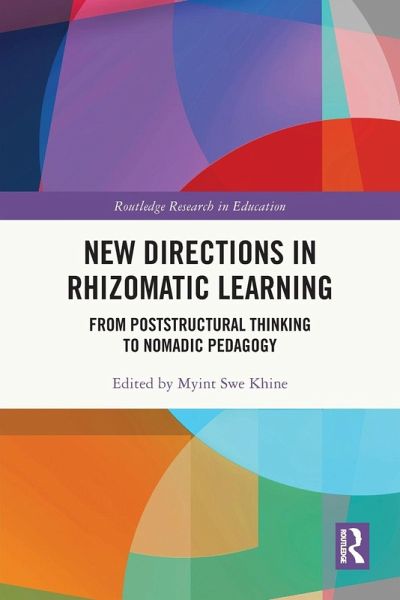
Drawing on the theories and philosophies of Deleuze and Guattari, this edited collection explores the concept of rhizomatic learning and consolidates recent explorations in theory building and multidisciplinary research to identify new directions in the field.
Drawing on the theories and philosophies of Deleuze and Guattari, this edited collection explores the concept of rhizomatic learning and consolidates recent explorations in theory building and multidisciplinary research to identify new directions in the field.
Myint Swe Khine holds master's degrees in education from the University of Southern California, Los Angeles, USA, and the University of Surrey, Guildford. UK, and a Doctor of Education from Curtin University, Australia. He worked at the National Institute of Education, Nanyang Technological University, Singapore, and was a Professor at Emirates College for Advanced Education in the United Arab Emirates. Dr. Khine currently teaches at Curtin University, Australia. He is a member of the Editorial Advisory Board of international academic journals and has published several edited books. One of the books, Large Scale School Reform and Social Capital Building, was published by Routledge in 2013.
Inhaltsangabe
PART I Introduction 1. Explorations in learning and rhizome metaphor PART II Theoretical foundations and rhizomatic perspective of learning 2. What should we be teaching if Google gives the answer before we have even finished typing the question? 3. Rhizomatic teacher development in the context of the ecological university 4. Rhizomatic learning: A critical appraisal from the perspective of cultural-historical theory 5. Rhizomatic learning: A catalyst for a new social contract 6. Semiosis, hybridity and the mediated mind 7. Rhizomes, nomads, and complexity: A new relational pedagogy for the era of networks, social media, and artificial intelligence PART III Pedagogical approaches and rhizomatic learning in action 8. Rhizomatic learning systems and precision language education: A perfect match 9. Rhizomatic pedagogy in higher education: A comparative analysis 10. Enabling rhizomatic collaborations: Social and technical factors that impact agile thinking and learning 11. The rhizomatic learning process of educational commons 12. Changing the image of thought: Rhizomatic learning and human-nature relationships in the Anthropocene 13. Rhizomatic learning and the problematic field of ideas
PART I Introduction 1. Explorations in learning and rhizome metaphor PART II Theoretical foundations and rhizomatic perspective of learning 2. What should we be teaching if Google gives the answer before we have even finished typing the question? 3. Rhizomatic teacher development in the context of the ecological university 4. Rhizomatic learning: A critical appraisal from the perspective of cultural-historical theory 5. Rhizomatic learning: A catalyst for a new social contract 6. Semiosis, hybridity and the mediated mind 7. Rhizomes, nomads, and complexity: A new relational pedagogy for the era of networks, social media, and artificial intelligence PART III Pedagogical approaches and rhizomatic learning in action 8. Rhizomatic learning systems and precision language education: A perfect match 9. Rhizomatic pedagogy in higher education: A comparative analysis 10. Enabling rhizomatic collaborations: Social and technical factors that impact agile thinking and learning 11. The rhizomatic learning process of educational commons 12. Changing the image of thought: Rhizomatic learning and human-nature relationships in the Anthropocene 13. Rhizomatic learning and the problematic field of ideas
Es gelten unsere Allgemeinen Geschäftsbedingungen: www.buecher.de/agb
Impressum
www.buecher.de ist ein Internetauftritt der buecher.de internetstores GmbH
Geschäftsführung: Monica Sawhney | Roland Kölbl | Günter Hilger
Sitz der Gesellschaft: Batheyer Straße 115 - 117, 58099 Hagen
Postanschrift: Bürgermeister-Wegele-Str. 12, 86167 Augsburg
Amtsgericht Hagen HRB 13257
Steuernummer: 321/5800/1497
USt-IdNr: DE450055826