

Andere Kunden interessierten sich auch für
 Epictetus. The Discourses and Manual, Together With Fragments of His Writings; Volume 122,99 €
![Philosophical Fragments [microform], Written During Intervals of Business]( "Philosophical Fragments [microform], Written During Intervals of Business") Philosophical Fragments [microform], Written During Intervals of Business18,99 €
Philosophical Fragments [microform], Written During Intervals of Business18,99 € The Cosmic Fragments25,99 €
![Fragments of Philosophy [microform]]( "Fragments of Philosophy [microform]") Fragments of Philosophy [microform]17,99 €
Fragments of Philosophy [microform]17,99 € Pannomial Fragments12,99 €
 Against Relativism15,99 €
 Fragments Of Existence13,99 €

![Philosophical Fragments [microform], Written During Intervals of Business](https://bilder.buecher.de/produkte/66/66120/66120605m.jpg "Philosophical Fragments [microform], Written During Intervals of Business")
![Fragments of Philosophy [microform]](https://bilder.buecher.de/produkte/66/66197/66197727m.jpg "Fragments of Philosophy [microform]")


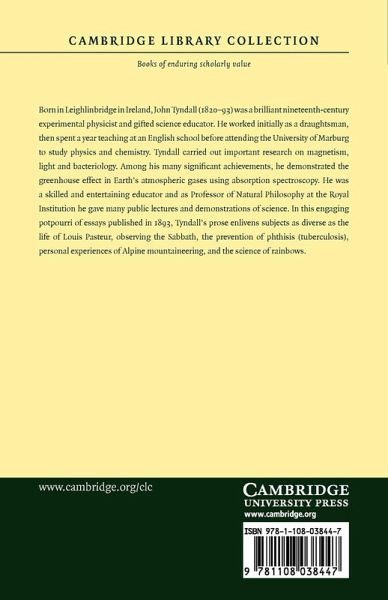
Born in Leighlinbridge in Ireland, John Tyndall (1820-93) was a brilliant nineteenth-century experimental physicist and gifted science educator. He worked initially as a draughtsman, then spent a year teaching at an English school before attending the University of Marburg to study physics and chemistry. Tyndall carried out important research on magnetism, light and bacteriology. Among his many significant achievements, he demonstrated the greenhouse effect in Earth's atmospheric gases using absorption spectroscopy. He was a skilled and entertaining educator and as Professor of Natural Philosophy at the Royal Institution he gave many public lectures and demonstrations of science. In this engaging potpourri of essays published in 1893, Tyndall's prose enlivens subjects as diverse as the life of Louis Pasteur, observing the Sabbath, the prevention of phthisis (tuberculosis), personal experiences of Alpine mountaineering, and the science of rainbows.