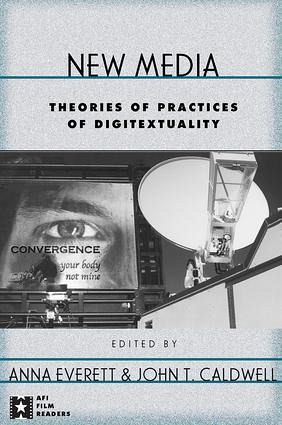
The rapid growth of new media technologies is radically changing film production and consumption. New Media responds to these revolutionary developments, addressing topics such as computer games, media convergence, and internet audiences.
The rapid growth of new media technologies is radically changing film production and consumption. New Media responds to these revolutionary developments, addressing topics such as computer games, media convergence, and internet audiences.
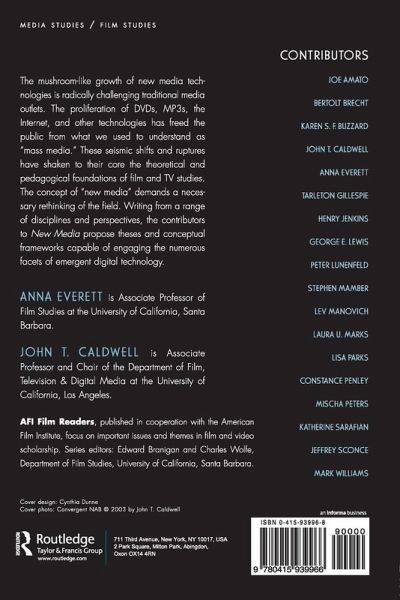
John Caldwell is Associate Professor and Chair of the Department of Film, Television & Digital Media at the University of California, Los Angeles. Anna Everett is Associate Professor of Film Studies at the University of California, Santa Barbara.
Inhaltsangabe
Illustrations Acknowledgments Introduction Issues in the Theory and Practice of Media Convergence: Anna Everett and John T. Caldwell Part 1: Digitextual Deconstructions 1. Digitextuality and Click Theory: Theses on Convergence Media in the Digital Age: Anna Everett 2. The Radio as an Apparatus of Communication: Bertolt Brecht 3. Invisible Media: Laura U. Marks 4. Exit Meat: Digital Bodies in a Virtual World: Mischa Peters Part 2: Digitextual Aesthetics 5. Space Invaders: Thoughts on Technology and the Production of Culture: Peter Lunenfeld 6. The Poetics of Augmented Space: Lev Manovich 7.Too Many Notes: Computers, Complexity, and Culture in Voyager : George E. Lewis 8. The Stories Digital Tools Tell: Tarleton Gillespie Part 3: Pre-Figuring Digitextuality 9. Second Shift Media Aesthetics: Programming, Interactivity, and User Flows: John T. Caldwell 10. Narrative Mapping: Stephen Mamber 11. Real-Time Fairy Tales: Cinema Pre-Figuring Digital Anxiety: Mark Williams 12. Digital Vapor/ Tulip Theory: Jeffrey Sconce Part 4: Digitextual Practices 13. Net Ratings: Defining a New Medium by the Old, Measuring Internet Audiences: Karen S.F. Buzzard 14. Flashing Digital Animations: Pixar's Digital Aesthetic: Katherine Sarafian 15. Log On: Corporate Feminism and the Oxygen Media Research Project: Constance Penley, Lisa Parks and Anna Everett 16. From Barbie to Mortal Kombat: Further Reflections: Henry Jenkins 17. Endnotes for a Theory of Convergence: Joe Amato
Illustrations Acknowledgments Introduction Issues in the Theory and Practice of Media Convergence: Anna Everett and John T. Caldwell Part 1: Digitextual Deconstructions 1. Digitextuality and Click Theory: Theses on Convergence Media in the Digital Age: Anna Everett 2. The Radio as an Apparatus of Communication: Bertolt Brecht 3. Invisible Media: Laura U. Marks 4. Exit Meat: Digital Bodies in a Virtual World: Mischa Peters Part 2: Digitextual Aesthetics 5. Space Invaders: Thoughts on Technology and the Production of Culture: Peter Lunenfeld 6. The Poetics of Augmented Space: Lev Manovich 7.Too Many Notes: Computers, Complexity, and Culture in Voyager : George E. Lewis 8. The Stories Digital Tools Tell: Tarleton Gillespie Part 3: Pre-Figuring Digitextuality 9. Second Shift Media Aesthetics: Programming, Interactivity, and User Flows: John T. Caldwell 10. Narrative Mapping: Stephen Mamber 11. Real-Time Fairy Tales: Cinema Pre-Figuring Digital Anxiety: Mark Williams 12. Digital Vapor/ Tulip Theory: Jeffrey Sconce Part 4: Digitextual Practices 13. Net Ratings: Defining a New Medium by the Old, Measuring Internet Audiences: Karen S.F. Buzzard 14. Flashing Digital Animations: Pixar's Digital Aesthetic: Katherine Sarafian 15. Log On: Corporate Feminism and the Oxygen Media Research Project: Constance Penley, Lisa Parks and Anna Everett 16. From Barbie to Mortal Kombat: Further Reflections: Henry Jenkins 17. Endnotes for a Theory of Convergence: Joe Amato
Es gelten unsere Allgemeinen Geschäftsbedingungen: www.buecher.de/agb
Impressum
www.buecher.de ist ein Internetauftritt der buecher.de internetstores GmbH
Geschäftsführung: Monica Sawhney | Roland Kölbl | Günter Hilger
Sitz der Gesellschaft: Batheyer Straße 115 - 117, 58099 Hagen
Postanschrift: Bürgermeister-Wegele-Str. 12, 86167 Augsburg
Amtsgericht Hagen HRB 13257
Steuernummer: 321/5800/1497
USt-IdNr: DE450055826