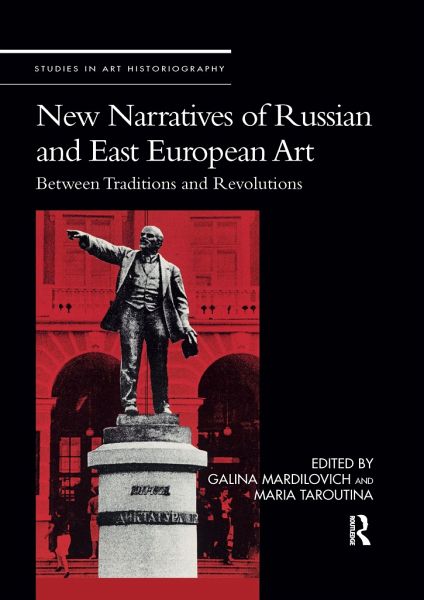
New Narratives of Russian and East European Art
Between Traditions and Revolutions
Herausgeber: Mardilovich, Galina; Taroutina, Maria
Schade – dieser Artikel ist leider ausverkauft. Sobald wir wissen, ob und wann der Artikel wieder verfügbar ist, informieren wir Sie an dieser Stelle.
New Narratives of Russian and East European Art
Between Traditions and Revolutions
Herausgeber: Mardilovich, Galina; Taroutina, Maria
- Broschiertes Buch
- Merkliste
- Auf die Merkliste
- Bewerten Bewerten
- Teilen
- Produkt teilen
- Produkterinnerung
- Produkterinnerung
This book brings together thirteen scholars to introduce the newest and most cutting-edge methodologies in the field of Russian and East European art history.
Andere Kunden interessierten sich auch für
Soviet-East European Relations as a Problem for the West48,99 €
Jeremy HowardVladimir Markov and Russian Primitivism46,99 €
Reading Russian Sources49,99 €
Horizontal Art History and Beyond43,99 €
Horizontal Art History and Beyond154,99 €
Galia GolanThe Soviet Union and National Liberation Movements in the Third World132,99 €
Charles Warren HostlerTurkism and the Soviets45,99 €-
-
-
This book brings together thirteen scholars to introduce the newest and most cutting-edge methodologies in the field of Russian and East European art history.
Produktdetails
- Produktdetails
- Studies in Art Historiography
- Verlag: Taylor & Francis Ltd
- Seitenzahl: 256
- Erscheinungstermin: 14. Juni 2022
- Englisch
- Abmessung: 245mm x 173mm x 24mm
- Gewicht: 470g
- ISBN-13: 9781032337845
- ISBN-10: 1032337842
- Artikelnr.: 64223723
- Herstellerkennzeichnung
- Libri GmbH
- Europaallee 1
- 36244 Bad Hersfeld
- gpsr@libri.de
- Studies in Art Historiography
- Verlag: Taylor & Francis Ltd
- Seitenzahl: 256
- Erscheinungstermin: 14. Juni 2022
- Englisch
- Abmessung: 245mm x 173mm x 24mm
- Gewicht: 470g
- ISBN-13: 9781032337845
- ISBN-10: 1032337842
- Artikelnr.: 64223723
- Herstellerkennzeichnung
- Libri GmbH
- Europaallee 1
- 36244 Bad Hersfeld
- gpsr@libri.de
Galina Mardilovich is Curator of Russian and European Art at the Mead Art Museum at Amherst College, USA. Maria Taroutina is Assistant Professor of Art History at Yale-NUS College, Singapore.
Introduction [Maria Taroutina and Galina Mardilovich];
PART I: Mobile Margins: Artists, Artworks, and Instituions;
Chapter One. Blood, Skin, and Paint: Karl Briullov in 1832: Allison Leigh;
Chapter Two: Iaroslavna's Lament and its Echoes in Late Nineteenth-Century
Russian Art: Alison Hilton;
Chapter Three: An Exercise in Close Looking: Ilia Repin's They Did Not
Expect Him: Galina Mardilovich;
Chapter Four: "Is disagreement among artists a good thing?": The End of
Salon-Type Exhibitions in Russia and Western Europe: Andrey Shabanov;
Chapter Five: Blurring Boundaries: Mikhail Vrubel's Decorative Turn and the
Rise of Russian Modernism: Maria Taroutina;
Chapter Six: Idiosyncrasy as an Alternative Modernist Narrative: Steven
Mansbach
PART II: Visualizing Ideology: New systems, Cold War Aesthetics, and
Post-Socialist Memory;
Chapter Seven: Art in the Age of Binary Inversion: Russian Constructivist
Graphic Design and the Interwar Grid: Kristin Romberg;
Chapter Eight: The Creative Mistakes of Socialist Realism: Maria Mileeva;
Chapter Nine: A Socialist Neo-Avant-Garde? The Case of Postwar Yugoslavia:
Nikolas Drosos;
Chapter Ten: The Troubled Public Sphere: Understanding the Art Scene in
Socialist Hungary: Katalin Cseh-Varga;
Chapter Eleven: The Nonidentity Problem in Contemporary Belarusian Art:
Tatsiana Zhurauliova;
Chapter Twelve: Marking Memories, Mediating Histories in the Work of
Deimantas Narkevicius: Ksenia Nouril;
Chapter Thirteen: History in the Future Tense: On Recent Installations by
Igor Makarevich and Elena Elagina: Jane A. Sharp
PART I: Mobile Margins: Artists, Artworks, and Instituions;
Chapter One. Blood, Skin, and Paint: Karl Briullov in 1832: Allison Leigh;
Chapter Two: Iaroslavna's Lament and its Echoes in Late Nineteenth-Century
Russian Art: Alison Hilton;
Chapter Three: An Exercise in Close Looking: Ilia Repin's They Did Not
Expect Him: Galina Mardilovich;
Chapter Four: "Is disagreement among artists a good thing?": The End of
Salon-Type Exhibitions in Russia and Western Europe: Andrey Shabanov;
Chapter Five: Blurring Boundaries: Mikhail Vrubel's Decorative Turn and the
Rise of Russian Modernism: Maria Taroutina;
Chapter Six: Idiosyncrasy as an Alternative Modernist Narrative: Steven
Mansbach
PART II: Visualizing Ideology: New systems, Cold War Aesthetics, and
Post-Socialist Memory;
Chapter Seven: Art in the Age of Binary Inversion: Russian Constructivist
Graphic Design and the Interwar Grid: Kristin Romberg;
Chapter Eight: The Creative Mistakes of Socialist Realism: Maria Mileeva;
Chapter Nine: A Socialist Neo-Avant-Garde? The Case of Postwar Yugoslavia:
Nikolas Drosos;
Chapter Ten: The Troubled Public Sphere: Understanding the Art Scene in
Socialist Hungary: Katalin Cseh-Varga;
Chapter Eleven: The Nonidentity Problem in Contemporary Belarusian Art:
Tatsiana Zhurauliova;
Chapter Twelve: Marking Memories, Mediating Histories in the Work of
Deimantas Narkevicius: Ksenia Nouril;
Chapter Thirteen: History in the Future Tense: On Recent Installations by
Igor Makarevich and Elena Elagina: Jane A. Sharp
Introduction [Maria Taroutina and Galina Mardilovich];
PART I: Mobile Margins: Artists, Artworks, and Instituions;
Chapter One. Blood, Skin, and Paint: Karl Briullov in 1832: Allison Leigh;
Chapter Two: Iaroslavna's Lament and its Echoes in Late Nineteenth-Century
Russian Art: Alison Hilton;
Chapter Three: An Exercise in Close Looking: Ilia Repin's They Did Not
Expect Him: Galina Mardilovich;
Chapter Four: "Is disagreement among artists a good thing?": The End of
Salon-Type Exhibitions in Russia and Western Europe: Andrey Shabanov;
Chapter Five: Blurring Boundaries: Mikhail Vrubel's Decorative Turn and the
Rise of Russian Modernism: Maria Taroutina;
Chapter Six: Idiosyncrasy as an Alternative Modernist Narrative: Steven
Mansbach
PART II: Visualizing Ideology: New systems, Cold War Aesthetics, and
Post-Socialist Memory;
Chapter Seven: Art in the Age of Binary Inversion: Russian Constructivist
Graphic Design and the Interwar Grid: Kristin Romberg;
Chapter Eight: The Creative Mistakes of Socialist Realism: Maria Mileeva;
Chapter Nine: A Socialist Neo-Avant-Garde? The Case of Postwar Yugoslavia:
Nikolas Drosos;
Chapter Ten: The Troubled Public Sphere: Understanding the Art Scene in
Socialist Hungary: Katalin Cseh-Varga;
Chapter Eleven: The Nonidentity Problem in Contemporary Belarusian Art:
Tatsiana Zhurauliova;
Chapter Twelve: Marking Memories, Mediating Histories in the Work of
Deimantas Narkevicius: Ksenia Nouril;
Chapter Thirteen: History in the Future Tense: On Recent Installations by
Igor Makarevich and Elena Elagina: Jane A. Sharp
PART I: Mobile Margins: Artists, Artworks, and Instituions;
Chapter One. Blood, Skin, and Paint: Karl Briullov in 1832: Allison Leigh;
Chapter Two: Iaroslavna's Lament and its Echoes in Late Nineteenth-Century
Russian Art: Alison Hilton;
Chapter Three: An Exercise in Close Looking: Ilia Repin's They Did Not
Expect Him: Galina Mardilovich;
Chapter Four: "Is disagreement among artists a good thing?": The End of
Salon-Type Exhibitions in Russia and Western Europe: Andrey Shabanov;
Chapter Five: Blurring Boundaries: Mikhail Vrubel's Decorative Turn and the
Rise of Russian Modernism: Maria Taroutina;
Chapter Six: Idiosyncrasy as an Alternative Modernist Narrative: Steven
Mansbach
PART II: Visualizing Ideology: New systems, Cold War Aesthetics, and
Post-Socialist Memory;
Chapter Seven: Art in the Age of Binary Inversion: Russian Constructivist
Graphic Design and the Interwar Grid: Kristin Romberg;
Chapter Eight: The Creative Mistakes of Socialist Realism: Maria Mileeva;
Chapter Nine: A Socialist Neo-Avant-Garde? The Case of Postwar Yugoslavia:
Nikolas Drosos;
Chapter Ten: The Troubled Public Sphere: Understanding the Art Scene in
Socialist Hungary: Katalin Cseh-Varga;
Chapter Eleven: The Nonidentity Problem in Contemporary Belarusian Art:
Tatsiana Zhurauliova;
Chapter Twelve: Marking Memories, Mediating Histories in the Work of
Deimantas Narkevicius: Ksenia Nouril;
Chapter Thirteen: History in the Future Tense: On Recent Installations by
Igor Makarevich and Elena Elagina: Jane A. Sharp