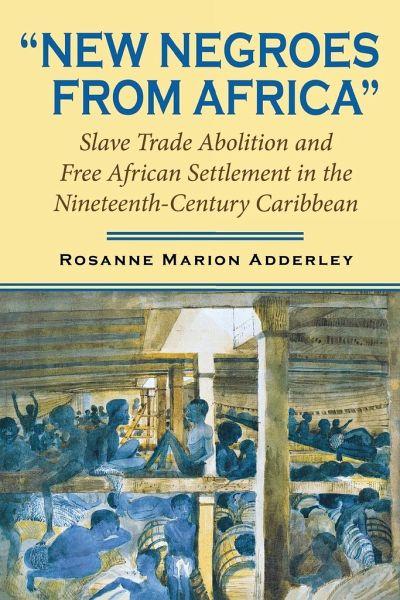
Rosanne Marion Adderley
"New Negroes from Africa"
Slave Trade Abolition and Free African Settlement in the Nineteenth-Century Caribbean
Rosanne Marion Adderley
"New Negroes from Africa"
Slave Trade Abolition and Free African Settlement in the Nineteenth-Century Caribbean
- Broschiertes Buch
- Merkliste
- Auf die Merkliste
- Bewerten Bewerten
- Teilen
- Produkt teilen
- Produkterinnerung
- Produkterinnerung
Rosanne Marion Adderley is Associate Professor of History at Tulane University in New Orleans.
Produktdetails
- Produktdetails
- Indiana University Press (IPS)
- Verlag: Indiana University Press
- Seitenzahl: 360
- Erscheinungstermin: 1. Oktober 2006
- Englisch
- Abmessung: 234mm x 156mm x 19mm
- Gewicht: 547g
- ISBN-13: 9780253218278
- ISBN-10: 0253218276
- Artikelnr.: 21652706
- Herstellerkennzeichnung
- Libri GmbH
- Europaallee 1
- 36244 Bad Hersfeld
- gpsr@libri.de
- Indiana University Press (IPS)
- Verlag: Indiana University Press
- Seitenzahl: 360
- Erscheinungstermin: 1. Oktober 2006
- Englisch
- Abmessung: 234mm x 156mm x 19mm
- Gewicht: 547g
- ISBN-13: 9780253218278
- ISBN-10: 0253218276
- Artikelnr.: 21652706
- Herstellerkennzeichnung
- Libri GmbH
- Europaallee 1
- 36244 Bad Hersfeld
- gpsr@libri.de
Rosanne Marion Adderley is Associate Professor of History at Tulane University in New Orleans.
Acknowledgments
Introduction
1. Potential Laborers or "Troublesome Savages"? Settlement of Liberated
Africans in the Bahamas
2. "Binding them to the trade of digging cane holes": Settlement of
Liberated Africans in Trinidad
3. "A fine family of what we call Creole Yarabas": African Ethnic
Identities in Liberated African Community Formation
4. "Assisted by his wife, an African": Gender, Family, and Household
Formation in the Experience of Liberated Africans
5. Orisha Worship and "Jesus Time": Religious Worlds of Liberated Africans
6. "Powers superior to those of other witches": New African Immigrants and
Supernatural Practice beyond Religious Spheres
7. "Deeply attached to his native country": Visions of Africa and
Mentalities of Exile in Liberated African Culture
Conclusion: African Creoles and Creole Africans
Appendix 1. Reports of Liberated African Arrivals in the Bahamas from
Governors' Correspondence
Appendix 2. Reports of Liberated African Arrivals in Trinidad from
Governors' Correspondence
Notes
Select Bibliography
Index
Introduction
1. Potential Laborers or "Troublesome Savages"? Settlement of Liberated
Africans in the Bahamas
2. "Binding them to the trade of digging cane holes": Settlement of
Liberated Africans in Trinidad
3. "A fine family of what we call Creole Yarabas": African Ethnic
Identities in Liberated African Community Formation
4. "Assisted by his wife, an African": Gender, Family, and Household
Formation in the Experience of Liberated Africans
5. Orisha Worship and "Jesus Time": Religious Worlds of Liberated Africans
6. "Powers superior to those of other witches": New African Immigrants and
Supernatural Practice beyond Religious Spheres
7. "Deeply attached to his native country": Visions of Africa and
Mentalities of Exile in Liberated African Culture
Conclusion: African Creoles and Creole Africans
Appendix 1. Reports of Liberated African Arrivals in the Bahamas from
Governors' Correspondence
Appendix 2. Reports of Liberated African Arrivals in Trinidad from
Governors' Correspondence
Notes
Select Bibliography
Index
Acknowledgments
Introduction
1. Potential Laborers or "Troublesome Savages"? Settlement of Liberated
Africans in the Bahamas
2. "Binding them to the trade of digging cane holes": Settlement of
Liberated Africans in Trinidad
3. "A fine family of what we call Creole Yarabas": African Ethnic
Identities in Liberated African Community Formation
4. "Assisted by his wife, an African": Gender, Family, and Household
Formation in the Experience of Liberated Africans
5. Orisha Worship and "Jesus Time": Religious Worlds of Liberated Africans
6. "Powers superior to those of other witches": New African Immigrants and
Supernatural Practice beyond Religious Spheres
7. "Deeply attached to his native country": Visions of Africa and
Mentalities of Exile in Liberated African Culture
Conclusion: African Creoles and Creole Africans
Appendix 1. Reports of Liberated African Arrivals in the Bahamas from
Governors' Correspondence
Appendix 2. Reports of Liberated African Arrivals in Trinidad from
Governors' Correspondence
Notes
Select Bibliography
Index
Introduction
1. Potential Laborers or "Troublesome Savages"? Settlement of Liberated
Africans in the Bahamas
2. "Binding them to the trade of digging cane holes": Settlement of
Liberated Africans in Trinidad
3. "A fine family of what we call Creole Yarabas": African Ethnic
Identities in Liberated African Community Formation
4. "Assisted by his wife, an African": Gender, Family, and Household
Formation in the Experience of Liberated Africans
5. Orisha Worship and "Jesus Time": Religious Worlds of Liberated Africans
6. "Powers superior to those of other witches": New African Immigrants and
Supernatural Practice beyond Religious Spheres
7. "Deeply attached to his native country": Visions of Africa and
Mentalities of Exile in Liberated African Culture
Conclusion: African Creoles and Creole Africans
Appendix 1. Reports of Liberated African Arrivals in the Bahamas from
Governors' Correspondence
Appendix 2. Reports of Liberated African Arrivals in Trinidad from
Governors' Correspondence
Notes
Select Bibliography
Index