
Andere Kunden interessierten sich auch für
 Elliptic-Hyperbolic Partial Differential Equations38,99 €
 Scalar models for water-waves problem: application to breaking wave40,99 €
 Bifurcation without Parameters27,99 €
 Contributions to Nonlinear Elliptic Equations and Systems76,99 €
 From Ordinary to Partial Differential Equations61,99 €
 Numerical Analysis and Optimization77,99 €
 Mathematical Analysis I57,99 €

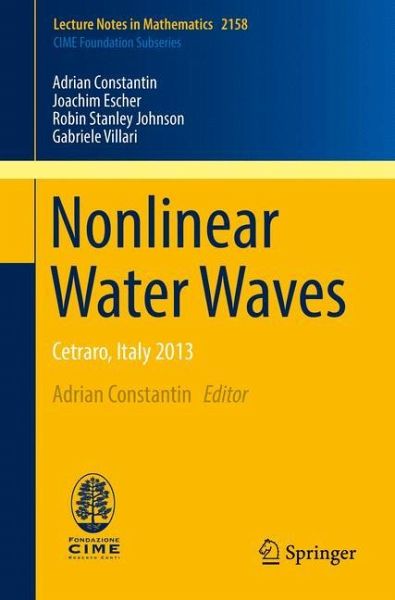
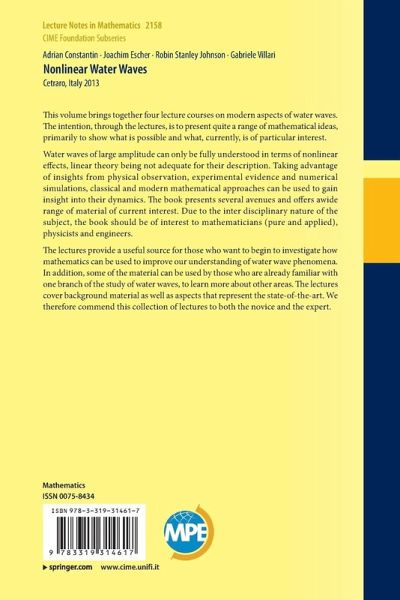
This volumebrings together four lecture courses on modern aspects of water waves. Theintention, through the lectures, is to present quite a range of mathematicalideas, primarily to show what is possible and what, currently, is of particularinterest.
Water wavesof large amplitude can only be fully understood in terms of nonlinear effects,linear theory being not adequate for their description. Taking advantage ofinsights from physical observation, experimental evidence and numericalsimulations, classical and modern mathematical approaches can be used to gaininsight into their dynamics. The book presents several avenues and offers awide range of material of current interest.
Thelectures provide a useful source for those who want to begin to investigate howmathematics can be used to improve our understanding of water wave phenomena.In addition, some of the material can be used by those who are already familiarwith one branch of the study of waterwaves, to learn more about other areas.
Water wavesof large amplitude can only be fully understood in terms of nonlinear effects,linear theory being not adequate for their description. Taking advantage ofinsights from physical observation, experimental evidence and numericalsimulations, classical and modern mathematical approaches can be used to gaininsight into their dynamics. The book presents several avenues and offers awide range of material of current interest.
Thelectures provide a useful source for those who want to begin to investigate howmathematics can be used to improve our understanding of water wave phenomena.In addition, some of the material can be used by those who are already familiarwith one branch of the study of waterwaves, to learn more about other areas.