
Andere Kunden interessierten sich auch für
 Optimal Space Flight Navigation76,99 €
 Mathematical Systems Theory II65,99 €
 Principles of Dynamic Optimization130,99 €
 Principles of Dynamic Optimization130,99 €
 The Robust Maximum Principle98,99 €
 Turnpike Phenomenon for Markov Decision Processes38,99 €
 Parallel Processing Techniques for Simulation39,99 €
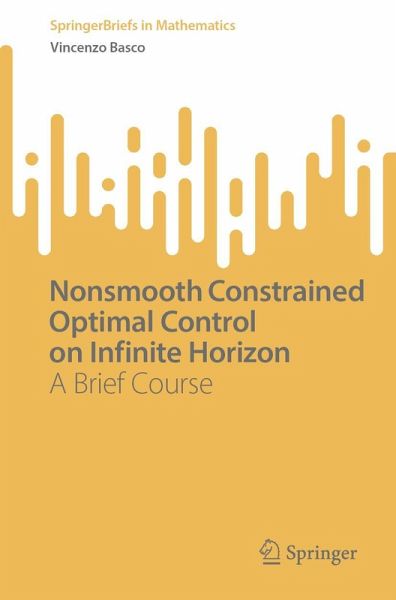
This book provides an introduction to nonsmooth constrained optimal control theory over infinite horizon, tackling the mathematical challenges that arise when classical finite-horizon methods prove inadequate. The work focuses on recent advances in handling nonsmooth time-dependent data and state constraints scenarios that commonly arise in fields such as engineering, machine learning, and artificial intelligence.
At its core, the book establishes foundational contributions, including viability results, extensions of Pontryagin's maximum principle to infinite horizons, regularity analysis of value functions, and necessary optimality conditions, with particular attention to transversality conditions and sensitivity relations. The analysis culminates in studying Hamilton-Jacobi-Bellman equations through weak solution notions suited to the nonsmooth framework.
Written as a brief course, the book aims to provide graduate students and researchers with the mathematical tools needed to analyze optimal control problems over infinite time horizons, where standard approaches may not apply.
At its core, the book establishes foundational contributions, including viability results, extensions of Pontryagin's maximum principle to infinite horizons, regularity analysis of value functions, and necessary optimality conditions, with particular attention to transversality conditions and sensitivity relations. The analysis culminates in studying Hamilton-Jacobi-Bellman equations through weak solution notions suited to the nonsmooth framework.
Written as a brief course, the book aims to provide graduate students and researchers with the mathematical tools needed to analyze optimal control problems over infinite time horizons, where standard approaches may not apply.