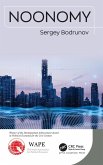
Noonomy explores the effect of modern technological shifts on human society. The author shows that technologies are about to undergo qualitative changes which will create new opportunities for personal development and the satisfaction of wants and, simultaneously, engender risks associated with growth opportunities of human interference with nature and technogenic stress on the environment. Based on the study of cutting-edge technologies and resulting socioeconomic shifts, Bodrunov makes the conclusion about the upcoming civilizational crisis. The crisis can be overcome through the formation…mehr
Noonomy explores the effect of modern technological shifts on human society. The author shows that technologies are about to undergo qualitative changes which will create new opportunities for personal development and the satisfaction of wants and, simultaneously, engender risks associated with growth opportunities of human interference with nature and technogenic stress on the environment. Based on the study of cutting-edge technologies and resulting socioeconomic shifts, Bodrunov makes the conclusion about the upcoming civilizational crisis. The crisis can be overcome through the formation of a new industrial society of the second generation reliant on knowledge-intensive material production and gradual removal of humans from immediate material production processes. These two trends can fully develop only subject to the transition from the current socioeconomic formation to a non-economic one-the noonomy.
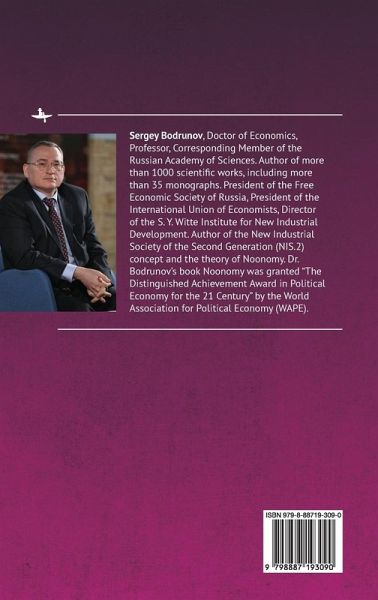
Sergey Bodrunov, Dr. of Economics, Professor, has authored more than 650 scholarly publications, including 30 monographs. He delivered lectures at the University of Cambridge (UK), Plekhanov Russian University of Economics, St. Petersburg State University of Economics, and other Russian universities. Dr. Bodrunov is an Expert of the Russian Academy of Sciences, Academician of the Russian Academy of Engineering, President of the Free Economic Society of Russia, Director of S.Y. Witte Institute for New Industrial Development (St. Petersburg), Honorary Doctor of the Ural State University of Economics, and Honorary Doctor of Plekhanov Russian University of Economics.
Inhaltsangabe
Foreword to the English Edition Scientific Editor's Foreword Introduction PART 1: METHODOLOGY 1. The Role of Material Production 2. Interaction Between Knowledge, Technologies, and Wants PART 2: NOOPRODUCTION: RUN-UP 3. New Industrial Society and Post-Industrialist Chimeras: Lessons from the Recent Past 4. Technological Prerequisites for Transitioning to a New Stage of Industrial Production PART 3: NOOPRODUCTION: NEW TECHNOLOGIES AS A CHALLENGE TO THE HUMANITY AND SOCIETY 5. Global Choice of the New Technological Revolution: Techno or Bio 6. Evolution of the Technosphere: Opportunities and Risks 7. Nooproduction: Technological Changes and Social Structure 8. Nooproduction: New Human Subject, New Wants and New Ways of Need Satisfaction PART 4: TOWARDS NOONOMY. 9. Economy: From Zoo to Noo 10. Noonomy: Cultural Imperatives and the End of Economic Civilization Conclusion: Crystal Clear Marx Index
Es gelten unsere Allgemeinen Geschäftsbedingungen: www.buecher.de/agb
Impressum
www.buecher.de ist ein Internetauftritt der buecher.de internetstores GmbH
Geschäftsführung: Monica Sawhney | Roland Kölbl | Günter Hilger
Sitz der Gesellschaft: Batheyer Straße 115 - 117, 58099 Hagen
Postanschrift: Bürgermeister-Wegele-Str. 12, 86167 Augsburg
Amtsgericht Hagen HRB 13257
Steuernummer: 321/5800/1497
USt-IdNr: DE450055826