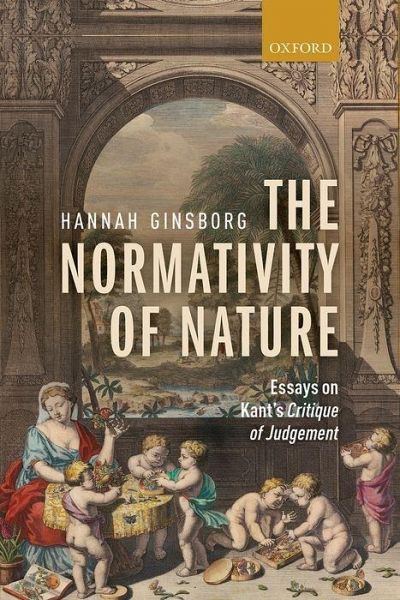
Most philosophers have taken the importance of Kant's Critique of Judgement to lie primarily in its contributions to aesthetics and to the philosophy of biology. Hannah Ginsborg, however, sees the Critique of Judgement as representing a central contribution to the understanding of human cognition more generally. The fourteen essays collected here advance a common interpretive project: that of bringing out the philosophical significance of the notion of judgement which figures in the third Critique and showing its importance both to Kant's own theoretical philosophy and to contemporary views of…mehr
Most philosophers have taken the importance of Kant's Critique of Judgement to lie primarily in its contributions to aesthetics and to the philosophy of biology. Hannah Ginsborg, however, sees the Critique of Judgement as representing a central contribution to the understanding of human cognition more generally. The fourteen essays collected here advance a common interpretive project: that of bringing out the philosophical significance of the notion of judgement which figures in the third Critique and showing its importance both to Kant's own theoretical philosophy and to contemporary views of human thought and cognition. To possess the capacity of judgment, on the interpretation presented here, is to respond to the world in a way which involves the recognition of one's responses as normatively appropriate to the objects which cause them. It is through this capacity that we are able not merely to respond discriminatively to objects, as animals do, but to bring them under concepts and so to make claims about them which can be true or false. The Critique of Judgement, on this reading, rejects the traditional dichotomy between the natural and the normative, taking nature itself -- both human nature and nature outside us -- to be comprehensible only in normative terms. The essays in this book develop this reading in its own right, and draw on it to address interpretive debates in Kant's aesthetics, theory of knowledge, and philosophy of biology. They also bring out its relevance to contemporary debates about concept-acquisition, the content of perception, and skepticism about rule-following and meaning.
Hannah Ginsborg is Professor of Philosophy at the University of California, Berkeley. She received a B.A. in Philosophy and Modern Languages from the University of Oxford, and a Ph.D. in Philosophy from Harvard University. Her publications include articles on Kant's theory of knowledge, aesthetics, and philosophy of biology, as well as on contemporary issues such as rule-following, the normativity of meaning, the content of perception, and the relation between perception and belief.
Inhaltsangabe
* Introduction * I. Aesthetics * 1: Kant on the Subjectivity of Taste * 2: On the Key to Kant's Critique of Taste * 3: Lawfulness without a Law: Kant on the Free Play of Imagination and Understanding * 4: Aesthetic Judging and the Intentionality of Pleasure * 5: The Pleasure of Judgment: Kant and the Possibility of Taste * II. Cognition * 6: Reflective Judgment and Taste * 7: Thinking the Particular as Contained under the Universal * 8: Aesthetic Judgment and Perceptual Normativity * 9: The Appearance of Spontaneity: Kant on Judgment and Empirical Self-Knowledge * III. Teleology * 10: Kant on Aesthetic and Biological Purposiveness * 11: Kant on Understanding Organisms as Natural Purposes * 12: Two Kinds of Mechanical Inexplicability in Kant and Aristotle * 13: Kant's Biological Teleology and its Philosophical Significance * 14: Oughts without Intentions: A Kantian Approach to Biological Functions * Bibliography * Index
* Introduction * I. Aesthetics * 1: Kant on the Subjectivity of Taste * 2: On the Key to Kant's Critique of Taste * 3: Lawfulness without a Law: Kant on the Free Play of Imagination and Understanding * 4: Aesthetic Judging and the Intentionality of Pleasure * 5: The Pleasure of Judgment: Kant and the Possibility of Taste * II. Cognition * 6: Reflective Judgment and Taste * 7: Thinking the Particular as Contained under the Universal * 8: Aesthetic Judgment and Perceptual Normativity * 9: The Appearance of Spontaneity: Kant on Judgment and Empirical Self-Knowledge * III. Teleology * 10: Kant on Aesthetic and Biological Purposiveness * 11: Kant on Understanding Organisms as Natural Purposes * 12: Two Kinds of Mechanical Inexplicability in Kant and Aristotle * 13: Kant's Biological Teleology and its Philosophical Significance * 14: Oughts without Intentions: A Kantian Approach to Biological Functions * Bibliography * Index
Es gelten unsere Allgemeinen Geschäftsbedingungen: www.buecher.de/agb
Impressum
www.buecher.de ist ein Internetauftritt der buecher.de internetstores GmbH
Geschäftsführung: Monica Sawhney | Roland Kölbl | Günter Hilger
Sitz der Gesellschaft: Batheyer Straße 115 - 117, 58099 Hagen
Postanschrift: Bürgermeister-Wegele-Str. 12, 86167 Augsburg
Amtsgericht Hagen HRB 13257
Steuernummer: 321/5800/1497
USt-IdNr: DE450055826