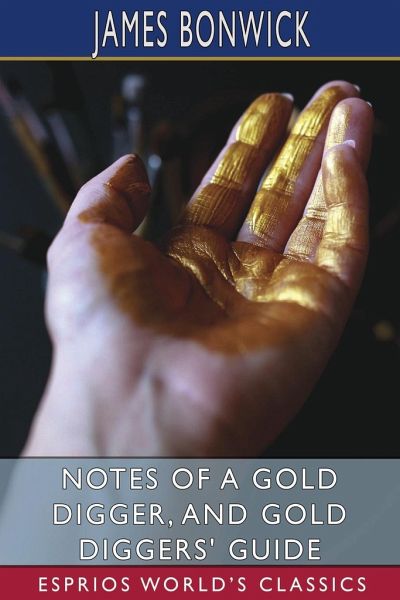
James Bonwick (8 July 1817 - 6 February 1906) was an English-born Australian historical and educational writer. Bonwick was born Lingfield, Surrey, England, the eldest son of James Bonwick, carpenter, and his second wife Mary Ann née Preston. James Bonwick, the elder, was a man of some mechanical ability, but he suffered from ill health, and his children were brought up in poor circumstances. His eldest son was educated at the Borough Road school, Southwark, and at 17 years of age began teaching at a school at Hemel Hempstead and similar positions followed at Bexley and Liverpool. In April…mehr
James Bonwick (8 July 1817 - 6 February 1906) was an English-born Australian historical and educational writer. Bonwick was born Lingfield, Surrey, England, the eldest son of James Bonwick, carpenter, and his second wife Mary Ann née Preston. James Bonwick, the elder, was a man of some mechanical ability, but he suffered from ill health, and his children were brought up in poor circumstances. His eldest son was educated at the Borough Road school, Southwark, and at 17 years of age began teaching at a school at Hemel Hempstead and similar positions followed at Bexley and Liverpool. In April 1840 he married Esther Ann Beddow, the daughter of a Baptist clergyman, and in the following year obtained a position at the Normal School, Hobart, Tasmania.
James Bonwick (1817-1906) was an English teacher, historian, and prolific writer renowned for his works on Australian history and the conditions of the indigenous populations. He emigrated to Australia in 1841 and became deeply involved in educational and historical projects, dedicating much of his life to writing and documenting. A prominent early work, 'Notes of a Gold Digger, and Gold Diggers' Guide' (1852), encapsulates the zeitgeist of the Australian gold rush era, offering not only practical advice for prospectors but also a valuable snapshot of the societal impacts of the gold rush. This work exemplifies Bonwick's keen observational skills and his talent for conveying the intricacies of frontier life. Bonwick's literary style often merged factual reporting with a narrative flair, reflecting his educational background and his drive to make history accessible to the public. His extensive bibliography includes titles focused on Australian aborigines, colonial history, and environmental observations, positioning him as a significant figure in the annals of Australian historiography. His contribution to the preservation of cultural and historical knowledge remains appreciated by scholars and history enthusiasts alike.
Es gelten unsere Allgemeinen Geschäftsbedingungen: www.buecher.de/agb
Impressum
www.buecher.de ist ein Internetauftritt der buecher.de internetstores GmbH
Geschäftsführung: Monica Sawhney | Roland Kölbl | Günter Hilger
Sitz der Gesellschaft: Batheyer Straße 115 - 117, 58099 Hagen
Postanschrift: Bürgermeister-Wegele-Str. 12, 86167 Augsburg
Amtsgericht Hagen HRB 13257
Steuernummer: 321/5800/1497
USt-IdNr: DE450055826