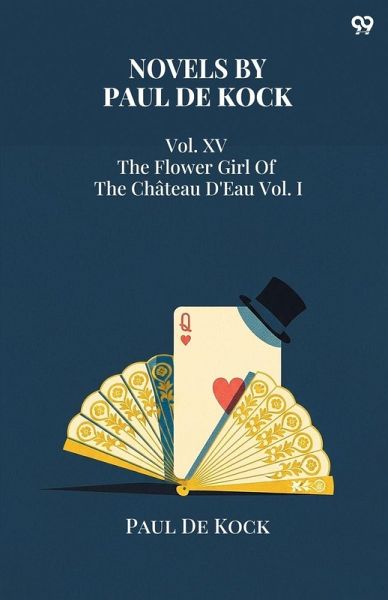
Novels of Paul De Kock Vol. XV: The flower girl of the Ch teau D'Eau Vol. I draws attention to the fragile intersections between beauty, poverty, and dignity in a city that offers little certainty to those who labor at its margins. The narrative begins in a market alive with noise and color, yet beneath its vibrancy lies an awareness of imbalance between the sellers and the buyers, between affection and transaction. The protagonist, seen among flowers and casual glances, represents more than romantic interest; she embodies the persistence of grace amid conditions of social invisibility.…mehr
Novels of Paul De Kock Vol. XV: The flower girl of the Ch teau D'Eau Vol. I draws attention to the fragile intersections between beauty, poverty, and dignity in a city that offers little certainty to those who labor at its margins. The narrative begins in a market alive with noise and color, yet beneath its vibrancy lies an awareness of imbalance between the sellers and the buyers, between affection and transaction. The protagonist, seen among flowers and casual glances, represents more than romantic interest; she embodies the persistence of grace amid conditions of social invisibility. Domestic scenes unfold with warmth and mischief, yet even here, the conversations betray a consciousness of status and expectation. As the story moves through scenes of everyday life, it invites reflection on how moments of laughter or charm often obscure deeper realities. The emotional core rests not in transformation but in endurance, in how the overlooked may carry quiet histories of abandonment and strength, suggesting that survival can itself be a form of defiant beauty.
Charles Paul De Kock was born on May 21, 1793, in Passy, Paris, to Jean Conrad de Kock. He became widely known in 19th-century France as a novelist whose works reached an unusually broad audience, owing to their accessible style and frequent use of humor, satire, and everyday life. Though his stories gained immense popularity and commercial success, especially among the lower and middle classes, they were often dismissed by critics for their perceived vulgarity and lack of refinement. De Kock focused on portraying the habits, desires, and follies of ordinary Parisians, often drawing from the familiar streets and neighborhoods that shaped his experiences. His books provided a comic and exaggerated reflection of urban life, filled with eccentric characters and situational mishaps. Beyond literature, he contributed to the cultural texture of the era by blending entertainment with social observations. He had children including Henry de Kock and Luis Casadesus, and among his grandchildren were Henri and Francis Casadesus. Charles Paul de Kock died in Paris on August 29, 1871, at the age of 78.
Es gelten unsere Allgemeinen Geschäftsbedingungen: www.buecher.de/agb
Impressum
www.buecher.de ist ein Internetauftritt der buecher.de internetstores GmbH
Geschäftsführung: Monica Sawhney | Roland Kölbl | Günter Hilger
Sitz der Gesellschaft: Batheyer Straße 115 - 117, 58099 Hagen
Postanschrift: Bürgermeister-Wegele-Str. 12, 86167 Augsburg
Amtsgericht Hagen HRB 13257
Steuernummer: 321/5800/1497
USt-IdNr: DE450055826