
Andere Kunden interessierten sich auch für
 Detect and Deter: Can Countries Verify the Nuclear Test Ban?76,99 €
 Obama and the Bomb53,50 €
 The Iran Threat20,99 €
 The Psychology of Nuclear Proliferation118,99 €
 The Psychology of Nuclear Proliferation42,99 €
 Die Politik der latenten Proliferation54,99 €
 The Nuclear Taboo122,99 €







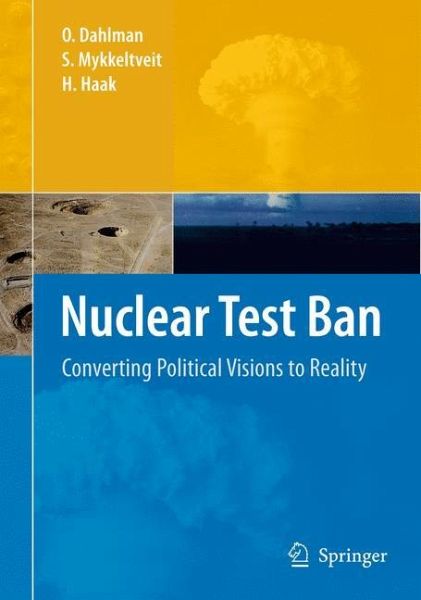
This unique book gives a broad presentation in laymen's language of the creation and the implementation of the treaty prohibiting nuclear test explosions - CTBT - one of the key guardians against nuclear proliferation.
Nuclear tests have caused public concern ever since the first such test was conducted, more than six decades ago. During the Cold War, however, con- tions were not conducive to discussing a complete ban on nuclear testing. It was not until 1993 that negotiations on such a treaty finally got under way. From then on, things moved relatively quickly: in 1996, the United Nations General Assembly adopted the Comprehensive Nuclear-Test-Ban Treaty (CTBT). To date, the Treaty has been signed by 178 states and ratified by 144, though it has yet to enter into force, as nine out of 44 ''Annex 2 states'', whose ratification is mandatory, have not heeded the call. Nevertheless, the CTBT verification system is already provisionally operational and has proven its effectiveness. We commend the CTBT organisation in Vienna for its successful efforts to build a verification network. This book is an excellent overview of the evolution of the CTBT and its verification regime. The authors are eminent scholars from the Netherlands, Norway and Sweden who have been intimately involved with the CTBT and its verification agency, the CTBTO Preparatory Commission, from their inc- tion to the present day. They have written a thorough and engaging narrative of the long road that led to the CTBT. Their story will appeal to both the layman and the expert and provide useful lessons for future negotiations on disarmament issues.
Nuclear tests have caused public concern ever since the first such test was conducted, more than six decades ago. During the Cold War, however, con- tions were not conducive to discussing a complete ban on nuclear testing. It was not until 1993 that negotiations on such a treaty finally got under way. From then on, things moved relatively quickly: in 1996, the United Nations General Assembly adopted the Comprehensive Nuclear-Test-Ban Treaty (CTBT). To date, the Treaty has been signed by 178 states and ratified by 144, though it has yet to enter into force, as nine out of 44 ''Annex 2 states'', whose ratification is mandatory, have not heeded the call. Nevertheless, the CTBT verification system is already provisionally operational and has proven its effectiveness. We commend the CTBT organisation in Vienna for its successful efforts to build a verification network. This book is an excellent overview of the evolution of the CTBT and its verification regime. The authors are eminent scholars from the Netherlands, Norway and Sweden who have been intimately involved with the CTBT and its verification agency, the CTBTO Preparatory Commission, from their inc- tion to the present day. They have written a thorough and engaging narrative of the long road that led to the CTBT. Their story will appeal to both the layman and the expert and provide useful lessons for future negotiations on disarmament issues.
From the reviews: "Drawing from their experience, the authors provide a well-structured and comprehensive view of the CTBT, from the construction of nuclear devices to the promising first results of the monitoring system of the treaty. In an impeccable edition, the chapters are clearly divided into subsections, and numerous illustrations are used to clarify the arguments in the text." G. Suarez, EOS Newsletter, Vol. 91, No. 21, p. 193 "The book focuses on the Comprehensive Nuclear Test Ban Treaty and the CTBT Organization (CTBTO) that runs the International Monitoring System (IMS) and the International Data Centre (IDC). The authors are experienced researchers with outstanding experience in seismic monitoring and who have helped to create what is now CTBTO. ... seems very important to scientists dealing with seismic- or hydroacoustic, infrasound and radionuclide monitoring ... ." (Pawel Wiejacz, Pure and Applied Geophysics, Vol. 167, 2010)