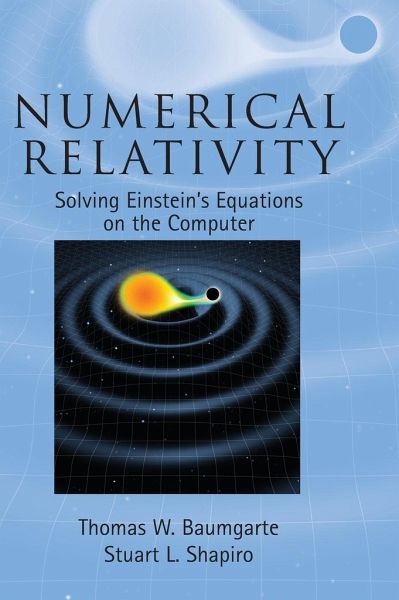
Aimed at students and researchers entering the field, this pedagogical introduction to numerical relativity will also interest scientists seeking a broad survey of its challenges and achievements. The book contains 300 exercises, numerous illustrations (many in color), summary boxes, and applications to help readers master the subject.
Thomas W. Baumgarte is a Professor of Physics at Bowdoin College, and an Adjunct Professor of Physics at the University of Illinois at Urbana-Champaign. He received his Diploma (1993) and Doctorate (1995) from Ludwig-Maximilians-Universität, München, and held postdoctoral positions at Cornell University and the University of Illinois before joining the faculty at Bowdoin College. He is a recipient of a John Simon Guggenheim Memorial Foundation Fellowship. He has written over 65 research articles on a variety of topics in general relativity and relativistic astrophysics, including black holes and neutron stars, gravitational collapse, and more formal mathematical issues.
Inhaltsangabe
Preface; Suggestions for using this book; 1. General relativity preliminaries; 2. The 3+1 decomposition of Einstein's equations; 3. Constructing initial data; 4. Choosing coordinates: the lapse and shift; 5. Matter sources; 6. Numerical methods; 7. Locating black hole horizons; 8. Spherically symmetric spacetimes; 9. Gravitational waves; 10. Collapse of collisionless clusters in axisymmetry; 11. Recasting the evolution equations; 12. Binary black hole initial data; 13. Binary black hole evolution; 14. Rotating stars; 15. Binary neutron star initial data; 16. Binary neutron star evolution; 17. Binary black hole-neutron stars: initial data and evolution; 18. Epilogue; Appendixes; References; Index.
Preface 1. Newton's and Einstein's gravity 2. Foliations of spacetime: constraint and evolution equations 3. Solving the constraint equations 4 Solving the evolution equations 5. Numerical simulations of black-hole binaries Epilogue Appendix A. A brief review of tensor properties Appendix B. A brief introduction to some numerical techniques Appendix C. A very brief introduction to matter sources Appendix D. A summary of important results Appendix E. Answers to selected problems References Index.
Preface; Suggestions for using this book; 1. General relativity preliminaries; 2. The 3+1 decomposition of Einstein's equations; 3. Constructing initial data; 4. Choosing coordinates: the lapse and shift; 5. Matter sources; 6. Numerical methods; 7. Locating black hole horizons; 8. Spherically symmetric spacetimes; 9. Gravitational waves; 10. Collapse of collisionless clusters in axisymmetry; 11. Recasting the evolution equations; 12. Binary black hole initial data; 13. Binary black hole evolution; 14. Rotating stars; 15. Binary neutron star initial data; 16. Binary neutron star evolution; 17. Binary black hole-neutron stars: initial data and evolution; 18. Epilogue; Appendixes; References; Index.
Preface 1. Newton's and Einstein's gravity 2. Foliations of spacetime: constraint and evolution equations 3. Solving the constraint equations 4 Solving the evolution equations 5. Numerical simulations of black-hole binaries Epilogue Appendix A. A brief review of tensor properties Appendix B. A brief introduction to some numerical techniques Appendix C. A very brief introduction to matter sources Appendix D. A summary of important results Appendix E. Answers to selected problems References Index.
Rezensionen
'Numerical relativity has come of age in the last few years, and Baumgarte and Shapiro have produced the first textbook on the subject. And what a book this is! Sufficiently complete to be an encyclopedia, yet accessible enough to be a genuine learning manual, the book is exceedingly well written. It covers virtually all aspects of numerical relativity, from formalism to the most modern application, and it is replete with beautiful and helpful diagrams. The book will serve as a useful reference to the researcher, and a source of enlightenment to many a student.' Eric Poisson, University of Guelph
Es gelten unsere Allgemeinen Geschäftsbedingungen: www.buecher.de/agb
Impressum
www.buecher.de ist ein Internetauftritt der buecher.de internetstores GmbH
Geschäftsführung: Monica Sawhney | Roland Kölbl | Günter Hilger
Sitz der Gesellschaft: Batheyer Straße 115 - 117, 58099 Hagen
Postanschrift: Bürgermeister-Wegele-Str. 12, 86167 Augsburg
Amtsgericht Hagen HRB 13257
Steuernummer: 321/5800/1497
USt-IdNr: DE450055826