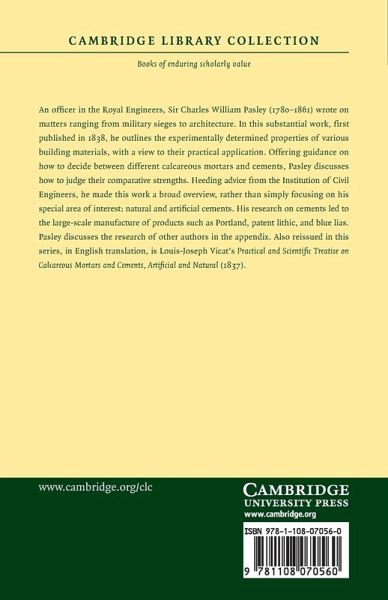
An officer in the Royal Engineers, Sir Charles William Pasley (1780-1861) wrote on matters ranging from military sieges to architecture. In this substantial work, first published in 1838, he outlines the experimentally determined properties of various building materials, with a view to their practical application. Offering guidance on how to decide between different calcareous mortars and cements, Pasley discusses how to judge their comparative strengths. Heeding advice from the Institution of Civil Engineers, he made this work a broad overview, rather than simply focusing on his special area…mehr
An officer in the Royal Engineers, Sir Charles William Pasley (1780-1861) wrote on matters ranging from military sieges to architecture. In this substantial work, first published in 1838, he outlines the experimentally determined properties of various building materials, with a view to their practical application. Offering guidance on how to decide between different calcareous mortars and cements, Pasley discusses how to judge their comparative strengths. Heeding advice from the Institution of Civil Engineers, he made this work a broad overview, rather than simply focusing on his special area of interest: natural and artificial cements. His research on cements led to the large-scale manufacture of products such as Portland, patent lithic, and blue lias. Pasley discusses the research of other authors in the appendix. Also reissued in this series, in English translation, is Louis-Joseph Vicat's Practical and Scientific Treatise on Calcareous Mortars and Cements, Artificial and Natural (1837).
Preface 1. Preliminary observations 2. Of the pure lime stones and their mortars 3. Of gypsum, alabaster or plaster stone 4. Of the water limes or hydraulic limes 5. Of concrete for foundations, etc. 6. Of grouting 7. Of magnesian limestones 8. Of the water cements of England 9. Experiments on artificial water cements, on a small scale 10. Experiments on artificial cement on a greater scale 11. The subject of concrete continued 12. Experiments on artificial cement tried at Chatham, in 1836 13. Experiments on the cohesiveness of various stones 14. Rules for judging of the quality of the cement supplied by a manufacturer 15. Rules for judging of the comparative cohesive strength of different sorts of cement 16. Experiments on artificial cement continued 17. The subject of concrete resumed, experiments on its resistance, when made into small artificial stones 18. Experiments on the comparative resistance of various natural stones, bricks and chalk 19. Experiments both with natural and artificial cement 20. Examples of the application of cement 21. General observations on fire-proof constructions 22. That cement, judiciously applied, may do away the necessity of timber chain bond and wooden lintels 23. Experiments on the comparative strength of natural and artificial cements continued 24. The subject of water limes continued 25. Of puzzolana 26. Of artificial puzzolana 27. Experiments on artificial puzzolana 28. Description of the common and puzzolana mortars used in the construction of the docks of Kingston upon Hull 29. Hasty experiments tried at Chatham 30. Of the comparative accuracy of measurement and of weight 31. Four modes of measuring lime 32. Experiments continued 33. Farther experiments on the strength of cement 34. Experiments on the resistance of two brick beams 35. Final resistance of Messrs Francis's experimental brick beam 36. Downfall of Mr Brunel's semi-arches 37. Experiments on the strength of hoop iron 38. Experiments chiefly on the comparative resistance of Yorkshire stone and other building materials 39. Final remarks upon the resistance of cement joints 40. Of wharf walls with or without counterforts 41. Remarks on trass 42. Description of the methods adopted in undersetting the foundations of the new Custom-house at London 43. Precautions necessary for preventing settlements in the walls of buildings on concrete foundations 44. Further remarks on Messrs Francis's brick beam 45. One of the uses of cement not before mentioned 46. Rules for making an artificial cement 47. Of kilns for building cement 48. Rules for making an artificial cement, when only hard lime stone is to be procured Appendix.
Preface 1. Preliminary observations 2. Of the pure lime stones and their mortars 3. Of gypsum, alabaster or plaster stone 4. Of the water limes or hydraulic limes 5. Of concrete for foundations, etc. 6. Of grouting 7. Of magnesian limestones 8. Of the water cements of England 9. Experiments on artificial water cements, on a small scale 10. Experiments on artificial cement on a greater scale 11. The subject of concrete continued 12. Experiments on artificial cement tried at Chatham, in 1836 13. Experiments on the cohesiveness of various stones 14. Rules for judging of the quality of the cement supplied by a manufacturer 15. Rules for judging of the comparative cohesive strength of different sorts of cement 16. Experiments on artificial cement continued 17. The subject of concrete resumed, experiments on its resistance, when made into small artificial stones 18. Experiments on the comparative resistance of various natural stones, bricks and chalk 19. Experiments both with natural and artificial cement 20. Examples of the application of cement 21. General observations on fire-proof constructions 22. That cement, judiciously applied, may do away the necessity of timber chain bond and wooden lintels 23. Experiments on the comparative strength of natural and artificial cements continued 24. The subject of water limes continued 25. Of puzzolana 26. Of artificial puzzolana 27. Experiments on artificial puzzolana 28. Description of the common and puzzolana mortars used in the construction of the docks of Kingston upon Hull 29. Hasty experiments tried at Chatham 30. Of the comparative accuracy of measurement and of weight 31. Four modes of measuring lime 32. Experiments continued 33. Farther experiments on the strength of cement 34. Experiments on the resistance of two brick beams 35. Final resistance of Messrs Francis's experimental brick beam 36. Downfall of Mr Brunel's semi-arches 37. Experiments on the strength of hoop iron 38. Experiments chiefly on the comparative resistance of Yorkshire stone and other building materials 39. Final remarks upon the resistance of cement joints 40. Of wharf walls with or without counterforts 41. Remarks on trass 42. Description of the methods adopted in undersetting the foundations of the new Custom-house at London 43. Precautions necessary for preventing settlements in the walls of buildings on concrete foundations 44. Further remarks on Messrs Francis's brick beam 45. One of the uses of cement not before mentioned 46. Rules for making an artificial cement 47. Of kilns for building cement 48. Rules for making an artificial cement, when only hard lime stone is to be procured Appendix.
Es gelten unsere Allgemeinen Geschäftsbedingungen: www.buecher.de/agb
Impressum
www.buecher.de ist ein Internetauftritt der buecher.de internetstores GmbH
Geschäftsführung: Monica Sawhney | Roland Kölbl | Günter Hilger
Sitz der Gesellschaft: Batheyer Straße 115 - 117, 58099 Hagen
Postanschrift: Bürgermeister-Wegele-Str. 12, 86167 Augsburg
Amtsgericht Hagen HRB 13257
Steuernummer: 321/5800/1497
USt-IdNr: DE450055826