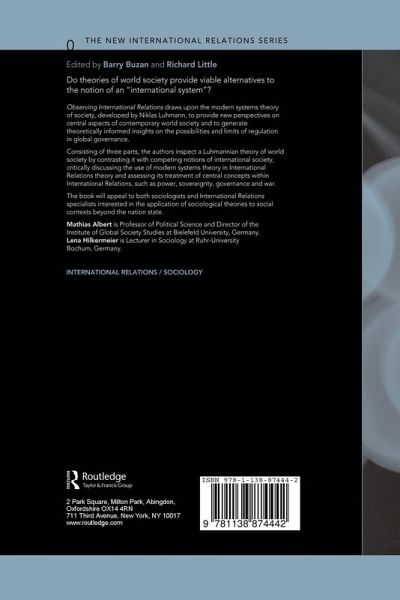
Observing International Relations draws upon the modern systems theory of society, as developed by Niklas Luhmann, to provide new perspectives on central aspects of contemporary world society.
Observing International Relations draws upon the modern systems theory of society, as developed by Niklas Luhmann, to provide new perspectives on central aspects of contemporary world society.
Mathias Albert is Professor of Political Science at the University of Bielefeld where he is also a Co-Director of the Institute for Global Society Studies. His research interests include theories of world society, issues of regionalization, law-formation beyond the state, and contemporary youth studies. Lena Hilkermeier is Assistant Professor at the Faculty of Social Sciences at Ruhr-University Bochum. Her research interests lie in the fields of organizational sociology, particularly in combination with theories of society, as well as in transnationalization studies.
Inhaltsangabe
1. Introduction Part 1: Luhmann and IR: A worthwhile encounter? 2. On the Modern Systems Theory of Society and IR: Contacts and disjunctures between different kinds of theorizing 3. Politics, Modern Systems Theory and the Critical Purpose of International Relations Theory 4. 'Corpus Mysticum': Niklas Luhmann's evocation of world society Part 2: Competing Notions of World Society and World Society as the 'Largest Social System Possible' 5. The 'English School' and World Society 6. Sociological Institutionalism and the Empirical Study of World Society 7. World Society from the Bottom Up 8. World Society, Systems Theory and the Classical Sociology of Modernity Part 3: Bringing Modern Systems Theory to the study of IR: Concepts and questions 9. Systems and Sovereignty: A systems theoretical look at the transformation of sovereignty 10. 'World Opinion' and the Turn to Post-sovereign International Governance 11. Society's War: The evolution of a self-referential military system 12. Organizations in/and World Society: A theoretical prolegomenon 13. Governance in a World Society: The perspective of systems theory 14. Constructivism and International Relations: An analysis of Luhmann's conceptualization of power15. Concluding Remarks
1. Introduction Part 1: Luhmann and IR: A worthwhile encounter? 2. On the Modern Systems Theory of Society and IR: Contacts and disjunctures between different kinds of theorizing 3. Politics, Modern Systems Theory and the Critical Purpose of International Relations Theory 4. 'Corpus Mysticum': Niklas Luhmann's evocation of world society Part 2: Competing Notions of World Society and World Society as the 'Largest Social System Possible' 5. The 'English School' and World Society 6. Sociological Institutionalism and the Empirical Study of World Society 7. World Society from the Bottom Up 8. World Society, Systems Theory and the Classical Sociology of Modernity Part 3: Bringing Modern Systems Theory to the study of IR: Concepts and questions 9. Systems and Sovereignty: A systems theoretical look at the transformation of sovereignty 10. 'World Opinion' and the Turn to Post-sovereign International Governance 11. Society's War: The evolution of a self-referential military system 12. Organizations in/and World Society: A theoretical prolegomenon 13. Governance in a World Society: The perspective of systems theory 14. Constructivism and International Relations: An analysis of Luhmann's conceptualization of power15. Concluding Remarks
Es gelten unsere Allgemeinen Geschäftsbedingungen: www.buecher.de/agb
Impressum
www.buecher.de ist ein Internetauftritt der buecher.de internetstores GmbH
Geschäftsführung: Monica Sawhney | Roland Kölbl | Günter Hilger
Sitz der Gesellschaft: Batheyer Straße 115 - 117, 58099 Hagen
Postanschrift: Bürgermeister-Wegele-Str. 12, 86167 Augsburg
Amtsgericht Hagen HRB 13257
Steuernummer: 321/5800/1497
USt-IdNr: DE450055826