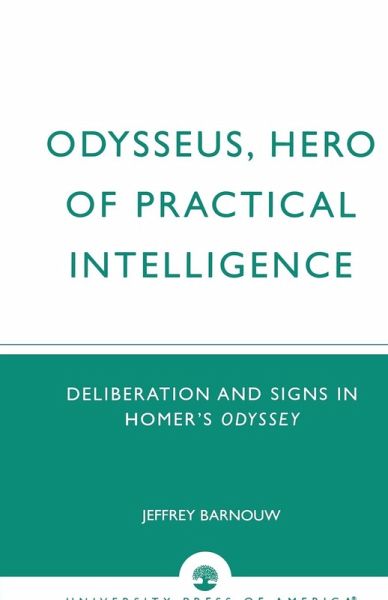

From the Stoics, there follows a psychological tradition leading, through Hobbes and Leibniz, to Peirce and Dewey. These thinkers are drawn on to show the significance of the conception of thinking first articulated in the Odyssey. Homer's work inaugurates an approach that has provoked philosophical conflict persisting into the present, and opposition to pragmatism and Pragmatism can be discerned in prominent critiques of Homer and his hero which are analyzed and countered in this study.
Chapter 1 Preface Chapter 2 Introduction Chapter 3 Part I: The Heart of Intelligence: Anticipating Consequences: In medias res: Two Critical Passages; Wily Yet Single-Minded; Recklessness vs. Consideration; Metis as Thinking Ahead and Then Back; Noos as Purpose in Odysseus and Zeus Chapter 4 Part II: The Contest of Philosophies: Plato and Chrysippus Claim Homer; Chrysippus's Conception of Human Motivation; Discourse and Division Within the Homeric Self; 'Mind'less Pragmatic Odysseus: Snell; German Pragmatisms: Leibniz and Kant; German P Chapter 5 Part III: Signs and Identity: Cognition and Recognition: Reconnaissance and Recognition; Homer's 'sema' and the Aristotelian and Stoic 'semeion'; More Shifts in the Foundation of Signs; Signs in Hobbes' 'Discursion' and 'Prudence'; The Scar as Sign: Chapter 6 Appendix: Writing and Oral Tradition Interact in Homer Chapter 7 Bibliography Chapter 8 Index of Names Chapter 9 Index of Concepts
Es gelten unsere Allgemeinen Geschäftsbedingungen: www.buecher.de/agb
Impressum
www.buecher.de ist ein Internetauftritt der buecher.de internetstores GmbH
Geschäftsführung: Monica Sawhney | Roland Kölbl | Günter Hilger
Sitz der Gesellschaft: Batheyer Straße 115 - 117, 58099 Hagen
Postanschrift: Bürgermeister-Wegele-Str. 12, 86167 Augsburg
Amtsgericht Hagen HRB 13257
Steuernummer: 321/5800/1497
USt-IdNr: DE450055826