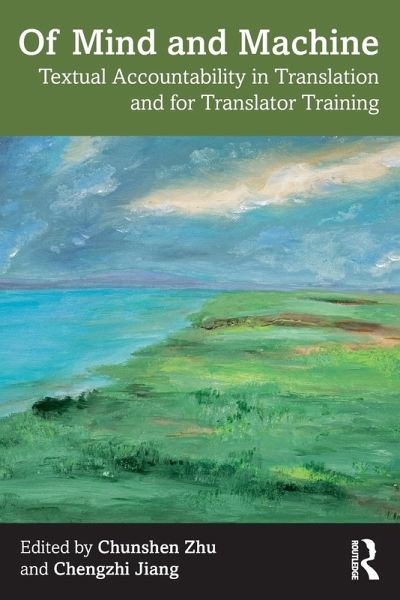
Of Mind and Machine provides a broad perspective on multi-level dialogic engagements between text and reader as seen from the use of language in presenting information to generate a discursive experience in various sociocultural settings.
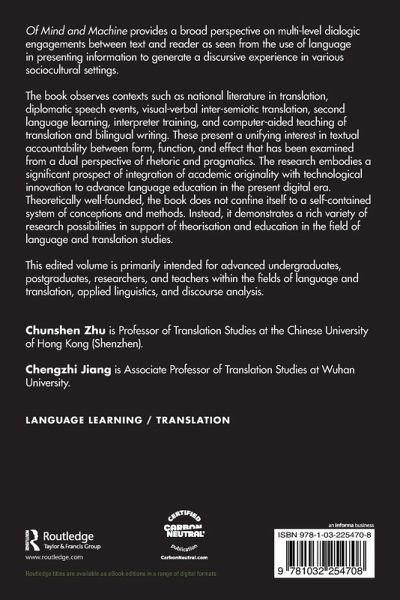
Of Mind and Machine provides a broad perspective on multi-level dialogic engagements between text and reader as seen from the use of language in presenting information to generate a discursive experience in various sociocultural settings.
Chunshen Zhu is Professor of Translation Studies at the Chinese University of Hong Kong (Shenzhen). Chengzhi Jiang is Associate Professor of Translation Studies at Wuhan University.
Inhaltsangabe
List of Figures and Tables List of Contributors Preface Acknowledgments PART I 1. Rhetoric as the antistrophos of pragmatics: Towards a 'Competition of Cooperation' in the study of language use 2. Translation criticism and the active presence of Chinese literature in the world 3. Dancing with ideology: Grammatical metaphor and identity presentation in translation 4. Bilingual and intersemiotic representation of distance(s) in Chinese landscape painting: From yi ('meaning') to yi ('freedom') 5. A study of yes/no questions in English and Chinese: With special reference to Chinese EFL learners' understanding of their forms and functions 6. The speech-act nature of interpreting and its implications for interpreter training PART II 7. ClinkNotes: Towards a corpus-based, machine-aided program of translation teaching 8. A corpus-based, machine-aided mode of translator training: ClinkNotes and beyond 9. Towards a textual accountability-driven mode of computer-aided translator training: Rationale, design, and development of an online teaching and self-learning platform 10. Making connections through knowledge nodes in translator training: On a computer-assisted pedagogical approach to literary translation Index
List of Figures and Tables List of Contributors Preface Acknowledgments PART I 1. Rhetoric as the antistrophos of pragmatics: Towards a 'Competition of Cooperation' in the study of language use 2. Translation criticism and the active presence of Chinese literature in the world 3. Dancing with ideology: Grammatical metaphor and identity presentation in translation 4. Bilingual and intersemiotic representation of distance(s) in Chinese landscape painting: From yi ('meaning') to yi ('freedom') 5. A study of yes/no questions in English and Chinese: With special reference to Chinese EFL learners' understanding of their forms and functions 6. The speech-act nature of interpreting and its implications for interpreter training PART II 7. ClinkNotes: Towards a corpus-based, machine-aided program of translation teaching 8. A corpus-based, machine-aided mode of translator training: ClinkNotes and beyond 9. Towards a textual accountability-driven mode of computer-aided translator training: Rationale, design, and development of an online teaching and self-learning platform 10. Making connections through knowledge nodes in translator training: On a computer-assisted pedagogical approach to literary translation Index
Es gelten unsere Allgemeinen Geschäftsbedingungen: www.buecher.de/agb
Impressum
www.buecher.de ist ein Internetauftritt der buecher.de internetstores GmbH
Geschäftsführung: Monica Sawhney | Roland Kölbl | Günter Hilger
Sitz der Gesellschaft: Batheyer Straße 115 - 117, 58099 Hagen
Postanschrift: Bürgermeister-Wegele-Str. 12, 86167 Augsburg
Amtsgericht Hagen HRB 13257
Steuernummer: 321/5800/1497
USt-IdNr: DE450055826