development and political response revealed is enormous, and provides ample practical examples of what might be done to bring about improvements for the increasing number of people who live in cities. Globalization, the shape of cities, the future of cities, the increasing gap between rich and poor inhabitants, and ethnic and racial segregation, are the key themes of this book. Taking examples from cities from Sao Paulo to Istanbul, from New York to Edinburgh, and adding their own ideas, the authors examine what might be done to improve things for all those who live in cities.
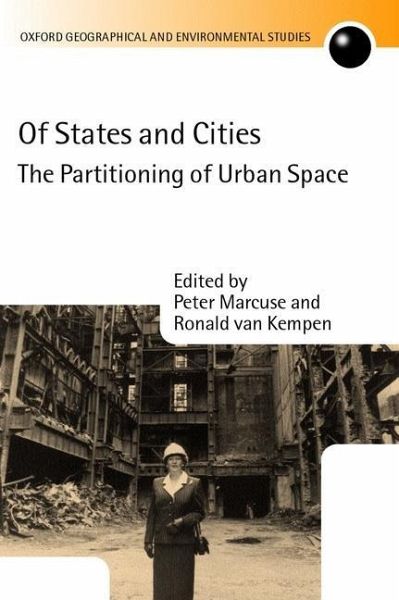
development and political response revealed is enormous, and provides ample practical examples of what might be done to bring about improvements for the increasing number of people who live in cities.Globalization, the shape of cities, the future of cities, the increasing gap between rich and poor inhabitants, and ethnic and racial segregation, are the key themes of this book. Taking examples from cities from Sao Paulo to Istanbul, from New York to Edinburgh, and adding their own ideas, the authors examine what might be done to improve things for all those who live in cities.
* 1: Peter Marcuse, Ronald van Kempen: States and Cities and the Partitioning of Urban Space: Introduction * 2: Peter Marcuse: The Divided City in History * 3: Ronald Van Kempen: The Academic Formulations: Explanations of the Partitioned City * 4: Peter Lee and Alan Murie: The Poor City: National and Local Perspectives on Changes in Residential Patterns in the British City * 5: Ronald van Kempen: Towards Partitioned Cities in the Netherlands? Changing Patterns of Segregation in a Highly Developed Welfare State * 6: Peter Marcuse: The Shifting Meaning of the Black Ghetto in the United States * 7: Sueli Ramos Schiffer: Economic Restructuring and Urban Segregation in Sao Paulo * 8: Janos Ladanyi: Residential Segregation among Social and Ethnic Groups in Budapest during the Post-communist Transition * 9: Grzegorz Weclawowicz: From Egalitarion Cities in Theory to Non-Egalitarian Cities in Practice: The Changing Social and Spatial Patterns in Polish Cities * 10: Murat Guvenc and Oguz Isik: A Metropolis at the Crossroads: The Changing Social Geography of Istanbul under the Impact of Globalization * 11: Loic Wacquant: The Rise of Advanced Marginality: Notes on its Nature and Implications * 12: Eva T. van Kempen: Poverty Pockets and Social Exclusion: On the Role of Place in Shaping Social Inequality * 13: Peter Marcuse, Ronald van Kempen: States and Cities and the Partitioning of Urban Space: Conclusions * Afterword on September 11 * Index
Es gelten unsere Allgemeinen Geschäftsbedingungen: www.buecher.de/agb
Impressum
www.buecher.de ist ein Internetauftritt der buecher.de internetstores GmbH
Geschäftsführung: Monica Sawhney | Roland Kölbl | Günter Hilger
Sitz der Gesellschaft: Batheyer Straße 115 - 117, 58099 Hagen
Postanschrift: Bürgermeister-Wegele-Str. 12, 86167 Augsburg
Amtsgericht Hagen HRB 13257
Steuernummer: 321/5800/1497
USt-IdNr: DE450055826