
Andere Kunden interessierten sich auch für
 Neighborhood Disorganization and Social Control38,99 €
 Serial Homicide38,99 €
 Labor Unions, Management Innovation and Organizational Change in Police Departments38,99 €
 Confidential Informants46,99 €
 Handbook of Life-Course Criminology113,99 €
 Memory Development from Early Childhood Through Emerging Adulthood76,99 €
 Memory Development from Early Childhood Through Emerging Adulthood76,99 €
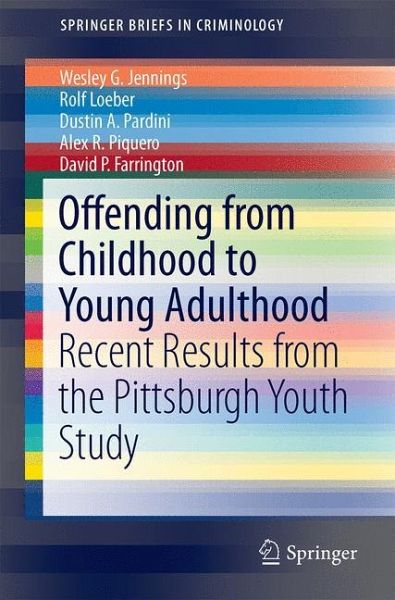
This Brief examines criminal careers by providing the most extensive and comprehensive investigation to date on the official offending, self-reported offending, and trajectories of offending of the Pittsburgh Youth Study (PYS) participants. The PYS is a longitudinal study, which was initiated in 1987, and involves repeated follow-ups on several community cohorts (starting in grades 1, 4, and 7) of inner-city boys in Pittsburgh, Pennsylvania. This Brief covers the Youngest and Oldest PYS cohorts (which had the most follow-up and most data available) from ages 10-30. It provides the most complete descriptive analyses of the criminal careers of these males to date.
The three cohorts are commonly referred to as the Youngest, Middle, and Oldest cohorts, respectively. Consistent with several prior publications with the PYS data (Loeber et al., 2008), this book focuses only on data from the Youngest and Oldest cohorts as these cohorts were followedup the most frequently and have the longest time window of data available.
It will be of interest to researchers in Criminology and Criminal Justice, as well as related fields like Sociology, Developmental Psychology, Social Policy, and Education.
The three cohorts are commonly referred to as the Youngest, Middle, and Oldest cohorts, respectively. Consistent with several prior publications with the PYS data (Loeber et al., 2008), this book focuses only on data from the Youngest and Oldest cohorts as these cohorts were followedup the most frequently and have the longest time window of data available.
It will be of interest to researchers in Criminology and Criminal Justice, as well as related fields like Sociology, Developmental Psychology, Social Policy, and Education.
"Offending from Childhood to Young Adulthood: Recent Research from the Pittsburgh Youth Study presents a major study of crime in Pittsburgh over several years ... . chapters are educational and important. ... This book would be most helpful to those concerned with data on crime. ... the massive data and the use of self-reports vs. official reports help us understand the course of crime over time (longitudinally) and thus makes a real contribution to understanding the complexity of criminal behavior." (Russell Eisenman, PsycCRITIQUES, Vol. 61 (44), October, 2016)
"Offending from Childhood to Young Adulthood provides a valuable account of the association between kids' offending and the duration. ... This book is significant, as authors combine multiple comparisons to give deep insights to age difference and offenses. It also an excellent work forresearchers, policy makers, criminology and sociology." (Yiyan Li, Canadian Graduate Journal of Sociology and Criminology, Vol.5 (1), 2016)
"Offending from Childhood to Young Adulthood provides a valuable account of the association between kids' offending and the duration. ... This book is significant, as authors combine multiple comparisons to give deep insights to age difference and offenses. It also an excellent work forresearchers, policy makers, criminology and sociology." (Yiyan Li, Canadian Graduate Journal of Sociology and Criminology, Vol.5 (1), 2016)