
Phil Barber
Official Vince Lombardi Playbook
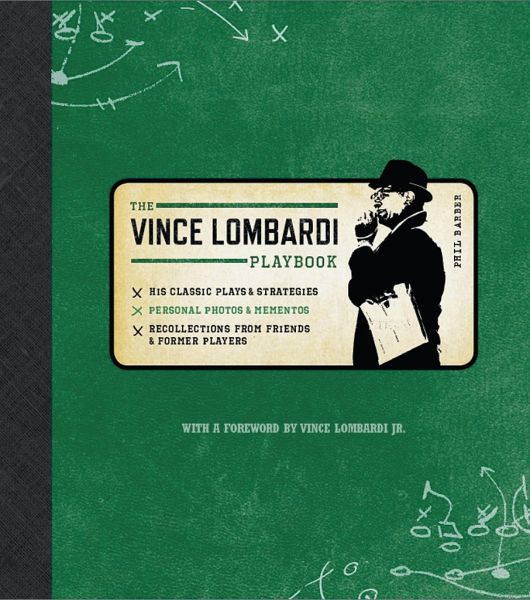
* His Classic Plays & Strategies * Personal Photos & Mementos * Recollections from Friends & Former Players
Phil Barber
Official Vince Lombardi Playbook
* His Classic Plays & Strategies * Personal Photos & Mementos * Recollections from Friends & Former Players
- Gebundenes Buch
- Merkliste
- Auf die Merkliste
- Bewerten Bewerten
- Teilen
- Produkt teilen
- Produkterinnerung
- Produkterinnerung
Vince Lombardi was notorious for his inability to throw anything away. What that means to fans of one of football’s greatest figures finally comes together in The Vince Lombardi Playbook—an unprecedented collection of intimate photos; colorful reflections from players who honed their skills under Lombardi; personal mementos; and an array of his handwritten speeches, personal letters, scouting reports, and photos of players. Above all, The Vince Lombardi Playbook highlights the plays that made the Packers great: the feared power sweep, the halfback option pass, the textbook traps, the risky…mehr
Andere Kunden interessierten sich auch für
 Mike TowleI Remember Vince Lombardi22,99 €
 Robert W CohenThe 50 Greatest Players in Green Bay Packers History27,99 €
 Steve GreenbergThe Diehard Football Fan's Bucket List Blitz17,99 €
 Jonathan Rand300 Pounds of Attitude18,99 €
 Kha BooksFootball Playbook13,99 €
") Bryce T. JohnsonThe Fantasy Football Fellowship Playbook (Revised 2021)21,99 €
Bryce T. JohnsonThe Fantasy Football Fellowship Playbook (Revised 2021)21,99 € Jordon ReplogleFLAG FOOTBALL 6v6 PLAYBOOK13,99 €
-
-
-

Vince Lombardi was notorious for his inability to throw anything away. What that means to fans of one of football’s greatest figures finally comes together in The Vince Lombardi Playbook—an unprecedented collection of intimate photos; colorful reflections from players who honed their skills under Lombardi; personal mementos; and an array of his handwritten speeches, personal letters, scouting reports, and photos of players. Above all, The Vince Lombardi Playbook highlights the plays that made the Packers great: the feared power sweep, the halfback option pass, the textbook traps, the risky third-and-short passes, and many others. Featured in diagrams in Lombardi’s original hand, with accompanying terminology and notations, these archival gems form an all-access pass onto the field and into the mind of a legend. Americans yearn for a more simple era, when athletes made news for their sporting accomplishments, not their arrests or congressional testimony. Most sports fans are equally nostalgic for the on-field simplicity of those days. Paying homage to a legend, The Vince Lombardi Playbook will be treasured by fans as an irresistible piece of history.
Produktdetails
- Produktdetails
- Verlag: Globe Pequot Publishing
- Seitenzahl: 160
- Erscheinungstermin: 1. September 2009
- Englisch
- Abmessung: 246mm x 212mm x 20mm
- Gewicht: 600g
- ISBN-13: 9781599215365
- ISBN-10: 1599215365
- Artikelnr.: 25917194
- Herstellerkennzeichnung
- Libri GmbH
- Europaallee 1
- 36244 Bad Hersfeld
- gpsr@libri.de
- Verlag: Globe Pequot Publishing
- Seitenzahl: 160
- Erscheinungstermin: 1. September 2009
- Englisch
- Abmessung: 246mm x 212mm x 20mm
- Gewicht: 600g
- ISBN-13: 9781599215365
- ISBN-10: 1599215365
- Artikelnr.: 25917194
- Herstellerkennzeichnung
- Libri GmbH
- Europaallee 1
- 36244 Bad Hersfeld
- gpsr@libri.de
Phil Barber has authored or coauthored twelve books, including We Were Champions: The 49ers’ Dynasty in Their Own Words. A journalist who has covered sports, especially professional football, for twenty years, he has been a longtime regular contributor to the Sporting News, consulting with coaches and scouts to expose the chalkboard strategy underlying the sport of football. Most recently a reporter for the Santa Rosa Press Democrat, he has approached the game from many angles. Barber previously spent seven years as a senior editor for NFL Publishing. After leaving that position he continued to write for NFL publications, as well as Sports Illustrated and the San Francisco Chronicle. He lives in Santa Rosa, California.
Introduction
Why Vince Lombardi remains not only relevant, but revered. What he meant to
the team, the region around Green Bay, the NFL and the game of football.
His philosophies of life, athletics, and motivation, and his approach to
the X’s and O’s of his sport.
Chapter 1 – Making of a Coach: Lombardi before Green Bay
Born in Brooklyn in 1913, Lombardi went on to become one of the renowned
“Seven Blocks of Granite” at Fordham. He learned execution and organization
from famed Army coach Red Blaik, the passing game from fellow West Point
assistant Sid Gillman, the power sweep from Fordham’s Frank Leahy and Jim
Crowley, and the requirements of the NFL from his five years as a New York
Giants assistant.
Chapter 2 – Swept Away: Lombardi’s running game
The enduring image of Lombardi’s Packers is guards Jerry Kramer and Fuzzy
Thurston leading a runner around the end, clearing out overmatched
defenders on one of Green Bay’s signature sweeps. The simplicity of
Lombardi’s running game was almost a return to the end runs of the old
Single-Wing offense, though he added traps and weakside counters to parry
the Giants’ defensive strategies.
Sample play: A classic counter run
Chapter 3 – Short-Short-Long: Lombardi’s passing game
Green Bay’s passing attack was generally cautious and patient. But when a
defense overcommitted to stopping the run, Lombardi would let Paul Hornung
throw a halfback option pass, or tell Bart Starr to throw deep on
third-and-inches.
Sample play: A three-receiver pattern for third-and-long situations
Chapter 4 – Green monster: Lombardi’s defense
While Lombardi is known primarily as an offensive coach, his defense sent
at least five players to the Hall of Fame – defensive end Willie Davis,
defensive tackle Henry Jordan, middle linebacker Ray Nitschke, cornerback
Herb Adderley and safety Willie Wood. The defensive side just as often
carried the day for the Packers.
Sample play: A blitz or a short-yardage stacked front
Chapter 5 – From Skoronski to Gregg: Lombardi’s linemen
Lombardi’s offensive linemen weren’t particularly huge – Hall of Famer
Forrest Gregg fluctuated between 230 and 250 pounds – or highly touted. But
under his tutelage they formed one of the league’s most impenetrable walls.
Lombardi’s blockers had to be quick and smart; he introduced the concept of
option blocking, in which a lineman lets his opponent make a move, then
uses the enemy’s momentum against him by driving him in that direction.
Sample play: The “Lombardi sweep” or blocking diagram
Chapter 6 – 350 Yards a Game: Lombardi’s backfield
Quarterback Bart Starr, fullback Jim Taylor and halfback Paul Hornung were
nobodies before Lombardi arrived. In his system they became all-time
greats. Starr was the perfect game manager, quick thinking and nearly
error-free. (He once threw 294 passes without an interception.) Lombardi’s
running backs learned the “run to daylight” philosophy, reading the blocks
up front and then making the appropriate cuts.
Sample play: A halfback option
Chapter 7 – Hired Hands: Lombardi’s receivers
The Green Bay receivers were never as celebrated as the backfield. But guys
like Max McGee, Boyd Dowler and Carroll Dale made timely contributions, and
Ron Kramer was one of the first tight ends to be targeted for receptions.
Lombardi expected all of them to work the middle of the field and exploit
one-on-one match-ups.
Sample play: A classic crossing route
Chapter 8 – Reaching the Pinnacle: The early championships
In 1961, his third season in Green Bay, Lombardi took the Packers all the
way to an NFL championship, capped with a 37–0 pasting of the Giants in the
title game. A year later, the Pack beat down New York again, 16–7 on the
road. And after finishing second in the Western Conference the next two
years, they reclaimed the title with a 23–12 victory over Cleveland in
1965.
Chapter 9 – Score Two for the Old Guard: The Super Bowls
Lombardi was under tremendous pressure to win the first AFL–NFL
Championship Game after the 1966 season (it wouldn’t be called the Super
Bowl until 1969), the first meaningful game between the two merging rival
leagues. His Packers delivered against the Kansas City Chiefs, just as they
would a year later against the Oakland Raiders — in Lombardi’s final game
as Green Bay coach.
Chapter 10 – Cold Comfort: The Ice Bowl
It may be the most famous game in NFL history. On a hard frozen field, with
a wind-chill factor of minus-49 degrees, the Packers and Dallas Cowboys
squared off for the right to play in Super Bowl II. Down 17–14 with sixteen
seconds left, Lombardi called a risky quarterback dive play, and Bart Starr
followed guard Jerry Kramer’s block to win it.
Sample play: The Wedge [see sample text]
Chapter 11 – The Buffer Zone: Lombardi’s assistant coaches
While Lombardi didn’t sprout an NFL “coaching tree” as impressive as Bill
Walsh’s or Paul Brown’s, he surrounded himself with capable and innovative
assistants – guys such as Bill Austin, Phil Bengtson, Jerry Burns, Tom
Fears and Norb Hecker. They carried out the Lombardi philosophy, and some
advanced to head coaching careers of their own.
Chapter 12 – The Chess Pieces: Lombardi’s players
The great coach had a love-hate relationship with his players. He needled
them, insulted them and sometimes berated them in his rough, intimidating
voice. They feared him as much as they respected him. But Lombardi could be
tender or funny, too. And there was no doubting his influence. Bart Starr,
Jim Taylor, Paul Hornung, Forrest Gregg, Ray Nitschke and Jerry Kramer,
among others, did almost nothing for the dreadful 1958 team before Lombardi
arrived.
Chapter 13 – Gone, but Not Forgotten: Lombardi’s legacy
After stepping down as Packers coach after the 1967 season, Lombardi got
itchy and took over the Washington Redskins in 1969. There he took another
downtrodden team to a winning record his first season, only to be claimed
by cancer the following season. Throughout the 1970s, though, before
changes in NFL rules ushered in an era of unfettered passing, Lombardi’s
play book remained the league standard.
Why Vince Lombardi remains not only relevant, but revered. What he meant to
the team, the region around Green Bay, the NFL and the game of football.
His philosophies of life, athletics, and motivation, and his approach to
the X’s and O’s of his sport.
Chapter 1 – Making of a Coach: Lombardi before Green Bay
Born in Brooklyn in 1913, Lombardi went on to become one of the renowned
“Seven Blocks of Granite” at Fordham. He learned execution and organization
from famed Army coach Red Blaik, the passing game from fellow West Point
assistant Sid Gillman, the power sweep from Fordham’s Frank Leahy and Jim
Crowley, and the requirements of the NFL from his five years as a New York
Giants assistant.
Chapter 2 – Swept Away: Lombardi’s running game
The enduring image of Lombardi’s Packers is guards Jerry Kramer and Fuzzy
Thurston leading a runner around the end, clearing out overmatched
defenders on one of Green Bay’s signature sweeps. The simplicity of
Lombardi’s running game was almost a return to the end runs of the old
Single-Wing offense, though he added traps and weakside counters to parry
the Giants’ defensive strategies.
Sample play: A classic counter run
Chapter 3 – Short-Short-Long: Lombardi’s passing game
Green Bay’s passing attack was generally cautious and patient. But when a
defense overcommitted to stopping the run, Lombardi would let Paul Hornung
throw a halfback option pass, or tell Bart Starr to throw deep on
third-and-inches.
Sample play: A three-receiver pattern for third-and-long situations
Chapter 4 – Green monster: Lombardi’s defense
While Lombardi is known primarily as an offensive coach, his defense sent
at least five players to the Hall of Fame – defensive end Willie Davis,
defensive tackle Henry Jordan, middle linebacker Ray Nitschke, cornerback
Herb Adderley and safety Willie Wood. The defensive side just as often
carried the day for the Packers.
Sample play: A blitz or a short-yardage stacked front
Chapter 5 – From Skoronski to Gregg: Lombardi’s linemen
Lombardi’s offensive linemen weren’t particularly huge – Hall of Famer
Forrest Gregg fluctuated between 230 and 250 pounds – or highly touted. But
under his tutelage they formed one of the league’s most impenetrable walls.
Lombardi’s blockers had to be quick and smart; he introduced the concept of
option blocking, in which a lineman lets his opponent make a move, then
uses the enemy’s momentum against him by driving him in that direction.
Sample play: The “Lombardi sweep” or blocking diagram
Chapter 6 – 350 Yards a Game: Lombardi’s backfield
Quarterback Bart Starr, fullback Jim Taylor and halfback Paul Hornung were
nobodies before Lombardi arrived. In his system they became all-time
greats. Starr was the perfect game manager, quick thinking and nearly
error-free. (He once threw 294 passes without an interception.) Lombardi’s
running backs learned the “run to daylight” philosophy, reading the blocks
up front and then making the appropriate cuts.
Sample play: A halfback option
Chapter 7 – Hired Hands: Lombardi’s receivers
The Green Bay receivers were never as celebrated as the backfield. But guys
like Max McGee, Boyd Dowler and Carroll Dale made timely contributions, and
Ron Kramer was one of the first tight ends to be targeted for receptions.
Lombardi expected all of them to work the middle of the field and exploit
one-on-one match-ups.
Sample play: A classic crossing route
Chapter 8 – Reaching the Pinnacle: The early championships
In 1961, his third season in Green Bay, Lombardi took the Packers all the
way to an NFL championship, capped with a 37–0 pasting of the Giants in the
title game. A year later, the Pack beat down New York again, 16–7 on the
road. And after finishing second in the Western Conference the next two
years, they reclaimed the title with a 23–12 victory over Cleveland in
1965.
Chapter 9 – Score Two for the Old Guard: The Super Bowls
Lombardi was under tremendous pressure to win the first AFL–NFL
Championship Game after the 1966 season (it wouldn’t be called the Super
Bowl until 1969), the first meaningful game between the two merging rival
leagues. His Packers delivered against the Kansas City Chiefs, just as they
would a year later against the Oakland Raiders — in Lombardi’s final game
as Green Bay coach.
Chapter 10 – Cold Comfort: The Ice Bowl
It may be the most famous game in NFL history. On a hard frozen field, with
a wind-chill factor of minus-49 degrees, the Packers and Dallas Cowboys
squared off for the right to play in Super Bowl II. Down 17–14 with sixteen
seconds left, Lombardi called a risky quarterback dive play, and Bart Starr
followed guard Jerry Kramer’s block to win it.
Sample play: The Wedge [see sample text]
Chapter 11 – The Buffer Zone: Lombardi’s assistant coaches
While Lombardi didn’t sprout an NFL “coaching tree” as impressive as Bill
Walsh’s or Paul Brown’s, he surrounded himself with capable and innovative
assistants – guys such as Bill Austin, Phil Bengtson, Jerry Burns, Tom
Fears and Norb Hecker. They carried out the Lombardi philosophy, and some
advanced to head coaching careers of their own.
Chapter 12 – The Chess Pieces: Lombardi’s players
The great coach had a love-hate relationship with his players. He needled
them, insulted them and sometimes berated them in his rough, intimidating
voice. They feared him as much as they respected him. But Lombardi could be
tender or funny, too. And there was no doubting his influence. Bart Starr,
Jim Taylor, Paul Hornung, Forrest Gregg, Ray Nitschke and Jerry Kramer,
among others, did almost nothing for the dreadful 1958 team before Lombardi
arrived.
Chapter 13 – Gone, but Not Forgotten: Lombardi’s legacy
After stepping down as Packers coach after the 1967 season, Lombardi got
itchy and took over the Washington Redskins in 1969. There he took another
downtrodden team to a winning record his first season, only to be claimed
by cancer the following season. Throughout the 1970s, though, before
changes in NFL rules ushered in an era of unfettered passing, Lombardi’s
play book remained the league standard.
Introduction
Why Vince Lombardi remains not only relevant, but revered. What he meant to
the team, the region around Green Bay, the NFL and the game of football.
His philosophies of life, athletics, and motivation, and his approach to
the X’s and O’s of his sport.
Chapter 1 – Making of a Coach: Lombardi before Green Bay
Born in Brooklyn in 1913, Lombardi went on to become one of the renowned
“Seven Blocks of Granite” at Fordham. He learned execution and organization
from famed Army coach Red Blaik, the passing game from fellow West Point
assistant Sid Gillman, the power sweep from Fordham’s Frank Leahy and Jim
Crowley, and the requirements of the NFL from his five years as a New York
Giants assistant.
Chapter 2 – Swept Away: Lombardi’s running game
The enduring image of Lombardi’s Packers is guards Jerry Kramer and Fuzzy
Thurston leading a runner around the end, clearing out overmatched
defenders on one of Green Bay’s signature sweeps. The simplicity of
Lombardi’s running game was almost a return to the end runs of the old
Single-Wing offense, though he added traps and weakside counters to parry
the Giants’ defensive strategies.
Sample play: A classic counter run
Chapter 3 – Short-Short-Long: Lombardi’s passing game
Green Bay’s passing attack was generally cautious and patient. But when a
defense overcommitted to stopping the run, Lombardi would let Paul Hornung
throw a halfback option pass, or tell Bart Starr to throw deep on
third-and-inches.
Sample play: A three-receiver pattern for third-and-long situations
Chapter 4 – Green monster: Lombardi’s defense
While Lombardi is known primarily as an offensive coach, his defense sent
at least five players to the Hall of Fame – defensive end Willie Davis,
defensive tackle Henry Jordan, middle linebacker Ray Nitschke, cornerback
Herb Adderley and safety Willie Wood. The defensive side just as often
carried the day for the Packers.
Sample play: A blitz or a short-yardage stacked front
Chapter 5 – From Skoronski to Gregg: Lombardi’s linemen
Lombardi’s offensive linemen weren’t particularly huge – Hall of Famer
Forrest Gregg fluctuated between 230 and 250 pounds – or highly touted. But
under his tutelage they formed one of the league’s most impenetrable walls.
Lombardi’s blockers had to be quick and smart; he introduced the concept of
option blocking, in which a lineman lets his opponent make a move, then
uses the enemy’s momentum against him by driving him in that direction.
Sample play: The “Lombardi sweep” or blocking diagram
Chapter 6 – 350 Yards a Game: Lombardi’s backfield
Quarterback Bart Starr, fullback Jim Taylor and halfback Paul Hornung were
nobodies before Lombardi arrived. In his system they became all-time
greats. Starr was the perfect game manager, quick thinking and nearly
error-free. (He once threw 294 passes without an interception.) Lombardi’s
running backs learned the “run to daylight” philosophy, reading the blocks
up front and then making the appropriate cuts.
Sample play: A halfback option
Chapter 7 – Hired Hands: Lombardi’s receivers
The Green Bay receivers were never as celebrated as the backfield. But guys
like Max McGee, Boyd Dowler and Carroll Dale made timely contributions, and
Ron Kramer was one of the first tight ends to be targeted for receptions.
Lombardi expected all of them to work the middle of the field and exploit
one-on-one match-ups.
Sample play: A classic crossing route
Chapter 8 – Reaching the Pinnacle: The early championships
In 1961, his third season in Green Bay, Lombardi took the Packers all the
way to an NFL championship, capped with a 37–0 pasting of the Giants in the
title game. A year later, the Pack beat down New York again, 16–7 on the
road. And after finishing second in the Western Conference the next two
years, they reclaimed the title with a 23–12 victory over Cleveland in
1965.
Chapter 9 – Score Two for the Old Guard: The Super Bowls
Lombardi was under tremendous pressure to win the first AFL–NFL
Championship Game after the 1966 season (it wouldn’t be called the Super
Bowl until 1969), the first meaningful game between the two merging rival
leagues. His Packers delivered against the Kansas City Chiefs, just as they
would a year later against the Oakland Raiders — in Lombardi’s final game
as Green Bay coach.
Chapter 10 – Cold Comfort: The Ice Bowl
It may be the most famous game in NFL history. On a hard frozen field, with
a wind-chill factor of minus-49 degrees, the Packers and Dallas Cowboys
squared off for the right to play in Super Bowl II. Down 17–14 with sixteen
seconds left, Lombardi called a risky quarterback dive play, and Bart Starr
followed guard Jerry Kramer’s block to win it.
Sample play: The Wedge [see sample text]
Chapter 11 – The Buffer Zone: Lombardi’s assistant coaches
While Lombardi didn’t sprout an NFL “coaching tree” as impressive as Bill
Walsh’s or Paul Brown’s, he surrounded himself with capable and innovative
assistants – guys such as Bill Austin, Phil Bengtson, Jerry Burns, Tom
Fears and Norb Hecker. They carried out the Lombardi philosophy, and some
advanced to head coaching careers of their own.
Chapter 12 – The Chess Pieces: Lombardi’s players
The great coach had a love-hate relationship with his players. He needled
them, insulted them and sometimes berated them in his rough, intimidating
voice. They feared him as much as they respected him. But Lombardi could be
tender or funny, too. And there was no doubting his influence. Bart Starr,
Jim Taylor, Paul Hornung, Forrest Gregg, Ray Nitschke and Jerry Kramer,
among others, did almost nothing for the dreadful 1958 team before Lombardi
arrived.
Chapter 13 – Gone, but Not Forgotten: Lombardi’s legacy
After stepping down as Packers coach after the 1967 season, Lombardi got
itchy and took over the Washington Redskins in 1969. There he took another
downtrodden team to a winning record his first season, only to be claimed
by cancer the following season. Throughout the 1970s, though, before
changes in NFL rules ushered in an era of unfettered passing, Lombardi’s
play book remained the league standard.
Why Vince Lombardi remains not only relevant, but revered. What he meant to
the team, the region around Green Bay, the NFL and the game of football.
His philosophies of life, athletics, and motivation, and his approach to
the X’s and O’s of his sport.
Chapter 1 – Making of a Coach: Lombardi before Green Bay
Born in Brooklyn in 1913, Lombardi went on to become one of the renowned
“Seven Blocks of Granite” at Fordham. He learned execution and organization
from famed Army coach Red Blaik, the passing game from fellow West Point
assistant Sid Gillman, the power sweep from Fordham’s Frank Leahy and Jim
Crowley, and the requirements of the NFL from his five years as a New York
Giants assistant.
Chapter 2 – Swept Away: Lombardi’s running game
The enduring image of Lombardi’s Packers is guards Jerry Kramer and Fuzzy
Thurston leading a runner around the end, clearing out overmatched
defenders on one of Green Bay’s signature sweeps. The simplicity of
Lombardi’s running game was almost a return to the end runs of the old
Single-Wing offense, though he added traps and weakside counters to parry
the Giants’ defensive strategies.
Sample play: A classic counter run
Chapter 3 – Short-Short-Long: Lombardi’s passing game
Green Bay’s passing attack was generally cautious and patient. But when a
defense overcommitted to stopping the run, Lombardi would let Paul Hornung
throw a halfback option pass, or tell Bart Starr to throw deep on
third-and-inches.
Sample play: A three-receiver pattern for third-and-long situations
Chapter 4 – Green monster: Lombardi’s defense
While Lombardi is known primarily as an offensive coach, his defense sent
at least five players to the Hall of Fame – defensive end Willie Davis,
defensive tackle Henry Jordan, middle linebacker Ray Nitschke, cornerback
Herb Adderley and safety Willie Wood. The defensive side just as often
carried the day for the Packers.
Sample play: A blitz or a short-yardage stacked front
Chapter 5 – From Skoronski to Gregg: Lombardi’s linemen
Lombardi’s offensive linemen weren’t particularly huge – Hall of Famer
Forrest Gregg fluctuated between 230 and 250 pounds – or highly touted. But
under his tutelage they formed one of the league’s most impenetrable walls.
Lombardi’s blockers had to be quick and smart; he introduced the concept of
option blocking, in which a lineman lets his opponent make a move, then
uses the enemy’s momentum against him by driving him in that direction.
Sample play: The “Lombardi sweep” or blocking diagram
Chapter 6 – 350 Yards a Game: Lombardi’s backfield
Quarterback Bart Starr, fullback Jim Taylor and halfback Paul Hornung were
nobodies before Lombardi arrived. In his system they became all-time
greats. Starr was the perfect game manager, quick thinking and nearly
error-free. (He once threw 294 passes without an interception.) Lombardi’s
running backs learned the “run to daylight” philosophy, reading the blocks
up front and then making the appropriate cuts.
Sample play: A halfback option
Chapter 7 – Hired Hands: Lombardi’s receivers
The Green Bay receivers were never as celebrated as the backfield. But guys
like Max McGee, Boyd Dowler and Carroll Dale made timely contributions, and
Ron Kramer was one of the first tight ends to be targeted for receptions.
Lombardi expected all of them to work the middle of the field and exploit
one-on-one match-ups.
Sample play: A classic crossing route
Chapter 8 – Reaching the Pinnacle: The early championships
In 1961, his third season in Green Bay, Lombardi took the Packers all the
way to an NFL championship, capped with a 37–0 pasting of the Giants in the
title game. A year later, the Pack beat down New York again, 16–7 on the
road. And after finishing second in the Western Conference the next two
years, they reclaimed the title with a 23–12 victory over Cleveland in
1965.
Chapter 9 – Score Two for the Old Guard: The Super Bowls
Lombardi was under tremendous pressure to win the first AFL–NFL
Championship Game after the 1966 season (it wouldn’t be called the Super
Bowl until 1969), the first meaningful game between the two merging rival
leagues. His Packers delivered against the Kansas City Chiefs, just as they
would a year later against the Oakland Raiders — in Lombardi’s final game
as Green Bay coach.
Chapter 10 – Cold Comfort: The Ice Bowl
It may be the most famous game in NFL history. On a hard frozen field, with
a wind-chill factor of minus-49 degrees, the Packers and Dallas Cowboys
squared off for the right to play in Super Bowl II. Down 17–14 with sixteen
seconds left, Lombardi called a risky quarterback dive play, and Bart Starr
followed guard Jerry Kramer’s block to win it.
Sample play: The Wedge [see sample text]
Chapter 11 – The Buffer Zone: Lombardi’s assistant coaches
While Lombardi didn’t sprout an NFL “coaching tree” as impressive as Bill
Walsh’s or Paul Brown’s, he surrounded himself with capable and innovative
assistants – guys such as Bill Austin, Phil Bengtson, Jerry Burns, Tom
Fears and Norb Hecker. They carried out the Lombardi philosophy, and some
advanced to head coaching careers of their own.
Chapter 12 – The Chess Pieces: Lombardi’s players
The great coach had a love-hate relationship with his players. He needled
them, insulted them and sometimes berated them in his rough, intimidating
voice. They feared him as much as they respected him. But Lombardi could be
tender or funny, too. And there was no doubting his influence. Bart Starr,
Jim Taylor, Paul Hornung, Forrest Gregg, Ray Nitschke and Jerry Kramer,
among others, did almost nothing for the dreadful 1958 team before Lombardi
arrived.
Chapter 13 – Gone, but Not Forgotten: Lombardi’s legacy
After stepping down as Packers coach after the 1967 season, Lombardi got
itchy and took over the Washington Redskins in 1969. There he took another
downtrodden team to a winning record his first season, only to be claimed
by cancer the following season. Throughout the 1970s, though, before
changes in NFL rules ushered in an era of unfettered passing, Lombardi’s
play book remained the league standard.