This is the first textbook to address quantified risk assessment (QRA) as specifically applied to offshore installations and operations. As the second part of the two-volume updated and expanded fourth edition, it adds a new focus on the recent development of Normally Unattended Installations (NUIs), which are essentially autonomous installations that combine digitalization, big data, drones and machine learning, and can be supported by W2W (walk-to-work) vessels. These minimalistic installations with no helideck and very limited safety systems will require a new approach to risk assessment…mehr
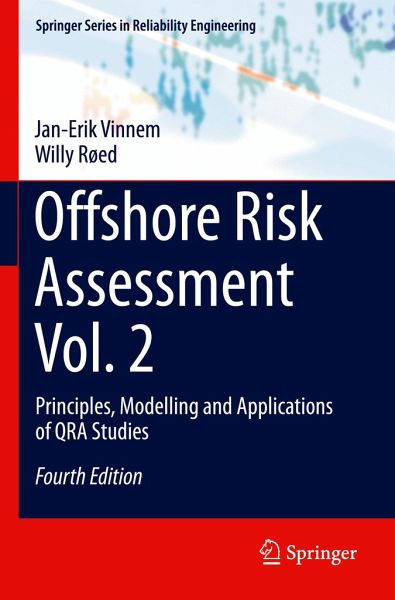
This is the first textbook to address quantified risk assessment (QRA) as specifically applied to offshore installations and operations. As the second part of the two-volume updated and expanded fourth edition, it adds a new focus on the recent development of Normally Unattended Installations (NUIs), which are essentially autonomous installations that combine digitalization, big data, drones and machine learning, and can be supported by W2W (walk-to-work) vessels. These minimalistic installations with no helideck and very limited safety systems will require a new approach to risk assessment and emergency planning, especially during manned periods involving W2W vessels.
Separate chapters analyse the main hazards for offshore structures: fire, explosion, collision, and falling objects, as well as structural and marine hazards. The book explores possible simplifications of risk assessment for traditional manned installations. Risk mitigation and control are also discussed, aswell as how the results of quantitative risk assessment studies should be presented. In closing, the book provides an updated approach to environmental risk assessment. The book offers a comprehensive reference guide for academics and students of marine/offshore risk assessment and management. It will also be of interest to professionals in the industry, as well as contractors, suppliers, consultants and regulatory authorities.
Xing-Wei Zhen is an associate professor of ocean engineering at Dalian University of Technology. He has more than 15-year experience in the academic research, consulting, teaching as well as project management. He has generated more than 100 scholarly works, including peer-reviewed publications, granted patents, software copyrights, etc. He works together with Prof. Jan-Erik VINNEM since the year 2018 in the fields of operational risk modelling, online risk analysis, barrier management, major accident risk indicators, and accident investigations. In addition, Xing-Wei ZHEN has broad research interests. He once invented the artificial seabed unit to extend the application of shallow-water rated subsea production systems in ultra-deep sea. He has also independently designed and constructed a large-scale internal wave experimental flume to explore and demystify the unique hydrodynamic phenomena of the underwater waves. However, his true passion lies in applied risk studies that he finds meaningful and beneficial to the society. Jan-Erik Vinnem is a world-renowned scholar in offshore risks and a professor emeritus at Norwegian University of Science and Technology, as well as a member of Norwegian Academy of Technological Sciences. He is the founder of Safetec Nordic AS and Preventor AS. He is the founder chairman and an honorary member of ESAR Norway and the chairman of ESREL conferences in 1998, 2007 and 2018. He is the project leader for developments of OLF Guideline 064, ISO 17776 and NORSOK Z-013 standards. His main research topics during the last 10 years have been management of barriers and monitoring of major accident risk, with extensive projects for Havtil and petroleum companies. He is the author of five books in risk analysis and has published more than 300 scientific papers in international journals and conferences. He is a recognized lecturer in risk management and risk analysis, and has conducted training courses for corporate clients in Norway as well as for international clients and research institutions across Denmark, Portugal, Brazil, Nigeria, India, Russia and China.
Inhaltsangabe
Part III.- 14.Methodology for Quantified Risk Assessment.- 15.Analysis Techniques.- 16.Presentation of Risk Results from QRA Studies.- 17.Evaluation of Personnel Risk Levels.- 18.Environmental Risk Analysis.- 19.Approach to Risk Based Design.- 20.Risk based Emergency Response Planning.- Part IV.- 21.Use of Risk Analysis during the Operations Phase.- 22.Use of Risk Indicators for Major Hazard Risk.- 23.Barrier Management for Major Hazard Risk.- Appendix A.Overview of Software.- Appendix B.Overview of Fatalities in Norwegian Sector.- Appendix C.Network Resources.
Part III.- 14.Methodology for Quantified Risk Assessment.- 15.Analysis Techniques.- 16.Presentation of Risk Results from QRA Studies.- 17.Evaluation of Personnel Risk Levels.- 18.Environmental Risk Analysis.- 19.Approach to Risk Based Design.- 20.Risk based Emergency Response Planning.- Part IV.- 21.Use of Risk Analysis during the Operations Phase.- 22.Use of Risk Indicators for Major Hazard Risk.- 23.Barrier Management for Major Hazard Risk.- Appendix A.Overview of Software.- Appendix B.Overview of Fatalities in Norwegian Sector.- Appendix C.Network Resources.
Rezensionen
"The book, which offers complete and up-to-date information about some environmental aspects and impacts, is useful for academics and students, as well as for professionals in the sector and regulatory authorities." (Emilia Di Lorenzo, zbMATH 1427.91004, 2020)
Es gelten unsere Allgemeinen Geschäftsbedingungen: www.buecher.de/agb
Impressum
www.buecher.de ist ein Internetauftritt der buecher.de internetstores GmbH
Geschäftsführung: Monica Sawhney | Roland Kölbl | Günter Hilger
Sitz der Gesellschaft: Batheyer Straße 115 - 117, 58099 Hagen
Postanschrift: Bürgermeister-Wegele-Str. 12, 86167 Augsburg
Amtsgericht Hagen HRB 13257
Steuernummer: 321/5800/1497
USt-IdNr: DE450055826