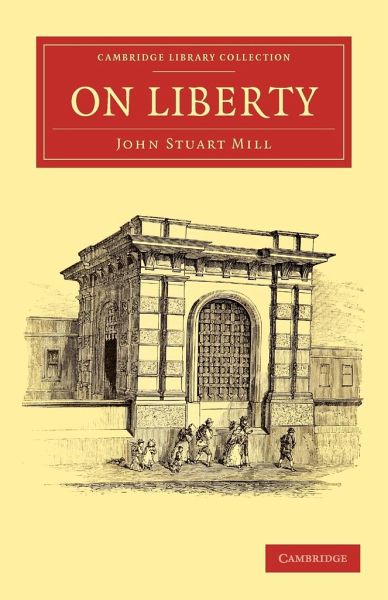
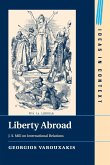
British philosopher and economist John Stuart Mill (1806-73) is the author of several essays, including Utilitarianism (1863) - a defence of Jeremy Bentham's principle applied to the field of ethics - and The Subjection of Women (1869), which advocates legal equality between the sexes. This work, arguably his most famous contribution to political philosophy and theory, was first published in 1859, and remains a major influence upon contemporary liberal political thought. In it, Mill argues for a limitation of the power of government and society (democracy's 'tyranny of the majority') over the…mehr
British philosopher and economist John Stuart Mill (1806-73) is the author of several essays, including Utilitarianism (1863) - a defence of Jeremy Bentham's principle applied to the field of ethics - and The Subjection of Women (1869), which advocates legal equality between the sexes. This work, arguably his most famous contribution to political philosophy and theory, was first published in 1859, and remains a major influence upon contemporary liberal political thought. In it, Mill argues for a limitation of the power of government and society (democracy's 'tyranny of the majority') over the individual, and defines liberty as an absolute individual right. According to the still much debated 'harm principle', power against the individual can only be exercised to prevent harm to others. Full of contemporary relevance, this essay also defends freedom of speech as a necessary condition of social and intellectual progress.
John Stuart Mill was an English philosopher, political economist, Member of Parliament (MP), and civil servant who lived from 20 May 1806 to 7 May 1873. He was one of the most significant intellectuals in the development of classical liberalism. The utilitarian movement was started by John Stuart Mill. Being a particularly bright youngster, he was able to read six Plato dialogues and Aesop's Fables by the age of eight. Jeremy Bentham and Francis Place provided guidance and support as John Stuart's father schooled him. At the age of eight, Mill started studying Latin, algebra, and Euclid classes. He liked to read Robinson Crusoe and Don Quixote in his free time. Along with his father, he studied David Ricardo and Adam Smith. He was deeply affected by the vibrant and welcoming culture of France. Mill was inspired to reject Bentham's theory of human nature by his correspondence with Auguste Comte. After 21 years of close friendship with Harriet Taylor, Mill wed her on April 21, 1851. After barely seven years of marriage and after experiencing acute lung congestion, she died in 1858. Thirteen days before his 67th birthday in 1873, Mill passed away from erysipelas in Avignon, France; he was buried next to his wife.
Inhaltsangabe
1. Introductory 2. Of the liberty of thought and discussion 3. Of individuality, as one of the elements of well-being 4. Of the limits to the authority of society over the individual 5. Applications.
1. Introductory 2. Of the liberty of thought and discussion 3. Of individuality, as one of the elements of well-being 4. Of the limits to the authority of society over the individual 5. Applications.
Es gelten unsere Allgemeinen Geschäftsbedingungen: www.buecher.de/agb
Impressum
www.buecher.de ist ein Internetauftritt der buecher.de internetstores GmbH
Geschäftsführung: Monica Sawhney | Roland Kölbl | Günter Hilger
Sitz der Gesellschaft: Batheyer Straße 115 - 117, 58099 Hagen
Postanschrift: Bürgermeister-Wegele-Str. 12, 86167 Augsburg
Amtsgericht Hagen HRB 13257
Steuernummer: 321/5800/1497
USt-IdNr: DE450055826