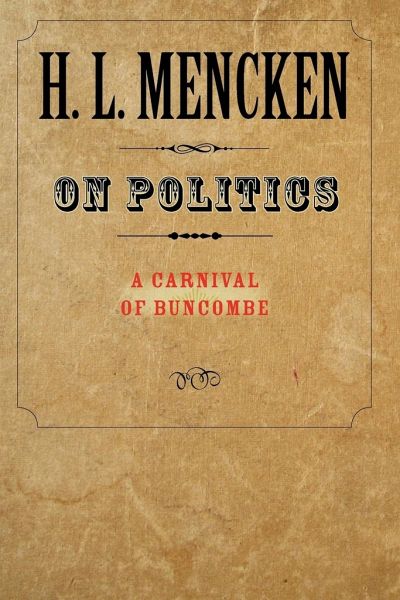
With a style that combined biting sarcasm with the "language of the free lunch counter," Henry Louis Mencken shook politics and politicians for nearly half a century. Now, fifty years after Mencken's death, the Johns Hopkins University Press announces The Buncombe Collection, newly packaged editions of nine Mencken classics: Happy Days, Heathen Days, Newspaper Day s, Prejudices, Treatise on the Gods, On Politics, Thirty-Five Years of Newspaper Work, Minority Report, and A Second Mencken Chrestomathy. With a style that combined biting sarcasm with the "language of the free lunch counter," Henry…mehr
With a style that combined biting sarcasm with the "language of the free lunch counter," Henry Louis Mencken shook politics and politicians for nearly half a century. Now, fifty years after Mencken's death, the Johns Hopkins University Press announces The Buncombe Collection, newly packaged editions of nine Mencken classics: Happy Days, Heathen Days, Newspaper Day s, Prejudices, Treatise on the Gods, On Politics, Thirty-Five Years of Newspaper Work, Minority Report, and A Second Mencken Chrestomathy. With a style that combined biting sarcasm with the "language of the free lunch counter," Henry Louis Mencken shook politics and politicians for nearly half a century. Now, fifty years after Mencken's death, the Johns Hopkins University Press announces The Buncombe Collection, newly packaged editions of nine Mencken classics: Happy Days, Heathen Days, Newspaper Day s, Prejudices, Treatise on the Gods, On Politics, Thirty-Five Years of Newspaper Work, Minority Report, and A Second Mencken Chrestomathy. These seventy political pieces from the 1920s and 1930s are drawn from Mencken's famous Monday columns in the Baltimore Evening Sun.
H. L. Mencken was an American journalist, essayist, satirist, cultural critic, and expert on American English. He lived from September 12, 1880, until January 29, 1956. He made extensive observations about the social scene, literature, music, well-known politicians, and modern movements. He also attracted notice for his parody reporting on the Scopes Trial, which he nicknamed the "Monkey Trial". Mencken is renowned as a scholar for his work on The American Language, a multi-volume examination of American English dialects. He was a vocal opponent of representative democracy, which he saw as a system in which weaker individuals ruled their superiors, and organized religion. He was a fan of the German philosopher Friedrich Nietzsche. Mencken opposed osteopathy and chiropractic while supporting scientific advancement. He openly criticized economics as well. For six years, Mencken worked as a reporter for the Herald. The newspaper was bought in June 1906, less than two and a half years after the Great Baltimore Fire, by Gen. Felix Agnus, the rival owner, and publisher of The Baltimore American, the town's oldest (since 1773) and largest daily, and Charles H. Grasty, the owner, and editor of The News since 1892.
Es gelten unsere Allgemeinen Geschäftsbedingungen: www.buecher.de/agb
Impressum
www.buecher.de ist ein Internetauftritt der buecher.de internetstores GmbH
Geschäftsführung: Monica Sawhney | Roland Kölbl | Günter Hilger
Sitz der Gesellschaft: Batheyer Straße 115 - 117, 58099 Hagen
Postanschrift: Bürgermeister-Wegele-Str. 12, 86167 Augsburg
Amtsgericht Hagen HRB 13257
Steuernummer: 321/5800/1497
USt-IdNr: DE450055826