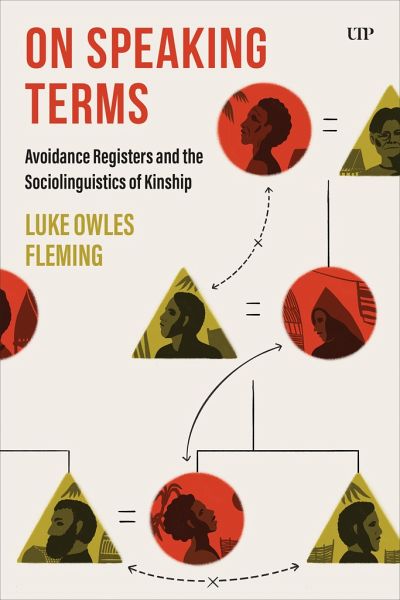
On Speaking Terms examines the sociolinguistic and non-verbal codes that enact interpersonal avoidance relationships in more than one hundred societies.
On Speaking Terms examines the sociolinguistic and non-verbal codes that enact interpersonal avoidance relationships in more than one hundred societies.
Luke Owles Fleming is an associate professor in the Department of Anthropology at the University of Montreal.
Inhaltsangabe
Introduction: The Total Orientation Part I: Proscriptive Regimes of Language and Avoidance Registers 1. Avoidance Lexicon, Everyday Grammar: Why Words Are Good to Proscribe 2. Many to One: Lexicon Asymmetries in Avoidance Registers Part II: The Sounds of Reference: Name Taboos 3. Name Registers: A Sociolinguistic Kind 4. Rigid Performativity: Cross-Cultural Convergences in Name Registers Part III: The Anti-phatic Function: Interactional Avoidances 5. Not on Speaking Terms: Closing and Re-routing Channels of Communication 6. Out of Touch: Sensory Avoidances and the Multimodality of Mutuality Part IV: The Pattern That Connects: Avoidance Registers as Scalar Honorific Formations 7. The Pragmatic Suspension of Semantic Distinctions: Honorific Pronouns in Kinship Avoidance 8. Degrees of Unfreedom: Formal Encompassment and the Structure of Avoidance Levels Conclusion: The Mutuality of Being Apart References Index
Introduction: The Total Orientation Part I: Proscriptive Regimes of Language and Avoidance Registers 1. Avoidance Lexicon, Everyday Grammar: Why Words Are Good to Proscribe 2. Many to One: Lexicon Asymmetries in Avoidance Registers Part II: The Sounds of Reference: Name Taboos 3. Name Registers: A Sociolinguistic Kind 4. Rigid Performativity: Cross-Cultural Convergences in Name Registers Part III: The Anti-phatic Function: Interactional Avoidances 5. Not on Speaking Terms: Closing and Re-routing Channels of Communication 6. Out of Touch: Sensory Avoidances and the Multimodality of Mutuality Part IV: The Pattern That Connects: Avoidance Registers as Scalar Honorific Formations 7. The Pragmatic Suspension of Semantic Distinctions: Honorific Pronouns in Kinship Avoidance 8. Degrees of Unfreedom: Formal Encompassment and the Structure of Avoidance Levels Conclusion: The Mutuality of Being Apart References Index
Es gelten unsere Allgemeinen Geschäftsbedingungen: www.buecher.de/agb
Impressum
www.buecher.de ist ein Internetauftritt der buecher.de internetstores GmbH
Geschäftsführung: Monica Sawhney | Roland Kölbl | Günter Hilger
Sitz der Gesellschaft: Batheyer Straße 115 - 117, 58099 Hagen
Postanschrift: Bürgermeister-Wegele-Str. 12, 86167 Augsburg
Amtsgericht Hagen HRB 13257
Steuernummer: 321/5800/1497
USt-IdNr: DE450055826