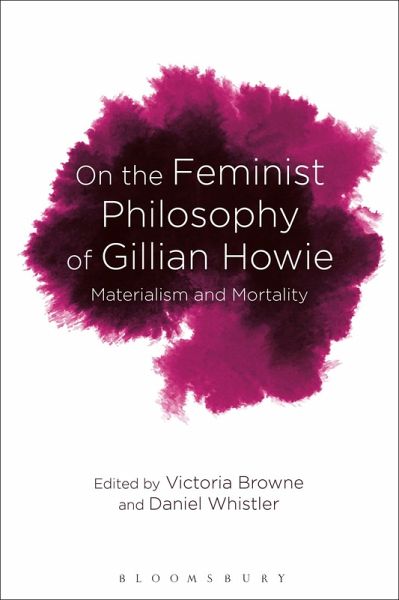
Over three decades, Gillian Howie wrote at the forefront of philosophy and critical theory, before her untimely death in 2013. This interdisciplinary collection uses her writings to explore the productive, yet often resistant, interrelationship between feminism and critical theory, examining the potential of Howie's particular form of materialism. The contributors also bring to this debate a serious engagement with Howie's late turn towards philosophies of mortality, therapy and 'living with dying'. The volume considers how differently embodied subjects are positioned within public…mehr
Over three decades, Gillian Howie wrote at the forefront of philosophy and critical theory, before her untimely death in 2013. This interdisciplinary collection uses her writings to explore the productive, yet often resistant, interrelationship between feminism and critical theory, examining the potential of Howie's particular form of materialism. The contributors also bring to this debate a serious engagement with Howie's late turn towards philosophies of mortality, therapy and 'living with dying'. The volume considers how differently embodied subjects are positioned within public institutions, discourses and spaces, and the role of philosophy, art, film, photography, and literature, in facing situations such as sexual oppression and life-limiting illness.
Victoria Browne is Lecturer in Politics at Oxford Brookes University, UK. She has published articles on feminist philosophy, temporality, and memory, and is the author of Feminism, Time and Nonlinear History (2014). Daniel Whistler is Senior Lecturer in Philosophy at the University of Liverpool, UK, and Humboldt Research Fellow at the Westfälische-Wilhelms Universität, Münster, Germany. He is the author of Schelling's Theory of Symbolic Language (2013) and co-author of The Right to Wear Religious Symbols (2013).
Inhaltsangabe
Acknowledgements Notes on the Contributors Editors' Introduction Gillian Howie's Philosophies of Embodied Practice, Victoria Browne and Daniel Whistler Part One: Feminism, Materialism, Critical Theory Chapter One When Feminist Philosophy Met Critical Theory: Gillian Howie's Historical Materialism, Stella Sandford Chapter Two Feminist Knowledge and Feminist Politics: Reflections on Howie and Late Feminism, Kimberly Hutchings Chapter Three Between Negative Dialectics and Sexual Difference: Generative Conjunctures in the Thinking of Gillian Howie, Joanna Hodge Chapter Four Scholarly Time and Feminist Time: Gillian Howie on Education and Intellectual Inheritance, Victoria Browne Chapter Five The Cloistered Imaginary, Daniel Whistler Part Two: Living with Dying Chapter Six How to Think about Death: Living with Dying, Gillian Howie Chapter Seven Gillian Howie's Situated Philosophy: Theorizing Living and Dying 'In Situation', Christine Battersby Chapter Eight The Relationality of Death, Alison Stone Chapter Nine Reflections on 'Living up to Death', Morny Joy Chapter Ten Learning to Die, Finally, Claire Colebrook Chapter Eleven 'What the Living Do': Poetry's Death and Dying, Deryn Rees-Jones Chapter Twelve Cancer Sucks: Photography and the Representation of Chronic Illness, Nedim Hassan Chapter Thirteen Movie-making as Palliative Care, Amy Hardie Chapter Fourteen Experience and Performance whilst Living with Disability and Dying: Disability Art as a Pathway to Flourishing, Janet Price and Ruth Gould Index
Acknowledgements Notes on the Contributors Editors' Introduction Gillian Howie's Philosophies of Embodied Practice, Victoria Browne and Daniel Whistler Part One: Feminism, Materialism, Critical Theory Chapter One When Feminist Philosophy Met Critical Theory: Gillian Howie's Historical Materialism, Stella Sandford Chapter Two Feminist Knowledge and Feminist Politics: Reflections on Howie and Late Feminism, Kimberly Hutchings Chapter Three Between Negative Dialectics and Sexual Difference: Generative Conjunctures in the Thinking of Gillian Howie, Joanna Hodge Chapter Four Scholarly Time and Feminist Time: Gillian Howie on Education and Intellectual Inheritance, Victoria Browne Chapter Five The Cloistered Imaginary, Daniel Whistler Part Two: Living with Dying Chapter Six How to Think about Death: Living with Dying, Gillian Howie Chapter Seven Gillian Howie's Situated Philosophy: Theorizing Living and Dying 'In Situation', Christine Battersby Chapter Eight The Relationality of Death, Alison Stone Chapter Nine Reflections on 'Living up to Death', Morny Joy Chapter Ten Learning to Die, Finally, Claire Colebrook Chapter Eleven 'What the Living Do': Poetry's Death and Dying, Deryn Rees-Jones Chapter Twelve Cancer Sucks: Photography and the Representation of Chronic Illness, Nedim Hassan Chapter Thirteen Movie-making as Palliative Care, Amy Hardie Chapter Fourteen Experience and Performance whilst Living with Disability and Dying: Disability Art as a Pathway to Flourishing, Janet Price and Ruth Gould Index
Es gelten unsere Allgemeinen Geschäftsbedingungen: www.buecher.de/agb
Impressum
www.buecher.de ist ein Internetauftritt der buecher.de internetstores GmbH
Geschäftsführung: Monica Sawhney | Roland Kölbl | Günter Hilger
Sitz der Gesellschaft: Batheyer Straße 115 - 117, 58099 Hagen
Postanschrift: Bürgermeister-Wegele-Str. 12, 86167 Augsburg
Amtsgericht Hagen HRB 13257
Steuernummer: 321/5800/1497
USt-IdNr: DE450055826