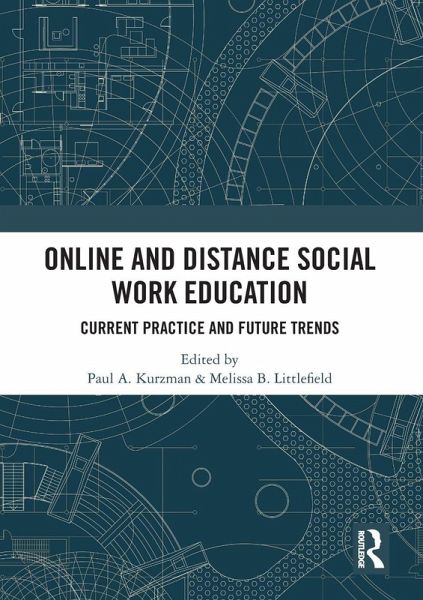
Online and Distance Social Work Education: Current Practice and Future Trends provides a comprehensive presentation on the evolution, current status and future direction of distance learning and online education in the social work profession.
Online and Distance Social Work Education: Current Practice and Future Trends provides a comprehensive presentation on the evolution, current status and future direction of distance learning and online education in the social work profession.
Paul A. Kurzman, PhD, ACSW is a Professor of Social Work at Hunter College and Professor of Social Welfare at The Graduate Center of the City University of New York where he teaches policy and practice in the MSW and Ph.D. programs. He is an author/editor of 10 books and Editor-in-Chief of the Journal of Teaching in Social Work. Melissa B. Littlefield, PhD, LGSW is Associate Professor and Chair of the Master of Social Work Department at Morgan State University in Baltimore, Maryland. She is a recognized expert on multiculturalism, race, ethics and computer technology.
Inhaltsangabe
Part I. An Overview and Perspective 1. An Introduction: Reimagining Social Work Education for the Digital Age 2. The Current Status of Social Work Online and Distance Education Part II. Emergent Paradigms 3. Community of Inquiry (CoI): A Framework for Social Work Distance Educators 4. Beyond the Online Versus On-Campus Debate: Leveraging Technology in a CoI Framework to Enhance Student and Faculty Presence in the MSW Classroom 5. A Synchronous Online Social Work PhD Program: Educational Design and Student/ Faculty Response 6. Reflections of an Online Social Work Professor: Illuminating an Alternative Pedagogy 7. Web-Based Social Work Courses: Guidelines for Developing and Implementing an Online Environment Part III. Ethical and Diversity Considerations 8. Digital Ethics in Social Work Education 9. Globalization or Colonization in Online Education: Opportunity or Oppression? 10. Diversity and Difference in the Online Environment 11. The Teacher-Learner Relationship: Considerations for Social Work in the Digital Age. Part IV. Strategies for Engagement 12. Introducing Social Work to Hyflex Blended Learning: A Student-Centered Approach 13. Teacher as Client Therapy (TACT): A Model for Simulated Learning for Traditional and Online Delivery Models 14. VoiceThread as a Tool in Online BSW Education 15. Exploring Online and Blended Course Delivery in Social Group Work 16. Converting a Face-to-Face Introductory Research Methods Course to an Online Format: Pedagogical Issues and Technological Tools 17. Using A Virtual Agency to Teach Research Part V. Tools for Assessment and Administration 18. Designing for Quality: Distance Education Rubrics for Online MSW Programs 19. Developing and Supporting Faculty Training for Online Social Work Education: The Columbia University School of Social Work Online Pedagogy Institute 20. The One-Minute Paper as a Catalyst for Change in Online Pedagogy 21. Cutting the Distance in Distance Education: Reflections on the Use of E-Technologies in a New Zealand Social Work Program 22. Human Service Administrator Perceptions of Online MSW Degree Programs
Part I. An Overview and Perspective 1. An Introduction: Reimagining Social Work Education for the Digital Age 2. The Current Status of Social Work Online and Distance Education Part II. Emergent Paradigms 3. Community of Inquiry (CoI): A Framework for Social Work Distance Educators 4. Beyond the Online Versus On-Campus Debate: Leveraging Technology in a CoI Framework to Enhance Student and Faculty Presence in the MSW Classroom 5. A Synchronous Online Social Work PhD Program: Educational Design and Student/ Faculty Response 6. Reflections of an Online Social Work Professor: Illuminating an Alternative Pedagogy 7. Web-Based Social Work Courses: Guidelines for Developing and Implementing an Online Environment Part III. Ethical and Diversity Considerations 8. Digital Ethics in Social Work Education 9. Globalization or Colonization in Online Education: Opportunity or Oppression? 10. Diversity and Difference in the Online Environment 11. The Teacher-Learner Relationship: Considerations for Social Work in the Digital Age. Part IV. Strategies for Engagement 12. Introducing Social Work to Hyflex Blended Learning: A Student-Centered Approach 13. Teacher as Client Therapy (TACT): A Model for Simulated Learning for Traditional and Online Delivery Models 14. VoiceThread as a Tool in Online BSW Education 15. Exploring Online and Blended Course Delivery in Social Group Work 16. Converting a Face-to-Face Introductory Research Methods Course to an Online Format: Pedagogical Issues and Technological Tools 17. Using A Virtual Agency to Teach Research Part V. Tools for Assessment and Administration 18. Designing for Quality: Distance Education Rubrics for Online MSW Programs 19. Developing and Supporting Faculty Training for Online Social Work Education: The Columbia University School of Social Work Online Pedagogy Institute 20. The One-Minute Paper as a Catalyst for Change in Online Pedagogy 21. Cutting the Distance in Distance Education: Reflections on the Use of E-Technologies in a New Zealand Social Work Program 22. Human Service Administrator Perceptions of Online MSW Degree Programs
Es gelten unsere Allgemeinen Geschäftsbedingungen: www.buecher.de/agb
Impressum
www.buecher.de ist ein Internetauftritt der buecher.de internetstores GmbH
Geschäftsführung: Monica Sawhney | Roland Kölbl | Günter Hilger
Sitz der Gesellschaft: Batheyer Straße 115 - 117, 58099 Hagen
Postanschrift: Bürgermeister-Wegele-Str. 12, 86167 Augsburg
Amtsgericht Hagen HRB 13257
Steuernummer: 321/5800/1497
USt-IdNr: DE450055826