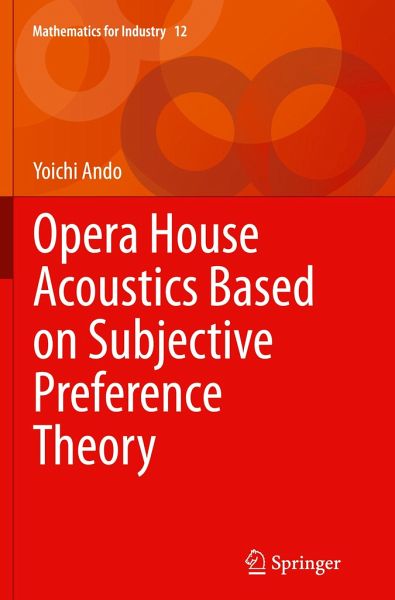
This book focuses on opera house acoustics based on subjective preference theory; it targets researchers in acoustics and vision who are working in physics, psychology and brain physiology. This book helps readers to understand any subjective attributes in relation to objective parameters based on the powerful and workable model of the auditory system. It is reconfirmed here that the well-known Helmholtz theory, which was based on a peripheral model of the auditory system, may not well describe pitch, timbre and duration as well as the spatial sensations described in this book, nor overall…mehr
This book focuses on opera house acoustics based on subjective preference theory; it targets researchers in acoustics and vision who are working in physics, psychology and brain physiology. This book helps readers to understand any subjective attributes in relation to objective parameters based on the powerful and workable model of the auditory system.
It is reconfirmed here that the well-known Helmholtz theory, which was based on a peripheral model of the auditory system, may not well describe pitch, timbre and duration as well as the spatial sensations described in this book, nor overall responses such as subjective preference of sound fields and the annoyance of environmental noise.
Yoshiharu Soeta: Board member of Acoustical Society of Japan in Kansai Branch, Assistant editor of Journal of Temporal Design in Architecture and the Environment, Ad-hoc reviewer of Journal of the Acoustical Society of America, Journal of Sound and Vibration, Noise Control Engineering Journal, Journal of Neurophysiology, and NeuroImage. Yoichi Ando: A series editor of 'Modern Acoustics and Signal Processing'. http://www.springer.com/series/3754 Editor-in-Chief of Journal of Temporal Design in Architecture and the Environment, Ad-hoc reviewer of Journal of the Acoustical Society of America, Journal of Sound and Vibration, and Acta Acustica united with Acustica.
Inhaltsangabe
Introduction.- Analyses of Temporal Factors of a Source Signal.- Formulations and Simulation of the Sound Field.- Model of Auditory-Brain System.- Temporal- and Spatial-Primary Percepts of the Sound and the Sound Field.- Theory of Subjective Preference for the Sound Field.- Examination of Subjective Preference Theory in an Existing Opera House.- Reverberance of the Sound Field.- Improvements of Subjective Prefences for Listeners and Performers.- Optimizing Room-Form.- Visual Temporal Sensations on the Stage Blending with Opera and Music.- Design Theory of Opera House Stage Persisting Individual Creations.- Appendix Appendix Comparison between Measured Orthogonal Factors Using a Dummy Head and Four Human-Real Heads.
Introduction.- Analyses of Temporal Factors of a Source Signal.- Formulations and Simulation of the Sound Field.- Model of Auditory-Brain System.- Temporal- and Spatial-Primary Percepts of the Sound and the Sound Field.- Theory of Subjective Preference for the Sound Field.- Examination of Subjective Preference Theory in an Existing Opera House.- Reverberance of the Sound Field.- Improvements of Subjective Prefences for Listeners and Performers.- Optimizing Room-Form.- Visual Temporal Sensations on the Stage Blending with Opera and Music.- Design Theory of Opera House Stage Persisting Individual Creations.- Appendix Appendix Comparison between Measured Orthogonal Factors Using a Dummy Head and Four Human-Real Heads.
Rezensionen
"This book's focus is on opera house acoustics based on subjective preference theory. ... The various mathematical concepts are clearly and succinctly summarized in combination with drawings and diagrams. This combination of mathematical concepts illustrated by visuals creates a content that can be understood by designers and performers that do not easily use mathematics, as well as engineers and mathematicians." (Bonnie Schnitta, Noise Control Engineering Journal, Vol. 65 (1), January-February, 2017)
Es gelten unsere Allgemeinen Geschäftsbedingungen: www.buecher.de/agb
Impressum
www.buecher.de ist ein Internetauftritt der buecher.de internetstores GmbH
Geschäftsführung: Monica Sawhney | Roland Kölbl | Günter Hilger
Sitz der Gesellschaft: Batheyer Straße 115 - 117, 58099 Hagen
Postanschrift: Bürgermeister-Wegele-Str. 12, 86167 Augsburg
Amtsgericht Hagen HRB 13257
Steuernummer: 321/5800/1497
USt-IdNr: DE450055826