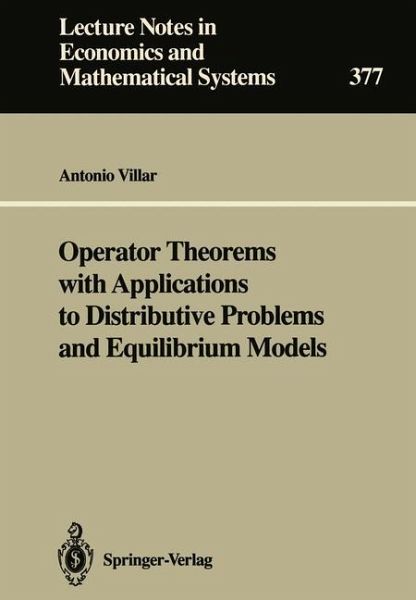
Presentation Many economic problems, as equilibrium models, input-output analysis, rational behaviour, etc. , are usually modelled in terms of operators in Euclidean spaces. This monograph deals with the analysis of a number of formal problems involving this kind of operators (with particular reference to complementarity problems and variational inequalities), and their applications to distributive problems and equilibrium models. Thus the purpose of this work is to provide a set of new results on the solvability of those problems, and a number of economic applications that will illustrate the…mehr
Presentation Many economic problems, as equilibrium models, input-output analysis, rational behaviour, etc. , are usually modelled in terms of operators in Euclidean spaces. This monograph deals with the analysis of a number of formal problems involving this kind of operators (with particular reference to complementarity problems and variational inequalities), and their applications to distributive problems and equilibrium models. Thus the purpose of this work is to provide a set of new results on the solvability of those problems, and a number of economic applications that will illustrate the interest of these results in economics. It is worth stressing from the very begining that our analysis concentrates on the existence (and in some cases optimality) of solutions. That is what is meant here by solvability (in particular, nothing will be said with respect to the uniqueness, stability, sensitivity analysis or computation of solutions). The results on the solvability of operatorproblems presented here, were actually arrived at as a way of solving specific economic models. Yet we are going to relate this case by somehow reversing the way it happened, that is, starting with the formal results and then presenting a number of economic models which appear as applications of VIII these formal results. The rationale for this approach is twofold. First, it provides a neat track via which to go through the whole work. Then, because I would like to emphasize the interest of complementarity and variational inequalities problems in economic modelling.
Produktdetails
Produktdetails
Lecture Notes in Economics and Mathematical Systems 377
Antonio Villar is Professor of Economics at the Universidad Pablo de Olavide (Seville), where he arrived in 2005 from the University of Alicante. He is also Senior Researcher at the Ivie (Valencian Institute for Economic Research). He got a Ph.D. at the University of Oxford in 1990, after a B.A. in Economics (University of Valencia, 1978) and a previous Doctorate (University of Alicante, 1983). He has been Visiting Professor at Stanford University, the European University Institute (Florence, Italy), the Institute for Advanced Studies (Vienna), Senior Associate at St. Antony's College, University of Oxford, and Visiting Researcher at the University of York, among others. During 2015/2016 he held a Thomas J. Alexander Fellowship at the OECD/EDU in Paris. In 2010 he got the Andalusian Prize for distinguished research in Social Sciences and Humanities. Hisresearch activity concentrates on Microeconomic Theory and its applications. In particular: (a) Welfare economics and social choice, including aspects of efficiency with externalities, public goods and non-convexities, distributive problems, inequality and welfare measurement, multidimensional indicators, Human Development and Economics of Education; and (b) General equilibrium, with special interest on the effects of increasing returns to scale in market economies. His latest research deals with the welfare analysis of some economic aspects that involve both private and public decisions, such as health, education and income distribution. A common theme of some of those topics is the design of multidimensional indicators and evaluation formulas capable of dealing with qualitative data. He has published 14 books and some 80 research papers.
Inhaltsangabe
First Part: Operator Theorems.- I. Operators in Euclidean Spaces: Eight Selected Problems.- II. The Main Formal Results: Some Theorems on Operators in Euclidean Spaces.- Second Part: applications to distributive problems and Equilibrium Models.- III. Efficient Allocations with Consumption Externalities.- IV. Market Equilibrium with Nonconvex Technologies.- V. Further Applications.- References.
First Part: Operator Theorems.- I. Operators in Euclidean Spaces: Eight Selected Problems.- II. The Main Formal Results: Some Theorems on Operators in Euclidean Spaces.- Second Part: applications to distributive problems and Equilibrium Models.- III. Efficient Allocations with Consumption Externalities.- IV. Market Equilibrium with Nonconvex Technologies.- V. Further Applications.- References.
Es gelten unsere Allgemeinen Geschäftsbedingungen: www.buecher.de/agb
Impressum
www.buecher.de ist ein Internetauftritt der buecher.de internetstores GmbH
Geschäftsführung: Monica Sawhney | Roland Kölbl | Günter Hilger
Sitz der Gesellschaft: Batheyer Straße 115 - 117, 58099 Hagen
Postanschrift: Bürgermeister-Wegele-Str. 12, 86167 Augsburg
Amtsgericht Hagen HRB 13257
Steuernummer: 321/5800/1497
USt-IdNr: DE450055826