
Johannes KeplerParalipomena to Witelo & Optical Part of Astronomy
Optics
Paralipomena to Witelo & Optical Part of Astronomy
Übersetzer: Donahue, William H
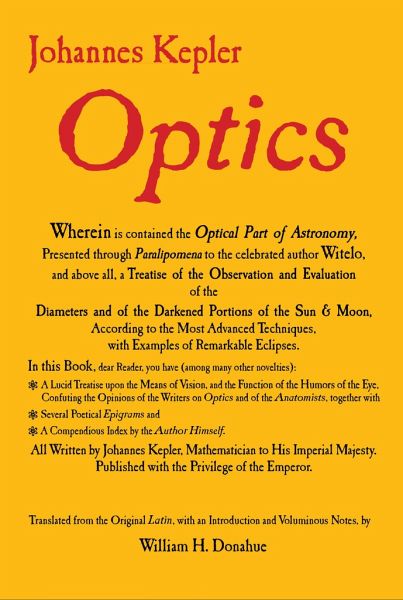
Johannes KeplerParalipomena to Witelo & Optical Part of Astronomy
Optics
Paralipomena to Witelo & Optical Part of Astronomy
Übersetzer: Donahue, William H
- Gebundenes Buch
- Merkliste
- Auf die Merkliste
- Bewerten Bewerten
- Teilen
- Produkt teilen
- Produkterinnerung
- Produkterinnerung
First (and only) English translation of the work that founded the modern science of optics. Originally published in Latin in 1604. Many diagrams and footnotes.
Andere Kunden interessierten sich auch für
 Casper HakfoortOptics in the Age of Euler103,99 €
 Thomas K SimpsonMaxwell's Mathematical Rhetoric43,99 €
 Stephen G LipsonOptics Experiments and Demonstrations for Student Laboratories112,99 €
 Ivan MorenoIntroduction to Metalens Optics176,99 €
 Osvaldo de MeloElementary Fourier Optics for Science and Engineering Students112,99 €
 Rafael G González-AcuñaOptics and Artificial Vision176,99 €
 Fulgence MarionThe Wonders of Optics29,99 €
-
-
-





First (and only) English translation of the work that founded the modern science of optics. Originally published in Latin in 1604. Many diagrams and footnotes.
Produktdetails
- Produktdetails
- Verlag: Green Lion Press
- Seitenzahl: 475
- Erscheinungstermin: 1. November 2000
- Englisch
- Abmessung: 262mm x 187mm x 34mm
- Gewicht: 1042g
- ISBN-13: 9781888009125
- ISBN-10: 1888009128
- Artikelnr.: 32544258
- Herstellerkennzeichnung
- Libri GmbH
- Europaallee 1
- 36244 Bad Hersfeld
- gpsr@libri.de
- Verlag: Green Lion Press
- Seitenzahl: 475
- Erscheinungstermin: 1. November 2000
- Englisch
- Abmessung: 262mm x 187mm x 34mm
- Gewicht: 1042g
- ISBN-13: 9781888009125
- ISBN-10: 1888009128
- Artikelnr.: 32544258
- Herstellerkennzeichnung
- Libri GmbH
- Europaallee 1
- 36244 Bad Hersfeld
- gpsr@libri.de
By Johannes Kepler - Translated by William H. Donahue
Contents
The Green Lion’s Preface ix
Translator’s Introduction xi
Kepler’s Optics
Kepler’s Dedication to the Emperor 5
Epigrams 11
Kepler’s Preface 13
1 On the Nature of Light 17
Appendix to Chapter One, and Airing of Aristotle’s Arguments on Vision
in De Anima 43
2 On the Shaping of Light 55
3 The Foundations of Catoptrics and Place of the Image 73
1. Refutation of Euclid, Witelo, and Alhazen 73
2. True Demonstration 76
4 On the Measure of Refractions 93
1. On the Debate between Tycho and Rothmann upon the matter of
refractions 93
2. Refutation of various authors’ various ways of measuring
refractions 96
3. Preparation for the true measurement of refractions 104
4. On the sections of a cone 106
5. What kind of quantity measures refractions? 110
6. Causes of the quantity of refractions 123
7. Consideration of those things that Witelo advised were necessary for
astronomy. 142
8. Whether the refractions are the same in all times and places. 146
9. On the observation of the Dutch in the far North 151
10. Conjectures from antiquity concerning refractions 155
5 On the Means of Vision 171
1. Anatomy of the Eye 171
2. The Means of Vision 179
3. Demonstration of those things that have been said about the crystalline
in regard to the means of vision 191
4. Consideration of those things that the optical writers and the
anatomists
have said concerning the means of vision 219
5. Those things that recoil upon Astronomy from the means of vision; or,
on flawed vision 226
6 On the varied light of the stars 237
1. On the light of the sun 237
2. On the illumination of the moon 241
3. On the circle of illumination of the moon and the earth 244
On the earth’s circle of illumination 246
4. On the phases of the moon 247
5. On knowing the age of the moon from the quantity of the
phases 248
6. The paradox that never ever was there a real new moon 251
7. On full and partial illumination of the illuminated bodies, and the
earth’s penumbra 252
8. On the Lines of the Moon’s Phases 256
9. On the moon’s spots 259
10. On the mutual illumination of the moon and the earth 263
11. On the first phase or rising of the moon 268
12. On the light of the other heavenly bodies 271
13. On the light of comets 274
7 On the Shadow of the Earth 279
1. On the form of the shadow 279
2. The paradox that the moon is not obscured by the earth’s
shadow 279
3. On the redness of the eclipsed moon 282
4. On the pallor of the eclipsed moon. 287
5. Problem: To measure the refractions in the regions at the greatest
distances by observation of eclipses of the moon. 289
8 On the Shadow of the Moon and Day2ti9m7e Darkness
1. The occasion of this enquiry 297
2. Examples from historical accounts, that the moon’s shadow brought
night into the day 299
3. Whether it can happen that in a central conjunction of the luminaries,
the sun is still not entirely hidden? 309
4. A number of corollaries on eclipses of the sun 313
5. On the mutual occultations of the other heavenly bodies 314
Contents vii
9 On Parallaxes 319
1. On the observable position or place of the heavenly bodies, or the
reckoning of it beneath the fixed stars 319
2. On the altitude of the heavenly bodies from the center of the earth and
the parallax resulting from the distance of the eyes 321
3. On the diurnal parallax resulting from the distance of the earth’s
surface from the center 323
4. A most easy and succinct derivation of the diurnal parallaxes in
longitude and latitude, using a new parallactic table 326
5. On the parallax resulting from the distance between the sun and the
earth, or the annual parallax 330
6. Short appendix on the curved tail of comets 332
10 Optical foundations of motions of heavenly bodies 335
11 On the observation of the diameters of the sun and moon and
eclipses of the two, following the principles of the art 347
Problem 1. To construct an ecliptic instrument 347
Problem 2. To measure the sun’s diameter with the instrument 350
Problem 3. To observe the sun’s diameter through a slit 353
Problem 4. To observe the moon’s diameter through the
instrument 354
Problem 5. To judge the ratio of the apparent diameters 355
Problem 6. To estimate the quantity of the defect 360
Problem 7. To find the true ratio of the diameters 362
Problem 8. To capture the image of the eclipsed sun on the
instrument 363
Problem 9. To extract the true image of the eclipsed sun 364
Problem 10. To extract the image more skilfully 364
Problem 11. To show the true image of the eclipse 365
Problem 12. From the image, to find the ratio of diameters, the visible
distance of centers, and the quantity of the eclipse 366
Problem 13. In an eclipse of the sun, to estimate the moon’s diameter
easily 367
Problem 14. To extract the inclinations of solar eclipses: Maestlin’s
method 369
Problem 15. To extract the inclinations using the eclipse
instrument 370
Problem 16. To mark out the inclinations even on the floor 371
Problem 17. From the marking of the ellipse, to learn the
inclination 372
Problem 18. To take lunar inclinations with the instrument 373
Problem 19. To note inclinations as is ordinarily done 374
Problem 20. To note the phases as is usually done 374
Problem 21. To compare the moon’s visible place to the fixed
stars 376
Problem 22. To note the times expeditiously 381
Problem 23. To elicit the time of the phases from the extension of the
ellipses 383
Problem 24. To dig up the visible latitude of the moon from the sun, as
well as the longitude 390
Problem 25. To find quickly the visible latitude at another
moment 391
Problem 26. To find the moon’s distance from earth 393
Problem 27. To investigate the instant of true conjunction, the true
latitude, and the difference of meridians 395
Problem 28. To reckon how much the observation of digits shall have
erred from the truth 399
Problem 29. To find the elongation of the sun from the meridian 400
Problem 30. To give the angle of visual latitude 409
Problem 31. Whether it is possible for the beginning of some solar eclipse
to decline towards the east, and for the end of another to decline to the
west; but for the beginning of an eclipsed moon to be in the west, and at
another time for the end to be in the east 413
Problem 32. Whether the visual path of the moon is a straight line 419
Conclusion 432
Kepler’s Index 435
Bibliography 451
Translator’s Index 455
Parallactic Tables Inside back cover
The Green Lion’s Preface ix
Translator’s Introduction xi
Kepler’s Optics
Kepler’s Dedication to the Emperor 5
Epigrams 11
Kepler’s Preface 13
1 On the Nature of Light 17
Appendix to Chapter One, and Airing of Aristotle’s Arguments on Vision
in De Anima 43
2 On the Shaping of Light 55
3 The Foundations of Catoptrics and Place of the Image 73
1. Refutation of Euclid, Witelo, and Alhazen 73
2. True Demonstration 76
4 On the Measure of Refractions 93
1. On the Debate between Tycho and Rothmann upon the matter of
refractions 93
2. Refutation of various authors’ various ways of measuring
refractions 96
3. Preparation for the true measurement of refractions 104
4. On the sections of a cone 106
5. What kind of quantity measures refractions? 110
6. Causes of the quantity of refractions 123
7. Consideration of those things that Witelo advised were necessary for
astronomy. 142
8. Whether the refractions are the same in all times and places. 146
9. On the observation of the Dutch in the far North 151
10. Conjectures from antiquity concerning refractions 155
5 On the Means of Vision 171
1. Anatomy of the Eye 171
2. The Means of Vision 179
3. Demonstration of those things that have been said about the crystalline
in regard to the means of vision 191
4. Consideration of those things that the optical writers and the
anatomists
have said concerning the means of vision 219
5. Those things that recoil upon Astronomy from the means of vision; or,
on flawed vision 226
6 On the varied light of the stars 237
1. On the light of the sun 237
2. On the illumination of the moon 241
3. On the circle of illumination of the moon and the earth 244
On the earth’s circle of illumination 246
4. On the phases of the moon 247
5. On knowing the age of the moon from the quantity of the
phases 248
6. The paradox that never ever was there a real new moon 251
7. On full and partial illumination of the illuminated bodies, and the
earth’s penumbra 252
8. On the Lines of the Moon’s Phases 256
9. On the moon’s spots 259
10. On the mutual illumination of the moon and the earth 263
11. On the first phase or rising of the moon 268
12. On the light of the other heavenly bodies 271
13. On the light of comets 274
7 On the Shadow of the Earth 279
1. On the form of the shadow 279
2. The paradox that the moon is not obscured by the earth’s
shadow 279
3. On the redness of the eclipsed moon 282
4. On the pallor of the eclipsed moon. 287
5. Problem: To measure the refractions in the regions at the greatest
distances by observation of eclipses of the moon. 289
8 On the Shadow of the Moon and Day2ti9m7e Darkness
1. The occasion of this enquiry 297
2. Examples from historical accounts, that the moon’s shadow brought
night into the day 299
3. Whether it can happen that in a central conjunction of the luminaries,
the sun is still not entirely hidden? 309
4. A number of corollaries on eclipses of the sun 313
5. On the mutual occultations of the other heavenly bodies 314
Contents vii
9 On Parallaxes 319
1. On the observable position or place of the heavenly bodies, or the
reckoning of it beneath the fixed stars 319
2. On the altitude of the heavenly bodies from the center of the earth and
the parallax resulting from the distance of the eyes 321
3. On the diurnal parallax resulting from the distance of the earth’s
surface from the center 323
4. A most easy and succinct derivation of the diurnal parallaxes in
longitude and latitude, using a new parallactic table 326
5. On the parallax resulting from the distance between the sun and the
earth, or the annual parallax 330
6. Short appendix on the curved tail of comets 332
10 Optical foundations of motions of heavenly bodies 335
11 On the observation of the diameters of the sun and moon and
eclipses of the two, following the principles of the art 347
Problem 1. To construct an ecliptic instrument 347
Problem 2. To measure the sun’s diameter with the instrument 350
Problem 3. To observe the sun’s diameter through a slit 353
Problem 4. To observe the moon’s diameter through the
instrument 354
Problem 5. To judge the ratio of the apparent diameters 355
Problem 6. To estimate the quantity of the defect 360
Problem 7. To find the true ratio of the diameters 362
Problem 8. To capture the image of the eclipsed sun on the
instrument 363
Problem 9. To extract the true image of the eclipsed sun 364
Problem 10. To extract the image more skilfully 364
Problem 11. To show the true image of the eclipse 365
Problem 12. From the image, to find the ratio of diameters, the visible
distance of centers, and the quantity of the eclipse 366
Problem 13. In an eclipse of the sun, to estimate the moon’s diameter
easily 367
Problem 14. To extract the inclinations of solar eclipses: Maestlin’s
method 369
Problem 15. To extract the inclinations using the eclipse
instrument 370
Problem 16. To mark out the inclinations even on the floor 371
Problem 17. From the marking of the ellipse, to learn the
inclination 372
Problem 18. To take lunar inclinations with the instrument 373
Problem 19. To note inclinations as is ordinarily done 374
Problem 20. To note the phases as is usually done 374
Problem 21. To compare the moon’s visible place to the fixed
stars 376
Problem 22. To note the times expeditiously 381
Problem 23. To elicit the time of the phases from the extension of the
ellipses 383
Problem 24. To dig up the visible latitude of the moon from the sun, as
well as the longitude 390
Problem 25. To find quickly the visible latitude at another
moment 391
Problem 26. To find the moon’s distance from earth 393
Problem 27. To investigate the instant of true conjunction, the true
latitude, and the difference of meridians 395
Problem 28. To reckon how much the observation of digits shall have
erred from the truth 399
Problem 29. To find the elongation of the sun from the meridian 400
Problem 30. To give the angle of visual latitude 409
Problem 31. Whether it is possible for the beginning of some solar eclipse
to decline towards the east, and for the end of another to decline to the
west; but for the beginning of an eclipsed moon to be in the west, and at
another time for the end to be in the east 413
Problem 32. Whether the visual path of the moon is a straight line 419
Conclusion 432
Kepler’s Index 435
Bibliography 451
Translator’s Index 455
Parallactic Tables Inside back cover
Contents
The Green Lion’s Preface ix
Translator’s Introduction xi
Kepler’s Optics
Kepler’s Dedication to the Emperor 5
Epigrams 11
Kepler’s Preface 13
1 On the Nature of Light 17
Appendix to Chapter One, and Airing of Aristotle’s Arguments on Vision
in De Anima 43
2 On the Shaping of Light 55
3 The Foundations of Catoptrics and Place of the Image 73
1. Refutation of Euclid, Witelo, and Alhazen 73
2. True Demonstration 76
4 On the Measure of Refractions 93
1. On the Debate between Tycho and Rothmann upon the matter of
refractions 93
2. Refutation of various authors’ various ways of measuring
refractions 96
3. Preparation for the true measurement of refractions 104
4. On the sections of a cone 106
5. What kind of quantity measures refractions? 110
6. Causes of the quantity of refractions 123
7. Consideration of those things that Witelo advised were necessary for
astronomy. 142
8. Whether the refractions are the same in all times and places. 146
9. On the observation of the Dutch in the far North 151
10. Conjectures from antiquity concerning refractions 155
5 On the Means of Vision 171
1. Anatomy of the Eye 171
2. The Means of Vision 179
3. Demonstration of those things that have been said about the crystalline
in regard to the means of vision 191
4. Consideration of those things that the optical writers and the
anatomists
have said concerning the means of vision 219
5. Those things that recoil upon Astronomy from the means of vision; or,
on flawed vision 226
6 On the varied light of the stars 237
1. On the light of the sun 237
2. On the illumination of the moon 241
3. On the circle of illumination of the moon and the earth 244
On the earth’s circle of illumination 246
4. On the phases of the moon 247
5. On knowing the age of the moon from the quantity of the
phases 248
6. The paradox that never ever was there a real new moon 251
7. On full and partial illumination of the illuminated bodies, and the
earth’s penumbra 252
8. On the Lines of the Moon’s Phases 256
9. On the moon’s spots 259
10. On the mutual illumination of the moon and the earth 263
11. On the first phase or rising of the moon 268
12. On the light of the other heavenly bodies 271
13. On the light of comets 274
7 On the Shadow of the Earth 279
1. On the form of the shadow 279
2. The paradox that the moon is not obscured by the earth’s
shadow 279
3. On the redness of the eclipsed moon 282
4. On the pallor of the eclipsed moon. 287
5. Problem: To measure the refractions in the regions at the greatest
distances by observation of eclipses of the moon. 289
8 On the Shadow of the Moon and Day2ti9m7e Darkness
1. The occasion of this enquiry 297
2. Examples from historical accounts, that the moon’s shadow brought
night into the day 299
3. Whether it can happen that in a central conjunction of the luminaries,
the sun is still not entirely hidden? 309
4. A number of corollaries on eclipses of the sun 313
5. On the mutual occultations of the other heavenly bodies 314
Contents vii
9 On Parallaxes 319
1. On the observable position or place of the heavenly bodies, or the
reckoning of it beneath the fixed stars 319
2. On the altitude of the heavenly bodies from the center of the earth and
the parallax resulting from the distance of the eyes 321
3. On the diurnal parallax resulting from the distance of the earth’s
surface from the center 323
4. A most easy and succinct derivation of the diurnal parallaxes in
longitude and latitude, using a new parallactic table 326
5. On the parallax resulting from the distance between the sun and the
earth, or the annual parallax 330
6. Short appendix on the curved tail of comets 332
10 Optical foundations of motions of heavenly bodies 335
11 On the observation of the diameters of the sun and moon and
eclipses of the two, following the principles of the art 347
Problem 1. To construct an ecliptic instrument 347
Problem 2. To measure the sun’s diameter with the instrument 350
Problem 3. To observe the sun’s diameter through a slit 353
Problem 4. To observe the moon’s diameter through the
instrument 354
Problem 5. To judge the ratio of the apparent diameters 355
Problem 6. To estimate the quantity of the defect 360
Problem 7. To find the true ratio of the diameters 362
Problem 8. To capture the image of the eclipsed sun on the
instrument 363
Problem 9. To extract the true image of the eclipsed sun 364
Problem 10. To extract the image more skilfully 364
Problem 11. To show the true image of the eclipse 365
Problem 12. From the image, to find the ratio of diameters, the visible
distance of centers, and the quantity of the eclipse 366
Problem 13. In an eclipse of the sun, to estimate the moon’s diameter
easily 367
Problem 14. To extract the inclinations of solar eclipses: Maestlin’s
method 369
Problem 15. To extract the inclinations using the eclipse
instrument 370
Problem 16. To mark out the inclinations even on the floor 371
Problem 17. From the marking of the ellipse, to learn the
inclination 372
Problem 18. To take lunar inclinations with the instrument 373
Problem 19. To note inclinations as is ordinarily done 374
Problem 20. To note the phases as is usually done 374
Problem 21. To compare the moon’s visible place to the fixed
stars 376
Problem 22. To note the times expeditiously 381
Problem 23. To elicit the time of the phases from the extension of the
ellipses 383
Problem 24. To dig up the visible latitude of the moon from the sun, as
well as the longitude 390
Problem 25. To find quickly the visible latitude at another
moment 391
Problem 26. To find the moon’s distance from earth 393
Problem 27. To investigate the instant of true conjunction, the true
latitude, and the difference of meridians 395
Problem 28. To reckon how much the observation of digits shall have
erred from the truth 399
Problem 29. To find the elongation of the sun from the meridian 400
Problem 30. To give the angle of visual latitude 409
Problem 31. Whether it is possible for the beginning of some solar eclipse
to decline towards the east, and for the end of another to decline to the
west; but for the beginning of an eclipsed moon to be in the west, and at
another time for the end to be in the east 413
Problem 32. Whether the visual path of the moon is a straight line 419
Conclusion 432
Kepler’s Index 435
Bibliography 451
Translator’s Index 455
Parallactic Tables Inside back cover
The Green Lion’s Preface ix
Translator’s Introduction xi
Kepler’s Optics
Kepler’s Dedication to the Emperor 5
Epigrams 11
Kepler’s Preface 13
1 On the Nature of Light 17
Appendix to Chapter One, and Airing of Aristotle’s Arguments on Vision
in De Anima 43
2 On the Shaping of Light 55
3 The Foundations of Catoptrics and Place of the Image 73
1. Refutation of Euclid, Witelo, and Alhazen 73
2. True Demonstration 76
4 On the Measure of Refractions 93
1. On the Debate between Tycho and Rothmann upon the matter of
refractions 93
2. Refutation of various authors’ various ways of measuring
refractions 96
3. Preparation for the true measurement of refractions 104
4. On the sections of a cone 106
5. What kind of quantity measures refractions? 110
6. Causes of the quantity of refractions 123
7. Consideration of those things that Witelo advised were necessary for
astronomy. 142
8. Whether the refractions are the same in all times and places. 146
9. On the observation of the Dutch in the far North 151
10. Conjectures from antiquity concerning refractions 155
5 On the Means of Vision 171
1. Anatomy of the Eye 171
2. The Means of Vision 179
3. Demonstration of those things that have been said about the crystalline
in regard to the means of vision 191
4. Consideration of those things that the optical writers and the
anatomists
have said concerning the means of vision 219
5. Those things that recoil upon Astronomy from the means of vision; or,
on flawed vision 226
6 On the varied light of the stars 237
1. On the light of the sun 237
2. On the illumination of the moon 241
3. On the circle of illumination of the moon and the earth 244
On the earth’s circle of illumination 246
4. On the phases of the moon 247
5. On knowing the age of the moon from the quantity of the
phases 248
6. The paradox that never ever was there a real new moon 251
7. On full and partial illumination of the illuminated bodies, and the
earth’s penumbra 252
8. On the Lines of the Moon’s Phases 256
9. On the moon’s spots 259
10. On the mutual illumination of the moon and the earth 263
11. On the first phase or rising of the moon 268
12. On the light of the other heavenly bodies 271
13. On the light of comets 274
7 On the Shadow of the Earth 279
1. On the form of the shadow 279
2. The paradox that the moon is not obscured by the earth’s
shadow 279
3. On the redness of the eclipsed moon 282
4. On the pallor of the eclipsed moon. 287
5. Problem: To measure the refractions in the regions at the greatest
distances by observation of eclipses of the moon. 289
8 On the Shadow of the Moon and Day2ti9m7e Darkness
1. The occasion of this enquiry 297
2. Examples from historical accounts, that the moon’s shadow brought
night into the day 299
3. Whether it can happen that in a central conjunction of the luminaries,
the sun is still not entirely hidden? 309
4. A number of corollaries on eclipses of the sun 313
5. On the mutual occultations of the other heavenly bodies 314
Contents vii
9 On Parallaxes 319
1. On the observable position or place of the heavenly bodies, or the
reckoning of it beneath the fixed stars 319
2. On the altitude of the heavenly bodies from the center of the earth and
the parallax resulting from the distance of the eyes 321
3. On the diurnal parallax resulting from the distance of the earth’s
surface from the center 323
4. A most easy and succinct derivation of the diurnal parallaxes in
longitude and latitude, using a new parallactic table 326
5. On the parallax resulting from the distance between the sun and the
earth, or the annual parallax 330
6. Short appendix on the curved tail of comets 332
10 Optical foundations of motions of heavenly bodies 335
11 On the observation of the diameters of the sun and moon and
eclipses of the two, following the principles of the art 347
Problem 1. To construct an ecliptic instrument 347
Problem 2. To measure the sun’s diameter with the instrument 350
Problem 3. To observe the sun’s diameter through a slit 353
Problem 4. To observe the moon’s diameter through the
instrument 354
Problem 5. To judge the ratio of the apparent diameters 355
Problem 6. To estimate the quantity of the defect 360
Problem 7. To find the true ratio of the diameters 362
Problem 8. To capture the image of the eclipsed sun on the
instrument 363
Problem 9. To extract the true image of the eclipsed sun 364
Problem 10. To extract the image more skilfully 364
Problem 11. To show the true image of the eclipse 365
Problem 12. From the image, to find the ratio of diameters, the visible
distance of centers, and the quantity of the eclipse 366
Problem 13. In an eclipse of the sun, to estimate the moon’s diameter
easily 367
Problem 14. To extract the inclinations of solar eclipses: Maestlin’s
method 369
Problem 15. To extract the inclinations using the eclipse
instrument 370
Problem 16. To mark out the inclinations even on the floor 371
Problem 17. From the marking of the ellipse, to learn the
inclination 372
Problem 18. To take lunar inclinations with the instrument 373
Problem 19. To note inclinations as is ordinarily done 374
Problem 20. To note the phases as is usually done 374
Problem 21. To compare the moon’s visible place to the fixed
stars 376
Problem 22. To note the times expeditiously 381
Problem 23. To elicit the time of the phases from the extension of the
ellipses 383
Problem 24. To dig up the visible latitude of the moon from the sun, as
well as the longitude 390
Problem 25. To find quickly the visible latitude at another
moment 391
Problem 26. To find the moon’s distance from earth 393
Problem 27. To investigate the instant of true conjunction, the true
latitude, and the difference of meridians 395
Problem 28. To reckon how much the observation of digits shall have
erred from the truth 399
Problem 29. To find the elongation of the sun from the meridian 400
Problem 30. To give the angle of visual latitude 409
Problem 31. Whether it is possible for the beginning of some solar eclipse
to decline towards the east, and for the end of another to decline to the
west; but for the beginning of an eclipsed moon to be in the west, and at
another time for the end to be in the east 413
Problem 32. Whether the visual path of the moon is a straight line 419
Conclusion 432
Kepler’s Index 435
Bibliography 451
Translator’s Index 455
Parallactic Tables Inside back cover