
Andere Kunden interessierten sich auch für
 Integrated Methods for Optimization38,99 €
 An Introduction to Continuous-Time Stochastic Processes49,99 €
 Elementary Analysis34,99 €
 Scientific Computing69,99 €
 Scientific Computing69,99 €
 A Primer on Linear Models59,99 €
 Scientific Computing77,99 €
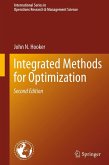
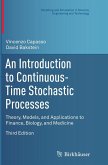

Finite-dimensional optimization problems occur throughout the mathematical sciences. The majority of these problems cannot be solved analytically. This introduction to optimization attempts to strike a balance between presentation of mathematical theory and development of numerical algorithms. Building on students' skills in calculus and linear algebra, the text provides a rigorous exposition without undue abstraction. Its stress on statistical applications will be especially appealing to graduate students of statistics and biostatistics. The intended audience also includes students in applied mathematics, computational biology, computer science, economics, and physics who want to see rigorous mathematics combined with real applications.
In this second edition the emphasis remains on finite-dimensional optimization. New material has been added on the MM algorithm, block descent and ascent, and the calculus of variations. Convex calculus is now treated in much greater depth. Advanced topics such as the Fenchel conjugate, subdifferentials, duality, feasibility, alternating projections, projected gradient methods, exact penalty methods, and Bregman iteration will equip students with the essentials for understanding modern data mining techniques in high dimensions.
In this second edition the emphasis remains on finite-dimensional optimization. New material has been added on the MM algorithm, block descent and ascent, and the calculus of variations. Convex calculus is now treated in much greater depth. Advanced topics such as the Fenchel conjugate, subdifferentials, duality, feasibility, alternating projections, projected gradient methods, exact penalty methods, and Bregman iteration will equip students with the essentials for understanding modern data mining techniques in high dimensions.