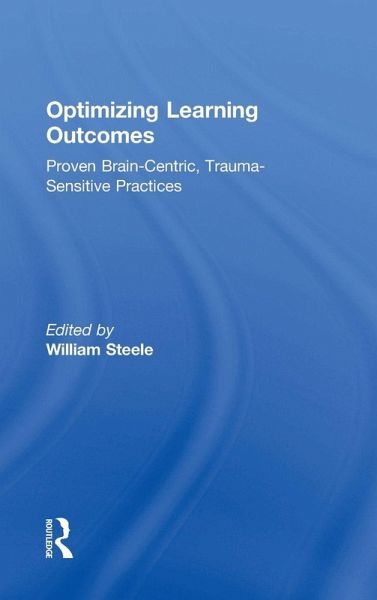
Optimizing Learning Outcomes provides answers for the most pressing questions that mental-health professionals, teachers, and administrators are facing in today's schools.
Optimizing Learning Outcomes provides answers for the most pressing questions that mental-health professionals, teachers, and administrators are facing in today's schools.
William Steele, PsyD, MSW, is the founder and was, for twenty-three years, the director of the National Institute for Trauma and Loss in Children (TLC), where he created trauma-specific, registered, evidence-based intervention programs and resources for schools and agencies. These programs are currently used in fifty-five countries. Now retired from TLC, he continues to write, consult, and train educators and practitioners across the United States.
Inhaltsangabe
About the Editor Contributors Acknowledgements Introduction 1.21st Century Neuroscience, Learning and Behavior: Not Doing More-Doing Differently William Steele 2. On Becoming a Self-Reg Haven Stuart Shanker and Susan Hopkins 3.Multi Sensory Practices for All: Changing Physiology, Behavior and Performance Roberta Sherf and Chris Bye 4.Students With Sensory Processing Challenges: Classroom Strategies Lindsey Biel 5.Brief Connections That Matter (CTMs): Student-Teacher Relationship William Steele 6. Growth Mindsets for Learning: Effective Effort Emily Diehl 7. Teacher Resilience, Sustained Effectiveness, and Self-Care William Steele 8. In School Neurological Reparative Therapy For Traumatized Students David Ziegler 9. A Vision for a Trauma-Sensitive School Susan F. Cole, Anne Eisner, Michael Gregory and Joel Ristuccia 10.Compassionate Schools: Responding to Kids Impacted by Adversity, Trauma, and Toxic Stress Ron Hertel and Susan O. Kincaid Appendices: Additional Sensory Processing Strategies Lindsey Biehl Trauma Related Intervention Considerations for IEP/504 Plan: Case Example Kathie Ritchie Additional Teaching & Learning Resources Kathie Ritchie Compassionate Schools Resources Ron Hertel and Susan O. Kincaid
About the Editor Contributors Acknowledgements Introduction 1.21st Century Neuroscience, Learning and Behavior: Not Doing More-Doing Differently William Steele 2. On Becoming a Self-Reg Haven Stuart Shanker and Susan Hopkins 3.Multi Sensory Practices for All: Changing Physiology, Behavior and Performance Roberta Sherf and Chris Bye 4.Students With Sensory Processing Challenges: Classroom Strategies Lindsey Biel 5.Brief Connections That Matter (CTMs): Student-Teacher Relationship William Steele 6. Growth Mindsets for Learning: Effective Effort Emily Diehl 7. Teacher Resilience, Sustained Effectiveness, and Self-Care William Steele 8. In School Neurological Reparative Therapy For Traumatized Students David Ziegler 9. A Vision for a Trauma-Sensitive School Susan F. Cole, Anne Eisner, Michael Gregory and Joel Ristuccia 10.Compassionate Schools: Responding to Kids Impacted by Adversity, Trauma, and Toxic Stress Ron Hertel and Susan O. Kincaid Appendices: Additional Sensory Processing Strategies Lindsey Biehl Trauma Related Intervention Considerations for IEP/504 Plan: Case Example Kathie Ritchie Additional Teaching & Learning Resources Kathie Ritchie Compassionate Schools Resources Ron Hertel and Susan O. Kincaid
Es gelten unsere Allgemeinen Geschäftsbedingungen: www.buecher.de/agb
Impressum
www.buecher.de ist ein Internetauftritt der buecher.de internetstores GmbH
Geschäftsführung: Monica Sawhney | Roland Kölbl | Günter Hilger
Sitz der Gesellschaft: Batheyer Straße 115 - 117, 58099 Hagen
Postanschrift: Bürgermeister-Wegele-Str. 12, 86167 Augsburg
Amtsgericht Hagen HRB 13257
Steuernummer: 321/5800/1497
USt-IdNr: DE450055826