
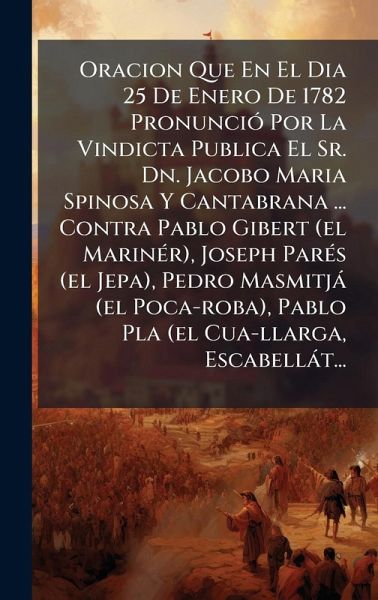
This historical document presents the speech delivered on January 25, 1782, by Jacobo Maria Spinosa Y Cantabrana as part of the public vindication against Pablo Gibert (el Marinér), Joseph Parés (el Jepa), Pedro Masmitjá (el Poca-roba), Pablo Pla (el Cua-llarga, Escabellát, ...). A fascinating glimpse into the legal and social customs of 18th-century Spain, this oration provides insight into the nature of crime and punishment during this period. The text offers a unique perspective on the individuals involved and the societal response to their alleged offenses. "Oracion Que En El Dia 25 De Enero De 1782 PronunciÃ3 Por La Vindicta Publica El Sr. Dn. Jacobo Maria Spinosa Y Cantabrana ... Contra Pablo Gibert (el Marinér), Joseph Parés (el Jepa), Pedro Masmitjá (el Poca-roba), Pablo Pla (el Cua-llarga, Escabellát...)" is an invaluable resource for historians, legal scholars, and anyone interested in the history of crime and justice in Spain. This work has been selected by scholars as being culturally important, and is part of the knowledge base of civilization as we know it. This work was reproduced from the original artifact, and remains as true to the original work as possible. Therefore, you will see the original copyright references, library stamps (as most of these works have been housed in our most important libraries around the world), and other notations in the work. This work is in the public domain in the United States of America, and possibly other nations. Within the United States, you may freely copy and distribute this work, as no entity (individual or corporate) has a copyright on the body of the work. As a reproduction of a historical artifact, this work may contain missing or blurred pages, poor pictures, errant marks, etc. Scholars believe, and we concur, that this work is important enough to be preserved, reproduced, and made generally available to the public. We appreciate your support of the preservation process, and thank you for being an important part of keeping this knowledge alive and relevant.