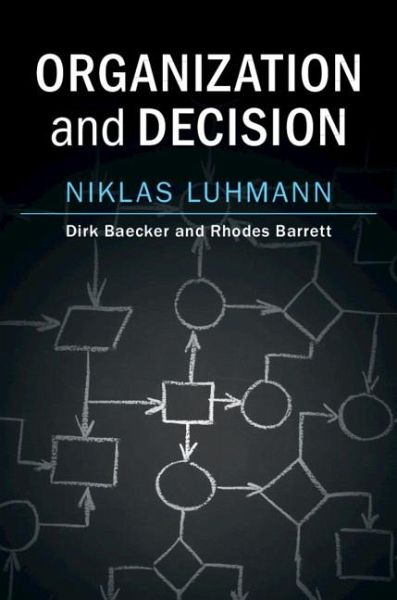
"Organizations deserve more attention than they have hitherto found-above all, a different sort of attention. This may seem a bold assertion given the many ways in which organizations are discussed in everyday communication and in the relevant scientific disciplines. But this is the very reason to concentrate our attention more strongly not on organizations as countable entities but on organization as a process. This is relevant from a theoretical perspective, given that inquiry into the essence of organization seems to have become unproductive (which is typical of questions of essence, indeed…mehr
"Organizations deserve more attention than they have hitherto found-above all, a different sort of attention. This may seem a bold assertion given the many ways in which organizations are discussed in everyday communication and in the relevant scientific disciplines. But this is the very reason to concentrate our attention more strongly not on organizations as countable entities but on organization as a process. This is relevant from a theoretical perspective, given that inquiry into the essence of organization seems to have become unproductive (which is typical of questions of essence, indeed of what- questions per se). But a different understanding of organization could prove important for the purposes of practical policy. Precisely because organizations (again in the plural) have become crucial, indispensable to modern life, it could be important to have a better grasp of their "intrinsic logic." Especially if heteronomy-be it subjection to owners or other "masters," to liberal or socialist ideologies, or to representatives of interests that are themselves organized-is increasingly called into question, it could be important to give organizations a conception of themselves that enables them to answer for themselves"--
Niklas Luhmann (1927-1998) ranks as one of the most important German social theorists of the twentieth century. His works have been highly influential in sociology and other social sciences, including organization studies. The significance of organizations for Luhmann can be traced in his biography: at the beginning of his career, he spent almost eight years as a legal expert in public administration, through which he gained professional expertise in the function of organizations. This practice inspired much of his later theoretical work at Harvard's Graduate School for Public Administration, the University for Public Administration at Speyer, the Center for Social Research in Dortmund, where he was head of department, and at the Department for Sociology at Bielefeld University, where he largely refrained from administrative work. This book, which was one of Luhmann's last, can be regarded as his conclusion to over thiry years of research on organized social systems.
Inhaltsangabe
1. Organization theory: the classical constructions 2. Organization as an autopoietic system 3. Membership and motives 4. The paradox of decision-making 5. Time relations 6. Uncertainty absorption 7. Decision premises 8. Decision programs 9. Personnel 10. The organization of organization 11. Structural change: the poetry of reform and the reality of evolution 12. Technology 13. Organization and society 14. Self-description 15. Rationality Conclusion: theory and practice.
1. Organization theory: the classical constructions 2. Organization as an autopoietic system 3. Membership and motives 4. The paradox of decision-making 5. Time relations 6. Uncertainty absorption 7. Decision premises 8. Decision programs 9. Personnel 10. The organization of organization 11. Structural change: the poetry of reform and the reality of evolution 12. Technology 13. Organization and society 14. Self-description 15. Rationality Conclusion: theory and practice.
Es gelten unsere Allgemeinen Geschäftsbedingungen: www.buecher.de/agb
Impressum
www.buecher.de ist ein Internetauftritt der buecher.de internetstores GmbH
Geschäftsführung: Monica Sawhney | Roland Kölbl | Günter Hilger
Sitz der Gesellschaft: Batheyer Straße 115 - 117, 58099 Hagen
Postanschrift: Bürgermeister-Wegele-Str. 12, 86167 Augsburg
Amtsgericht Hagen HRB 13257
Steuernummer: 321/5800/1497
USt-IdNr: DE450055826