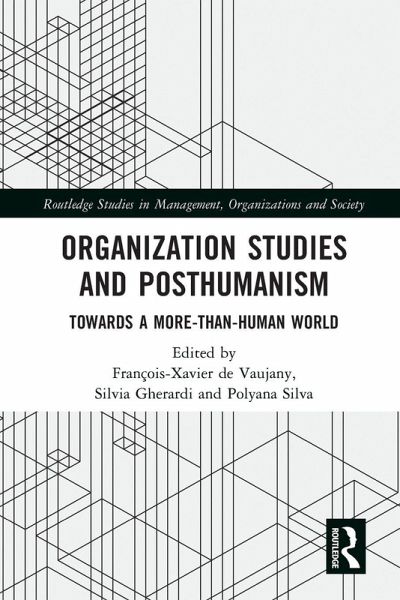
François-Xavier de Vaujany is full professor of Organization Studies at Université Paris Dauphine-PSL and researcher within DRM. His research deals with the political and societal dimensions of (new) ways of organizing work and their management. He is particularly interested in the time-space of contemporary digital organization of work. Post-phenomenologies and process philosophy are key perspectives of his research emphasizing the apocalyptic process of digital management and organization. Silvia Gherardi is senior professor of sociology of organization at the University of Trento (Italy), where she founded the Research Unit on Communication, Organizational Learning, and Aesthetics (www.unitn.it/rucola). She is also professor II at the School of Business, Society and Engineering, M¿lardalens University (Sweden). She received the degree of "Doctor Honoris Causa" from Roskilde University (2005), East Finland University (2010) and St Andrews University (2014). Her research interests include feminist new materialism, entrepreneurship, epistemology of practice, and postqualitative methodologies in organization studies. Polyana Silva is currently a PhD candidate at the University of Sao Paulo, where she is conducting research on the enmeshed aspects of life in a digitalized and virtualized worlds. Her particular areas of interest include virtual worlds, virtual beings, and metaverse projects, which she approaches from a posthumanist perspective. She has been part of organizing committees of research-oriented events such as the Chaire France-Brésil USP, a Chaire devoted to "Digitality and Management: Presence, Time and Space"; and the Organizations, Artifacts & Practices (OAP) Workshop. She is a member of the research groups "Public Sector Accounting and Governance in Brazil (PSAG)" and Meta:lab - Metaverse Laboratory for Research and Innovation.
Inhaltsangabe
Introduction: Too-human? Inquiring in-between different disciplinary areas in Managing and Organizing Part I: Contextualizing the debate in a more-than-human world 1.1 We are the Missing People: On posthumanist onto-epistemologies in Organization Studies 1.2 Entrepreneuring as multispecies composting 1.3 From Legitimation to Alegitimation: Inviting Posthuman and Prehuman Ontologies into Theories of Institutions 1.4 Posthumanism as a system of codifying events Part II: Posthumanism in the world of management and organizing 2.1. Mapping the Posthumanist Conversations in Organization Studies 2.2. How practice theory participates to the critical posthumanist conversations 2.3 Posthumanism and sociomaterial organising: The case of Superbergamo's aid practices during the Covid19 pandemic 2.4 Between action and deliberation: Contributions of a posthumanist practice theory approach 2.5 Deleuzoguattarian cartographies of work and organizing in the human-robotic workplace Part III: Posthumanism: History or becoming? 3.1 Monsters and myths: Transhuman temporal narratives and mind/body problems 3.2 Lacan's challenge to posthumanism: The ethical case for speaking subjects 3.3 Edith Stein's Realms amid Posthumanism's Evolving Landscape: Conversations on the subject of "Subjectivity" 3.4 From expertise to encounter: Repopulating the inquiry for worldly healing General Conclusion: The Paradoxical Invitation of Posthumanism to Organization Studies: Between Processuality and Criticality
Introduction: Too-human? Inquiring in-between different disciplinary areas in Managing and Organizing Part I: Contextualizing the debate in a more-than-human world 1.1 We are the Missing People: On posthumanist onto-epistemologies in Organization Studies 1.2 Entrepreneuring as multispecies composting 1.3 From Legitimation to Alegitimation: Inviting Posthuman and Prehuman Ontologies into Theories of Institutions 1.4 Posthumanism as a system of codifying events Part II: Posthumanism in the world of management and organizing 2.1. Mapping the Posthumanist Conversations in Organization Studies 2.2. How practice theory participates to the critical posthumanist conversations 2.3 Posthumanism and sociomaterial organising: The case of Superbergamo's aid practices during the Covid19 pandemic 2.4 Between action and deliberation: Contributions of a posthumanist practice theory approach 2.5 Deleuzoguattarian cartographies of work and organizing in the human-robotic workplace Part III: Posthumanism: History or becoming? 3.1 Monsters and myths: Transhuman temporal narratives and mind/body problems 3.2 Lacan's challenge to posthumanism: The ethical case for speaking subjects 3.3 Edith Stein's Realms amid Posthumanism's Evolving Landscape: Conversations on the subject of "Subjectivity" 3.4 From expertise to encounter: Repopulating the inquiry for worldly healing General Conclusion: The Paradoxical Invitation of Posthumanism to Organization Studies: Between Processuality and Criticality
Es gelten unsere Allgemeinen Geschäftsbedingungen: www.buecher.de/agb
Impressum
www.buecher.de ist ein Internetauftritt der buecher.de internetstores GmbH
Geschäftsführung: Monica Sawhney | Roland Kölbl | Günter Hilger
Sitz der Gesellschaft: Batheyer Straße 115 - 117, 58099 Hagen
Postanschrift: Bürgermeister-Wegele-Str. 12, 86167 Augsburg
Amtsgericht Hagen HRB 13257
Steuernummer: 321/5800/1497
USt-IdNr: DE450055826