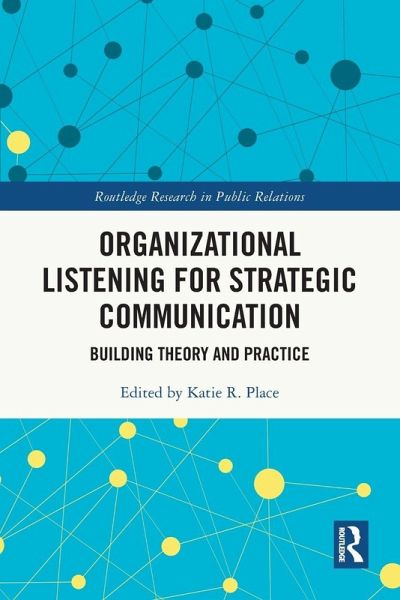
Embracing listening as a useful tool for strengthening organization-publics and organization-employee relationships, this book offers theoretical and practical insights for listening across myriad strategic communication contexts.
Embracing listening as a useful tool for strengthening organization-publics and organization-employee relationships, this book offers theoretical and practical insights for listening across myriad strategic communication contexts.
Katie R. Place is Professor of Strategic Communication in the School of Communication at Quinnipiac University, USA. Her research examines power, ethics, and listening in public relations. She has authored more than 60 conference papers or publications in such peer-reviewed journals as Journal of Public Relations Research, Public Relations Review, and Journal of Media Ethics.
Inhaltsangabe
Unit 1: Organizational Listening Competencies and Technologies 1.Stakeholders' Conceptualizations of Organizational Listening 2. Incorporating competent interpersonal listening practices in social media 3. Developing Organizational Employee Communication Competency Diagnostics : Breaking Employee Silence via Organizational Climate of Listening for Dialogic Employee Communication 4: The Power of AI-Enabled Chatbots as an Organizational Social Listening Tool 5. Evaluating Organizational Listening: Models and Methods for Measuring the Value of Listening for Identifying Opportunities, Risks, and Crises Unit 2: Organizational Listening for Ethics and Justice 6. The State of Ethical Listening to External Stakeholders in U.S. Organizations 7. Why Are Organizations Criticized for Not Listening? Findings from Practitioners and Publics 8. Improving Organizational Listening to Build Trust with Black Residents and Disrupt Racism in Local Government 9. Organizational Social Listening & Corporate Climate Advocacy: Amazon & Amazon Employees for Climate Justice Unit 3: Organizational Listening for Diversity, Equity, and Inclusion 10. Organizational Listening for Diversity, Equity & Inclusion 11. Listening in polarized times: Centering presence in Arendt's actualized plurality for organizational listening 12. Listening to historically marginalized publics: A conceptualization of perceived organizational listening in LGBTQ advocacy 13. Organizational Listening and Empowered women in the workplace: A cross-cultural comparison between the U.S. and South Korea Unit 4: Cultural and Global Considerations for Organizational Listening 14. The Local and the Global in Organizational Listening Amidst an Evolving Media Landscape 15. Listening across borders: Global considerations for listening and public diplomacy Conclusion. The Future of Organizational Listening Research and Practice
Unit 1: Organizational Listening Competencies and Technologies 1.Stakeholders' Conceptualizations of Organizational Listening 2. Incorporating competent interpersonal listening practices in social media 3. Developing Organizational Employee Communication Competency Diagnostics : Breaking Employee Silence via Organizational Climate of Listening for Dialogic Employee Communication 4: The Power of AI-Enabled Chatbots as an Organizational Social Listening Tool 5. Evaluating Organizational Listening: Models and Methods for Measuring the Value of Listening for Identifying Opportunities, Risks, and Crises Unit 2: Organizational Listening for Ethics and Justice 6. The State of Ethical Listening to External Stakeholders in U.S. Organizations 7. Why Are Organizations Criticized for Not Listening? Findings from Practitioners and Publics 8. Improving Organizational Listening to Build Trust with Black Residents and Disrupt Racism in Local Government 9. Organizational Social Listening & Corporate Climate Advocacy: Amazon & Amazon Employees for Climate Justice Unit 3: Organizational Listening for Diversity, Equity, and Inclusion 10. Organizational Listening for Diversity, Equity & Inclusion 11. Listening in polarized times: Centering presence in Arendt's actualized plurality for organizational listening 12. Listening to historically marginalized publics: A conceptualization of perceived organizational listening in LGBTQ advocacy 13. Organizational Listening and Empowered women in the workplace: A cross-cultural comparison between the U.S. and South Korea Unit 4: Cultural and Global Considerations for Organizational Listening 14. The Local and the Global in Organizational Listening Amidst an Evolving Media Landscape 15. Listening across borders: Global considerations for listening and public diplomacy Conclusion. The Future of Organizational Listening Research and Practice
Es gelten unsere Allgemeinen Geschäftsbedingungen: www.buecher.de/agb
Impressum
www.buecher.de ist ein Internetauftritt der buecher.de internetstores GmbH
Geschäftsführung: Monica Sawhney | Roland Kölbl | Günter Hilger
Sitz der Gesellschaft: Batheyer Straße 115 - 117, 58099 Hagen
Postanschrift: Bürgermeister-Wegele-Str. 12, 86167 Augsburg
Amtsgericht Hagen HRB 13257
Steuernummer: 321/5800/1497
USt-IdNr: DE450055826