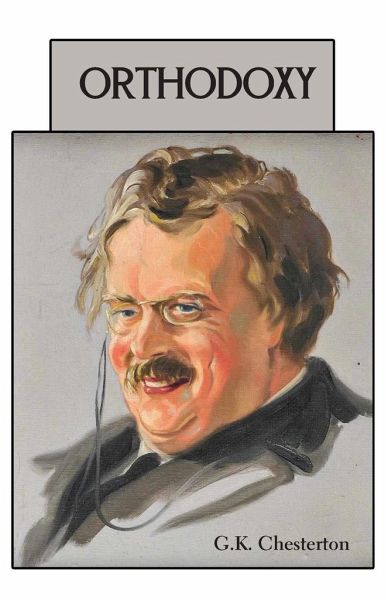
This book is meant to be a companion to "Heretics," and to put the positive side in addition to the negative. Many critics complained of the book called "Heretics" because it merely criticised current philosophies without offering any alternative philosophy. This book is an attempt to answer the challenge. It is unavoidably affirmative and therefore unavoidably autobiographical. The writer has been driven back upon somewhat the same difficulty as that which beset Newman in writing his Apologia; he has been forced to be egotistical only in order to be sincere. While everything else may be…mehr
This book is meant to be a companion to "Heretics," and to put the positive side in addition to the negative. Many critics complained of the book called "Heretics" because it merely criticised current philosophies without offering any alternative philosophy. This book is an attempt to answer the challenge. It is unavoidably affirmative and therefore unavoidably autobiographical. The writer has been driven back upon somewhat the same difficulty as that which beset Newman in writing his Apologia; he has been forced to be egotistical only in order to be sincere. While everything else may be different the motive in both cases is the same. It is the purpose of the writer to attempt an explanation, not of whether the Christian Faith can be believed, but of how he personally has come to believe it. The book is therefore arranged upon the positive principle of a riddle and its answer. It deals first with all the writer's own solitary and sincere speculations and then with all the startling style in which they were all suddenly satisfied by the Christian Theology. The writer regards it as amounting to a convincing creed. But if it is not that it is at least a repeated and surprising coincidence. Gilbert K. Chesterton
Gilbert Keith Chesterton KC*SG was an English author, philosopher, Christian defender, and literary and art reviewer who was born on May 29, 1874, and died on June 14, 1936. Chesterton wrote about theology and made up the character Father Brown, a priest-detective. Some people who don't agree with him have seen how popular books like Orthodoxy and The Everlasting Man are. Chesterton often called himself a "orthodox Christian," and this view became more and more similar to Catholicism until he finally left high church Anglicanism. Authors from the Victorian era like Matthew Arnold, Thomas Carlyle, John Henry Newman, and John Ruskin saw him as an heir. The "prince of paradox" has been used to describe him. A review in Time said this about Chesterton's writing style: "Whenever possible, Chesterton made his points with popular sayings, proverbs, and allegories-first carefully turning them inside out." His writings had an impact on Jorge Luis Borges, who said that his writings were like Edgar Allan Poe's. Chesterton was born in Campden Hill, Kensington, London. His father, Edward Chesterton (1841-1922), was an estate agent, and his mother, Marie Louise Grosjean, was from Switzerland and France. Chesterton was baptized into the Church of England when he was one month old, even though his family was a Unitarian and only sometimes followed their beliefs.
Es gelten unsere Allgemeinen Geschäftsbedingungen: www.buecher.de/agb
Impressum
www.buecher.de ist ein Internetauftritt der buecher.de internetstores GmbH
Geschäftsführung: Monica Sawhney | Roland Kölbl | Günter Hilger
Sitz der Gesellschaft: Batheyer Straße 115 - 117, 58099 Hagen
Postanschrift: Bürgermeister-Wegele-Str. 12, 86167 Augsburg
Amtsgericht Hagen HRB 13257
Steuernummer: 321/5800/1497
USt-IdNr: DE450055826