
Andere Kunden interessierten sich auch für
 The Defendant11,00 €
 Robert Burns How To Know Him21,00 €
 All Things Considered17,00 €
 The Ballad of St. Barbara11,00 €
 The First Christmas Tree9,95 €
 Sanders of the river21,00 €
 The first men in the moon21,00 €



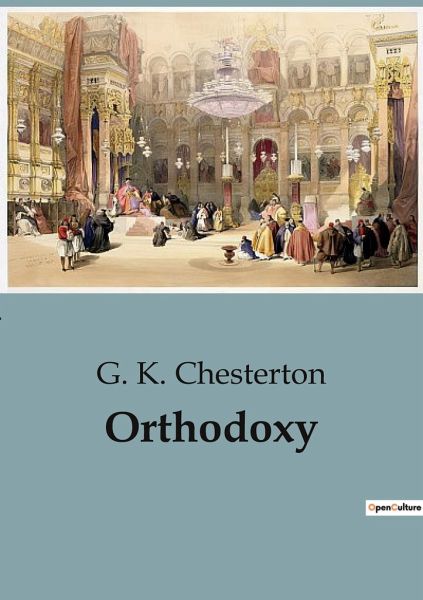
In "Orthodoxy," G.K. Chesterton embarks on a philosophical journey to explore the paradoxes of modern thought and the defense of reason. The text begins with an introduction that sets the stage for a response to critics who challenged Chesterton to articulate his own cosmic theory. He humorously describes his realization that his seemingly novel ideas were, in fact, aligned with traditional Christian orthodoxy. The narrative unfolds with a discussion on the nature of sanity and madness, where Chesterton argues that reason, when detached from mysticism, can lead to insanity. He illustrates this with the metaphor of a man who believes he has discovered England, only to find it was already known-a reflection of his own intellectual journey. Chesterton critiques the modern world's tendency to isolate virtues, leading to their distortion. He highlights how humility, once a virtue that encouraged change, has shifted to undermine conviction, resulting in a society that doubts its own beliefs. This misplaced humility, he argues, is more dangerous than arrogance. The text delves into the dangers of unchecked skepticism, warning that it can lead to the destruction of reason itself. Chesterton asserts that reason requires faith, as it is an act of faith to believe that our thoughts correspond to reality. The work is a defense of the necessity of religious authority as a safeguard for reason, arguing that without it, the human intellect risks self-destruction. Chesterton's exploration is not merely an academic exercise but a personal reflection on his own intellectual evolution, ultimately affirming the value of Christian orthodoxy as a framework that balances reason and mysticism.