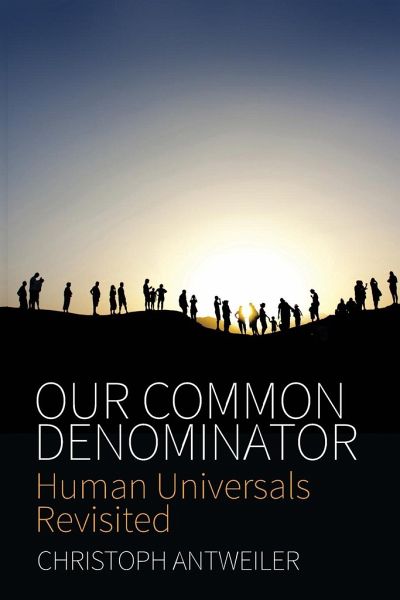
A re-assertion of the importance of "universals" or cross-cultural commonalities in anthropological research. Poses the question of how anthropology can help mankind approach humanity from a vantage point open to commonalities.
A re-assertion of the importance of "universals" or cross-cultural commonalities in anthropological research. Poses the question of how anthropology can help mankind approach humanity from a vantage point open to commonalities.
Christoph Antweiler is an anthropologist and Professor of Southeast Asian Studies at the University of Bonn, Germany. He is a member of the Academia Europaea, London and serves on the advisory board of the Humboldt Forum, Berlin.
Inhaltsangabe
List of Tables Preface Introduction Chapter 1. Humankind: Current Societal Debates * Universal Postulates Everywhere! * Popular Universality in Visual Media: "The Family of Man" * Normative Universalism Chapter 2. A World of Cultures: Their Differences and Likenesses * Finding Patterns in Diversity: George Peter Murdock and Donald Edward Brown * Universals as Subject Matter: Concept, Terms and Metaphors * Universals do matter: The Relevance of Universals in General and for Cultural Studies * Universals in Cultural Anthropology Today: the forgotten Half in the Science of Humanity Chapter 3. Cultures and Human Nature: Human Beings are biologically Cultural * The Nexus of Intra-cultural Diversity and Universals * Human Nature and the Proper Image of Who We Are * Homo sapiens: Uniqueness versus Special Status Chapter 4. Universals: Examples from Several Realms * Qualifying Remarks * Narration and Expressive Culture * Sociality * Worldview and Images of Humanity * Rituals and Beliefs * Cognition and Knowledge * Languages and Speaking * Behavior and Experience * Gender, Sexuality and Social Reproduction Chapter 5. Methods: Deduction, Case Studies and Comparison * Finding Potential Candidates and Deducing from Theory * Case Studies: Testing Postulated Universals * Concepts beyond Cultural Bias? * Inventories of Universals * Evaluating Lists of Universals and Holistic Forms of Representation * Cross-cultural Comparison * Cross-species Comparison Chapter 6. Taxonomy: The Forms, Levels and Depth of Universals * Levels, Spheres and Time Frame * Substance and Depth * Degree of Universality * Conditional Universals and other Specific Forms * Relations between basic Anthropological Orientations Chapter 7. Toward Explanation: Why do Universals exist? * Ten Pitfalls in Research and in Anti-universalism * Systematics of Explanatory Approaches * Cultural Contact: Universals through Cultural Transfer and Diffusion * Function, Convergence and Structural Implication: Emerging Universals through Real-Life Circumstances * Evolution: Universals Based on Adaptation * Complex Causes Chapter 8. Critical Positions: Arguments against Universalism * Reification, Hidden Syllogisms and Implicit Primitivity * Relativist and Empirical Criticisms * Fundamental Criticism: Charges of Eurocentrism and Hegemony Chapter 9. Synthesis: Human Universals and the Human Sciences Bibliography Index
List of Tables Preface Introduction Chapter 1. Humankind: Current Societal Debates * Universal Postulates Everywhere! * Popular Universality in Visual Media: "The Family of Man" * Normative Universalism Chapter 2. A World of Cultures: Their Differences and Likenesses * Finding Patterns in Diversity: George Peter Murdock and Donald Edward Brown * Universals as Subject Matter: Concept, Terms and Metaphors * Universals do matter: The Relevance of Universals in General and for Cultural Studies * Universals in Cultural Anthropology Today: the forgotten Half in the Science of Humanity Chapter 3. Cultures and Human Nature: Human Beings are biologically Cultural * The Nexus of Intra-cultural Diversity and Universals * Human Nature and the Proper Image of Who We Are * Homo sapiens: Uniqueness versus Special Status Chapter 4. Universals: Examples from Several Realms * Qualifying Remarks * Narration and Expressive Culture * Sociality * Worldview and Images of Humanity * Rituals and Beliefs * Cognition and Knowledge * Languages and Speaking * Behavior and Experience * Gender, Sexuality and Social Reproduction Chapter 5. Methods: Deduction, Case Studies and Comparison * Finding Potential Candidates and Deducing from Theory * Case Studies: Testing Postulated Universals * Concepts beyond Cultural Bias? * Inventories of Universals * Evaluating Lists of Universals and Holistic Forms of Representation * Cross-cultural Comparison * Cross-species Comparison Chapter 6. Taxonomy: The Forms, Levels and Depth of Universals * Levels, Spheres and Time Frame * Substance and Depth * Degree of Universality * Conditional Universals and other Specific Forms * Relations between basic Anthropological Orientations Chapter 7. Toward Explanation: Why do Universals exist? * Ten Pitfalls in Research and in Anti-universalism * Systematics of Explanatory Approaches * Cultural Contact: Universals through Cultural Transfer and Diffusion * Function, Convergence and Structural Implication: Emerging Universals through Real-Life Circumstances * Evolution: Universals Based on Adaptation * Complex Causes Chapter 8. Critical Positions: Arguments against Universalism * Reification, Hidden Syllogisms and Implicit Primitivity * Relativist and Empirical Criticisms * Fundamental Criticism: Charges of Eurocentrism and Hegemony Chapter 9. Synthesis: Human Universals and the Human Sciences Bibliography Index
Es gelten unsere Allgemeinen Geschäftsbedingungen: www.buecher.de/agb
Impressum
www.buecher.de ist ein Internetauftritt der buecher.de internetstores GmbH
Geschäftsführung: Monica Sawhney | Roland Kölbl | Günter Hilger
Sitz der Gesellschaft: Batheyer Straße 115 - 117, 58099 Hagen
Postanschrift: Bürgermeister-Wegele-Str. 12, 86167 Augsburg
Amtsgericht Hagen HRB 13257
Steuernummer: 321/5800/1497
USt-IdNr: DE450055826