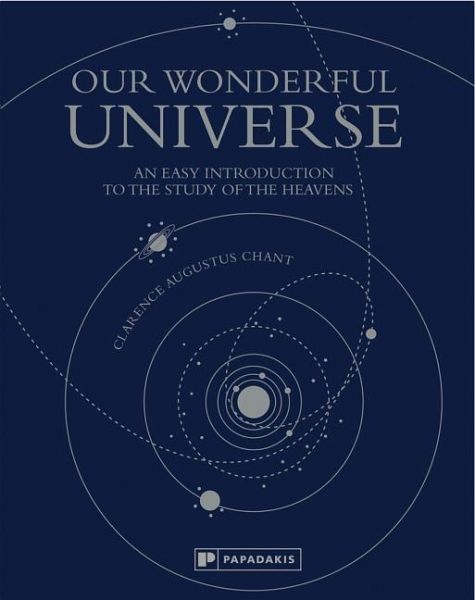
Written in a clear and charming style, Our Wonderful Universe is developed in the form of a talk, presenting the fundamental facts of astronomy in a simple and logical progression. It is illustrated with the complete set of drawings and plates that accompanied the original edition.
Written in a clear and charming style, Our Wonderful Universe is developed in the form of a talk, presenting the fundamental facts of astronomy in a simple and logical progression. It is illustrated with the complete set of drawings and plates that accompanied the original edition.
Clarence Augustus Chant (May 31, 1865 - November 18, 1956) was a Canadian astronomer and physicist. He is considered by many to be the father of Canadian astronomy , and indeed, five of his former students went on to become directors of astronomical observatories. Educated at the University of Toronto and Harvard, he taught at the University of Toronto from 1891 until his retirement in 1935. Chant was notable for his early work on X-ray photographs, but especially for his development of Canadian astronomy. In 1907, during his last year as President of the Royal Astronomical Society, he created the Journal of the Royal Astronomical Society of Canada and the Observer's Handbook. He would remain the editor of both publications until his death in 1956. Chant participated in five total solar-eclipse expeditions, the most important being the one he led to Australia in 1922 to test Einstein's theory of the deflection of starlight by a massive body. In 1928 he published Our Wonderful Universe with enormous success; it was translated into five languages. Through his efforts, the dream of a great observatory near Toronto came to fruition in 1933, when Mrs David Dunlap presented to the University of Toronto an observatory with a 74-inch (1.88 m) telescope. It remains to this day the largest optical telescope in Canada. He died at 91 during the November 1956 lunar eclipse, while still residing at the Observatory House. Asteroid 3341 is named in his honor, and in 1940, the Royal Astronomical Society of Canada created the Chant Medal, awarded each year to a Canadian amateur astronomer in recognition of their work.
Inhaltsangabe
Part I: The Celestial Sphere and its Motions Chapter I The Celestial Sphere Chapter II The Motion of the Sun and the Moon in the Sky Part II: The Sun and its System Chapter III The Planetary System – The Earth Chapter IV The Sun and the Moon Chapter V Mercury and Venus Chapter VI Mars Chapter VII Jupiter – Saturn – Uranus – Neptune Chapter VIII Asteroids – The Nebular Hypothesis – Comets – Meteors Part III: The Universe of Stars Chapter IX The Stars in Their Seasons Chapter X The Number of the Stars; Their Distances The Nebulae Chapter XI Dark Markings – Clusters – The Nature of the Stars Appendix: Some Interesting Astronomical Facts Index Acknowledgements
Part I: The Celestial Sphere and its Motions Chapter I The Celestial Sphere Chapter II The Motion of the Sun and the Moon in the Sky Part II: The Sun and its System Chapter III The Planetary System – The Earth Chapter IV The Sun and the Moon Chapter V Mercury and Venus Chapter VI Mars Chapter VII Jupiter – Saturn – Uranus – Neptune Chapter VIII Asteroids – The Nebular Hypothesis – Comets – Meteors Part III: The Universe of Stars Chapter IX The Stars in Their Seasons Chapter X The Number of the Stars; Their Distances The Nebulae Chapter XI Dark Markings – Clusters – The Nature of the Stars Appendix: Some Interesting Astronomical Facts Index Acknowledgements
Es gelten unsere Allgemeinen Geschäftsbedingungen: www.buecher.de/agb
Impressum
www.buecher.de ist ein Internetauftritt der buecher.de internetstores GmbH
Geschäftsführung: Monica Sawhney | Roland Kölbl | Günter Hilger
Sitz der Gesellschaft: Batheyer Straße 115 - 117, 58099 Hagen
Postanschrift: Bürgermeister-Wegele-Str. 12, 86167 Augsburg
Amtsgericht Hagen HRB 13257
Steuernummer: 321/5800/1497
USt-IdNr: DE450055826