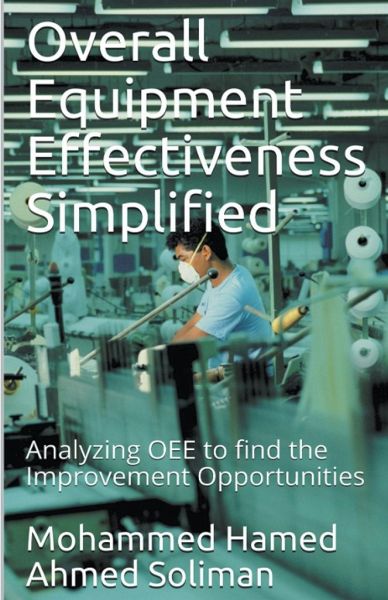
Boost Manufacturing Performance by Mastering OEE Is your equipment running at peak efficiency-or costing you money in hidden losses? In Overall Equipment Effectiveness Simplified, you'll learn how to uncover and eliminate the hidden inefficiencies in your production line using one of the most powerful metrics in manufacturing: OEE. This hands-on guide will help you:Understand the 3 core pillars: Availability, Performance, and Quality Diagnose problems using Six Big Losses Link OEE to Total Productive Maintenance (TPM) and Lean initiatives Discover real-world improvement opportunities-fast…mehr
Boost Manufacturing Performance by Mastering OEE Is your equipment running at peak efficiency-or costing you money in hidden losses? In Overall Equipment Effectiveness Simplified, you'll learn how to uncover and eliminate the hidden inefficiencies in your production line using one of the most powerful metrics in manufacturing: OEE. This hands-on guide will help you:Understand the 3 core pillars: Availability, Performance, and Quality Diagnose problems using Six Big Losses Link OEE to Total Productive Maintenance (TPM) and Lean initiatives Discover real-world improvement opportunities-fast Whether you're a production manager, process engineer, or continuous improvement leader, this book gives you the tools to stop guesswork and start data-driven improvement. More about this Book: Overall Equipment Effectiveness (OEE): A measurement of total productive maintenance (TPM) that quantifies how efficiently equipment is used. OEE is derived from three factors:Availability rate: calculates the percentage of scheduled time lost due to equipment breakdowns and changeovers Performance rate: measures operating speed losses-running slower than the design speed and brief stops Quality rate: calculates the percentage of parts lost to scrap and rework OEE is calculated by multiplying these three components, and each one presents numerous improvement opportunities. The six primary losses-failures, modifications, small stoppages, lower operating speeds, and scrap-are often the focus of OEE, but some businesses also include other significant measures they deem important.
Dr. Mohammed Hamed Ahmed Soliman is an internationally recognized Lean expert, author, and university lecturer. He has published over 100 books and articles on Lean thinking, quality systems, and industrial excellence. He currently teaches Industrial Engineering and Management Systems at the American University in Cairo, an Executive Advisor and a member of the Advisory Committee of the IEOM International Society, and consults for global organizations across manufacturing, public services, and education. With nearly two decades of academic and professional experience, Dr. Soliman has trained professionals across the Middle East, including engagements with Princess Nourah University in Saudi Arabia and Vale Oman Pelletizing Company. He has designed and delivered over 60 leadership and technical development programs, helping organizations build a culture of continuous improvement and operational excellence. Earlier in his career, he worked in various industrial sectors including crystal-glass manufacturing, fertilizers, and chemicals, while educating teams on the Toyota Production System. He has led numerous lean transformation projects, delivering measurable results and uncovering substantial cost savings by targeting waste across production and service environments. His lectures and training materials have reached over 200,000 learners via SlideShare, and his research is ranked among the most downloaded papers on the Social Science Research Network (SSRN) by Elsevier. Dr. Soliman holds a BSc in Engineering, a master's in Quality Management, and postgraduate degrees in Industrial Engineering and Engineering Management. He also holds certifications in quality, cost, and operations management. He is a member of the Institute of Industrial and Systems Engineers (IISE) and the Society for Engineering and Management Systems (SEMS). His insights have been featured in SAGE Publications, Industrial Management, Lean Thinking, and other peer-reviewed platforms.
Es gelten unsere Allgemeinen Geschäftsbedingungen: www.buecher.de/agb
Impressum
www.buecher.de ist ein Internetauftritt der buecher.de internetstores GmbH
Geschäftsführung: Monica Sawhney | Roland Kölbl | Günter Hilger
Sitz der Gesellschaft: Batheyer Straße 115 - 117, 58099 Hagen
Postanschrift: Bürgermeister-Wegele-Str. 12, 86167 Augsburg
Amtsgericht Hagen HRB 13257
Steuernummer: 321/5800/1497
USt-IdNr: DE450055826