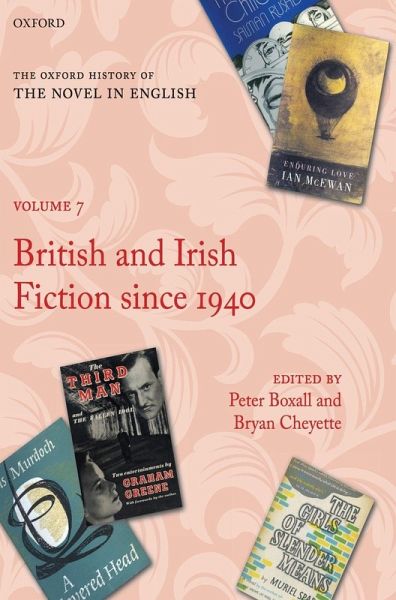
This volume offers the fullest and most nuanced account available of the last eight decades of British prose fiction. It begins during the Second World War, when novel production fell by more than a third, and ends at a time when new technologies have made possible the publication of an unprecedented number of fiction titles and have changed completely the relationship between authors, publishers, the novel and the reader. The collection is made up of thirty-four chapters by leading scholars in the fieldwho detail the impact of global warfare on the novel from the Second World War to the Cold…mehr
This volume offers the fullest and most nuanced account available of the last eight decades of British prose fiction. It begins during the Second World War, when novel production fell by more than a third, and ends at a time when new technologies have made possible the publication of an unprecedented number of fiction titles and have changed completely the relationship between authors, publishers, the novel and the reader. The collection is made up of thirty-four chapters by leading scholars in the fieldwho detail the impact of global warfare on the novel from the Second World War to the Cold War to the twenty-first century; the reflexive continuities of late modernism; the influence of film and television on the novel form; mobile and fluid connectionsbetween sexuality, gender and different periods of women's writing; a broad range of migrant and ethnic fictions; and the continuities and discontinuities of prose fiction in different regional, national, class and global contexts. Across the volume there is a blurring of the boundary between genre fiction and literary fiction, as the literary thinking of the period is traced in the spy novel, the children's novel, the historical novel, the serial novel, shorter fiction, the science fiction novel, and the comic novel. The final chapters of the volume explore the relationship of twenty-first century fiction to post-war culture, and show how this new fiction both emerges from the history of the novel, and prefigures the novel to come.
Peter Boxall is Professor of English at the University of Sussex. His books include Don DeLillo: The Possibility of Fiction (Routledge, 2006), Since Beckett: Contemporary Writing in the Wake of Modernism (Continuum, 2009) and Twenty-First Century Fiction: A Critical Introduction (CUP, 2013). He has edited a number of collections, including Thinking Poetry and Beckett/Aesthetics/Politics, and a recent Faber edition of Beckett's novel Malone Dies. He is also the editor of Textual Practice and 1001 Books. His most recent book, The Value of the Novel, is forthcoming with CUP in 2015. He is currently working on a book entitled The Prosthetic Imagination: A History of the Novel as Artificial Life. Bryan Cheyette is Chair of Modern Literature at the University of Reading. He has held visiting appointments at the University of Michigan, Dartmouth College and the University of Pennsylvania. His books include Muriel Spark: The Writer and Her Work (2000) and Diasporas of the Mind: Jewish and Postcolonial Writing and the Nightmare of History (2014). He is the editor of six previous books, most notably Between 'Race' and Culture (1996), Modernity, Culture and 'the Jew' (1997), and Contemporary Jewish Writing in Britain and Ireland (1998). He is currently working on a biography of Israel Zangwill and he has reviewed contemporary fiction for the TLS, The Independent and the Guardian.
Inhaltsangabe
* Introduction: The Life and Death of the Post-War Novel * Part 1: 1940-1973: Key Figures and Contexts * 1: Andrew Nash: The Material History of the Novel I: 1940-1973 * 2: Lara Feigel: Fiction during the Second World War * 3: Robert Eaglestone: The Question of Evil: Neo-Christianity and the Novel * 4: Nicola Wilson: Working Class Fictions * 5: John McLeod: The Novel and the End of Empire * 6: C.L. Innes: Migrant Writing * 7: Liz Sage: Women's Fiction after the War * 8: Zachary Leader: The Movement towards Englishness * 9: Tyrus Miller: The Continuities of Late Modernism: Before and after Beckett * 10: Philip Tew: Comedy, Class and Nation * 11: Michael Cronin: In the Wake of Joyce: Irish Writing after 1939 * 12: Rod Mengham: Judging the Distance: Fiction with Europe in Mind * Part 2: Genres/Subgenres * 13: Laura Marcus: Cinematic and Televisual Fiction * 14: John Brannigan: The Novel as History * 15: Nick Bentley: The Novel Sequence * 16: Adrian Hunter: Novel, Novella, Short Story * 17: Martin Priestman: Spies, Detectives and Heroes: From the Cold War to the War on Terror * 18: Peter Hunt: The Children's Novel * 19: Emma Parker: Queers, Chaps, Chicks and Lads * 20: Nadia Valman: Jewish Fictions * 21: Liam Connell: The Regional and the Global * 22: Sherryl Vint: Dystopian Science Fiction and the Return of the Gothic * Part 3: 1973-Present: Key Figures and Contexts * 23: Andrew Nash: The Material History of the Novel II 1973-Present * 24: Paul Crosthwaite: Fiction and Trauma from the Second World War to 9/11 * 25: David James: Decentring Englishness * 26: Mary Eagleton: The Feminist Novel * 27: Peter Morey: Black British and British Asian Fiction * 28: Matthew Hart: A Plurinational Literature? Nationalism in British and Northern Irish Fiction Since 1970 * 29: Scott Hames: The New Scottish Renaissance? * 30: Derek Hand: Ireland and Europe after 1973 * 31: Kirsti Bohata: Welsh Fiction: 1979, 1997 and after * Part IV: Approaching the Twenty-first Century Novel * 32: Berthold Schoene: Twenty-First Century Fiction * 33: Peter Boxall and Bryan Cheyette: The Future of the Novel
* Introduction: The Life and Death of the Post-War Novel * Part 1: 1940-1973: Key Figures and Contexts * 1: Andrew Nash: The Material History of the Novel I: 1940-1973 * 2: Lara Feigel: Fiction during the Second World War * 3: Robert Eaglestone: The Question of Evil: Neo-Christianity and the Novel * 4: Nicola Wilson: Working Class Fictions * 5: John McLeod: The Novel and the End of Empire * 6: C.L. Innes: Migrant Writing * 7: Liz Sage: Women's Fiction after the War * 8: Zachary Leader: The Movement towards Englishness * 9: Tyrus Miller: The Continuities of Late Modernism: Before and after Beckett * 10: Philip Tew: Comedy, Class and Nation * 11: Michael Cronin: In the Wake of Joyce: Irish Writing after 1939 * 12: Rod Mengham: Judging the Distance: Fiction with Europe in Mind * Part 2: Genres/Subgenres * 13: Laura Marcus: Cinematic and Televisual Fiction * 14: John Brannigan: The Novel as History * 15: Nick Bentley: The Novel Sequence * 16: Adrian Hunter: Novel, Novella, Short Story * 17: Martin Priestman: Spies, Detectives and Heroes: From the Cold War to the War on Terror * 18: Peter Hunt: The Children's Novel * 19: Emma Parker: Queers, Chaps, Chicks and Lads * 20: Nadia Valman: Jewish Fictions * 21: Liam Connell: The Regional and the Global * 22: Sherryl Vint: Dystopian Science Fiction and the Return of the Gothic * Part 3: 1973-Present: Key Figures and Contexts * 23: Andrew Nash: The Material History of the Novel II 1973-Present * 24: Paul Crosthwaite: Fiction and Trauma from the Second World War to 9/11 * 25: David James: Decentring Englishness * 26: Mary Eagleton: The Feminist Novel * 27: Peter Morey: Black British and British Asian Fiction * 28: Matthew Hart: A Plurinational Literature? Nationalism in British and Northern Irish Fiction Since 1970 * 29: Scott Hames: The New Scottish Renaissance? * 30: Derek Hand: Ireland and Europe after 1973 * 31: Kirsti Bohata: Welsh Fiction: 1979, 1997 and after * Part IV: Approaching the Twenty-first Century Novel * 32: Berthold Schoene: Twenty-First Century Fiction * 33: Peter Boxall and Bryan Cheyette: The Future of the Novel
Es gelten unsere Allgemeinen Geschäftsbedingungen: www.buecher.de/agb
Impressum
www.buecher.de ist ein Internetauftritt der buecher.de internetstores GmbH
Geschäftsführung: Monica Sawhney | Roland Kölbl | Günter Hilger
Sitz der Gesellschaft: Batheyer Straße 115 - 117, 58099 Hagen
Postanschrift: Bürgermeister-Wegele-Str. 12, 86167 Augsburg
Amtsgericht Hagen HRB 13257
Steuernummer: 321/5800/1497
USt-IdNr: DE450055826